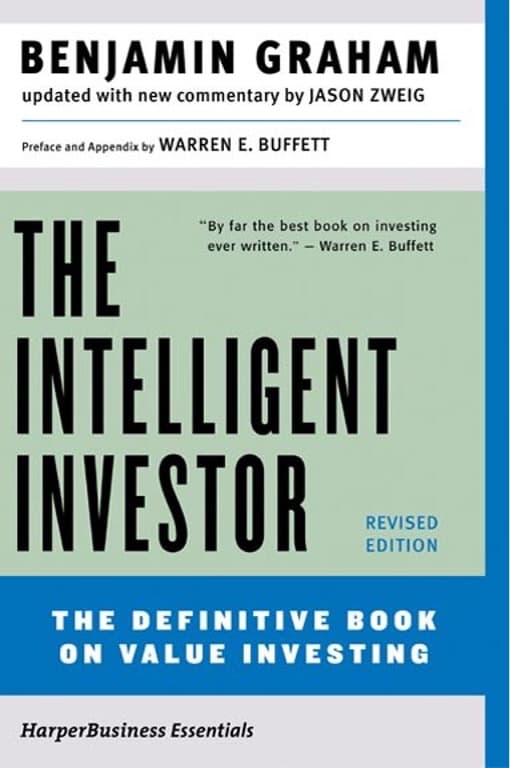
By Benjamin Graham · Analysed by Manuscript AI
14-day guarantee · Results in 2 hours or less
Overview
This is the revised edition of Benjamin Graham's The Intelligent Investor, which preserves his 1972 text intact and adds, after each chapter, a commentary by Jason Zweig that updates the arguments with examples from the 1990s bubble and the 2000–2002 crash. A preface by Warren Buffett and a biographical note on Graham frame the book. Their shared premise is that successful investing depends less on intellect than on a sound framework and emotional discipline.
Graham's central argument separates investing from speculating. An investment, by his definition, rests on thorough analysis, safety of principal, and an adequate return. He divides investors into the defensive, who want safety and freedom from effort, and the enterprising, who will put in work to seek better-than-average results. For defensive investors he recommends a division between high-grade bonds and leading stocks, usually 50–50 and never beyond a 25–75 range either way. He pairs this with diversification, dollar-cost averaging, and attention to price. He examines a century of market history, the limits of inflation as a case for stocks, bond and preferred-stock choices, and the poor record of forecasting and market timing. He argues that growth stocks and new issues are usually overpriced, and he criticizes mutual funds that chase performance. He also advises skepticism toward Wall Street advisers and toward per-share earnings distorted by special charges, dilution, and accounting choices.
For enterprising investors he describes bargain issues, unpopular large companies, secondary companies, and special situations. He applies numerical tests to stock selection and illustrates them with comparisons of four listed companies and eight pairs of companies. Four case histories (Penn Central, Ling-Temco-Vought, NVF, and AAA Enterprises) show how ignoring simple warning signs leads to ruin. His chapter on shareholders and managements treats dividend policy, stock splits, and the duty of owners to hold managers accountable. Two ideas recur throughout. The "Mr. Market" parable presents the market as a moody partner who offers prices but does not set value. "Margin of safety" is the closing concept, meaning that price must sit far enough below value to absorb error and bad luck.
Zweig's commentaries apply these ideas to dot-com stocks, day trading, Enron and WorldCom, index funds, TIPS, junk-bond funds, option-driven executive pay, and repurchase plans, and they cite behavioral research on overconfidence and loss aversion. The appendixes include Buffett's essay on Graham's disciples, a 1958 Graham talk on the new speculation, tax rules, and several short case histories.
The Manuscript
How the book is built — structure, themes, audience and positioning.
The book's central message is that investing success depends on temperament and discipline rather than forecasting or brilliance: pay no more than a stock is worth, insist on a "margin of safety," and refuse to let the market's moods dictate your decisions. Graham distinguishes investing, which "upon thorough analysis promises safety of principal and an adequate return," from speculation, and he stresses that "the investor's chief problem—and even his worst enemy—is likely to be himself." His Mr. Market parable shows how to use the market's daily quotes only "to the extent that it suits his book," buying when prices are foolishly low and ignoring them otherwise.
Zweig's commentary reinforces this with recent cases (dot-com stocks, IPOs, Enron-style accounting), arguing that "the future of security prices is never predictable," so the investor's task is to control his own behavior through diversification, low-cost indexing, and steady buying rather than trying to beat the market.
The book has two voices, and the contrast between them is its defining stylistic feature. Graham writes in a measured, courtly first-person plural ("We shall illustrate..."), dry and aphoristic, with sentences that unfold through qualifications: "It is almost a contradiction in terms to suggest as a feasible policy for the average stockowner that he lighten his holdings when the market advances beyond a certain point." His rhythm is periodic and balanced, relieved by sudden brevity ("That way lies sorrow.") and flashes of sardonic wit: "O wondrous fairyland of Wall Street..." and the "thirty tyrants" of the Dow. Imagery is sparing but memorable, and the Mr. Market parable shows his best concrete invention. Literary allusions (Aristotle, Goethe, Spinoza) lend authority suited to a reader he treats as intelligent.
Zweig's commentary is brisker and breezier: direct address ("Notice that..."), jokes, and vivid, specific detail. Lines such as "Like Mr. Creosote in Monty Python's The Meaning of Life, WorldCom was gorging itself to the bursting point" and the Phil Jackson basketball analogy make abstractions tangible. The register suits a general reader who needs motivation as well as method.
Two weaknesses. First, Zweig's humor often overreaches into strained or glib comedy: "unrefrigerated dead fish," "tell him you are late for an appointment with your proctologist," "dopey ideas." Such lines undercut the gravity of the losses he describes and clash with Graham's restraint. Second, Graham's long, dense passages of tabulated comparison, especially the pair-by-pair analyses in Chapter 18, bury the lesson under figures, and Zweig's commentary sometimes piles up similar statistics (the long lists of dot-com losses) until the examples blur.
A specific improvement: Zweig should cap each commentary section at two or three of the most telling examples, as he does with Inktomi, and let one restrained, well-chosen joke carry the tone instead of several.
The central thesis holds across the book: price must be tied to value, and the investor's real enemy is himself. Zweig's commentaries repeatedly pick up Graham's phrases. The Introduction commentary quotes "the investor's chief problem—and even his worst enemy—is likely to be himself," and Chapter 8 returns to it with Mr. Market. The alternating Graham-chapter/commentary structure also gives a steady rhythm, and Zweig usually opens with a short epigraph and a concrete hook, which eases the shift from 1972 to 2003.
The flow is only partly continuous, though. First, difficulty and style jump abruptly between sections. Chapter 8's parable of Mr. Market ("Imagine that in some private business you own a small share that cost you $1,000") is accessible, but Chapter 11 moves straight into coverage ratios, "Recommended Minimum 'Coverage' for Bonds," and the growth formula "(8.5 plus twice the expected annual growth rate)." Chapter 12 then dwells on ALCOA's footnotes. Zweig's colloquial jokes ("hot milk" and "yogurt," "Acapulco high dive") sit awkwardly beside Graham's dense, dated tables.
Second, the chapters on bonds, convertibles, warrants and the long case histories feel like detours. Graham himself says of warrants, "this is too technical a matter for discussion here." The 1971 yields and Penn Central details interrupt the momentum built by Chapters 8 and 20's behavioural message, and Chapters 14–15 and 18 are largely stock-by-stock data. Readers can lose the thread of why each is there.
A fix: add a brief bridging paragraph at the start of each technical block (Chapters 11–18) stating how it serves the "margin of safety" idea. For example: "The next chapters show how to measure value so you never overpay." That would make the later chapters visibly pay off Chapter 20's central concept.
Graham's personality comes through strongly and consistently: dry, erudite, skeptical, and quietly wry, with an unmistakable passion for sober discipline over excitement. He addresses lay readers as intelligent equals, without sermonizing. His humor is understated. He calls reckless investors "a laughable contradiction in terms—something like 'spendthrift misers,'" and dismisses brokerage-house forecasts as "somewhat less reliable than the simple tossing of a coin." The Mr. Market parable ("Mr. Market lets his enthusiasm or his fears run away with him") shows his gift for turning a hard concept into a vivid, memorable character.
Candor is central to his voice. He admits his own failures: "As it turned out, this was not a particularly brilliant counsel," and he concedes that his formula "no longer worked" after 1949. This self-exposure builds trust and fits an audience he is asking to doubt confident experts. His literary range (Santayana, Aristotle, Goethe, Spinoza) signals a cultivated mind, and the Postscript, where he reflects on one lucky decision outweighing "a lifetime of journeyman efforts," is personal without being sentimental.
His indignation surfaces on warrants: "a near fraud, an existing menace, and a potential disaster." That passion is real, though the tone occasionally turns dense and technical, as in the long accounting discussions of ALCOA and NVF, which demand more patience than a general reader may have.
Zweig's commentary is a deliberate tonal contrast: chattier, punchier, and jokier ("unrefrigerated dead fish," "Mr. Creosote"). It makes Graham more accessible, though it sometimes overpowers his restraint.
The prose is generally accessible, but it works in two registers that differ sharply in clarity.
Graham's sentences are long and periodic, with Latinate diction and period vocabulary. He writes "contradistinction to 'speculator,'" "the cognoscenti," "simon-pure investment policy," "verisimilitude," and "heteroclite." He also leans on dated finance shorthand such as "multiplier," "quotational loss," and "senior issues." A lay reader will stumble on these, though his core arguments stay clear. Graham often reduces them to plain, memorable images: "buy their stocks as they bought their groceries, not as they bought their perfume"; the Mr. Market parable; "heads I win, tails you lose." Dense passages such as the ALCOA footnote analysis and the bond-coverage tables are heavy going but clearly structured.
Zweig's commentary is deliberately plainer: short sentences, direct address, and humor ("like a smoker who thinks he can protect himself against lung cancer by smoking low-tar cigarettes"). He glosses terms in footnotes, for example explaining shorting and margin accounts in a few lines. Some of his glosses add their own jargon, though, as with "Gordon equation," "survivorship bias," and "ROIC." His accounting chapters pile up acronyms ("MORON, CHILLA, WOOPIPRAD"). The jokes occasionally strain, as in the "proctologist" quip.
The text is not simplistic. Even the commentary assumes readers can follow price/earnings ratios, bond yields, and convertible mechanics. The heaviest jargon is confined to the technical chapters (11–13, 16), where lay readers will need patience, and the Zweig footnotes are the main rescue.
Most chapters open with a stated purpose but often lack a formal conclusion. Chapter 1 begins, "This chapter will outline the viewpoints that will be set forth in the remainder of the book," and Chapter 20 closes with a labeled "To Sum Up." Elsewhere endings are inconsistent: Chapter 8 has a "Summary" and "An Added Consideration," while Chapter 7 ends with "Broader Implications of Our Rules for Investment." Headings are clear and frequent, such as "Results to Be Expected by the Defensive Investor" and "The A. & P. Example," and flow well. Zweig's commentaries use playful, signposted headings ("Unsafe at High Speed," "The Money Illusion") and typically close with a pointed lesson.
Yes. Graham and Zweig both give concrete steps. Three of the clearest:
1. Put investing on autopilot with dollar-cost averaging and rebalancing. Zweig tells the reader to set target percentages for stocks and bonds, then change them "only as your life circumstances change." He suggests rebalancing "every six months, no more and no less, on easy-to-remember dates like New Year's and the Fourth of July." For the stock portion he recommends index funds: "Let's say you can spare $500 a month," split as "$300 into one that holds the total U.S. stock market, $100 into one that holds foreign stocks, and $100 into one that holds U.S. bonds." Chapter 8 also supplies an "Investment Owner's Contract" for the reader to fill in and sign.
2. Screen individual stocks with Graham's criteria and do the homework. Graham lists seven tests for the defensive investor, for example "current assets should be at least twice current liabilities" and "Current price should not be more than 15 times average earnings of the past three years." Zweig adds that the reader should "download at least five years' worth of annual reports" from EDGAR and read the proxy statement. His advice on the footnotes is blunt: "start reading on the last page and slowly work your way toward the front."
3. Test your stock picking on paper before risking money. Zweig reports Graham's suggestion to track picks for a year, then "measure your results against how you would have done if you had put all your money in an S & P 500 index fund." If you do pick stocks, he says to "limit it to a maximum of 10% of your overall portfolio."
Mostly yes, with a clear division of labor between the two voices. Graham's prose is lucid at the level of principle but dense at the level of execution. The central ideas land cleanly: "Mr. Market" is a parable ("Imagine that in some private business you own a small share that cost you $1,000"), and the margin-of-safety idea is illustrated with roulette arithmetic. But his chapters on security analysis (11, 12) and the eight-pair comparisons (18) are thick with tables, ratios, and period-specific figures. The reader must hold many numbers at once, and Graham concedes this himself: "It is a good deal to expect from the reader that he study all these figures with care."
Zweig's commentaries are what make the book navigable. They translate 1972 numbers into 2003 equivalents, and they use vivid analogies: Mr. Market as "Dr. Jekyll," the "Money illusion," the 65-mph vs. 130-mph driving example for "temporarily right" investing.
The devices are used well, with one caveat. The sidebars are tightly scoped and practical: the "Investment Owner's Contract," the "Why No 100% Stocks?" test, the "Words of Warning" list for advisers, the Benjamin Graham Financial Network satire. Each adds something the running text lacks. The editorial footnotes (marked with * or †) are helpful for defining terms such as "margin account," "short selling," and "coupon," though they interrupt Graham's pages heavily in places. Some figures, such as the Barber-Odean bar chart and the "Funnel of Fund Performance," make their point at a glance. The caveat is that several tables (Figure 7-1, Figure 14-1, Figure 20-2) are dense, and a reader must rely on the captions to see what the numbers prove.
Deep Dive
Readability metrics, an AI-generated summary and tailored recommendations for every chapter.
1. Investment Is Defined by Analysis, Safety, and Adequate Return
Main idea: Graham separates investing from speculating with a strict definition, and he warns that Wall Street's habit of calling every buyer or seller an "investor" hides the risks people are actually taking.
Supporting evidence: "An investment operation is one which, upon thorough analysis promises safety of principal and an adequate return. Operations not meeting these requirements are speculative."
Significance: Every later recommendation in the book, from portfolio allocation to stock selection, is measured against this definition, and the commentary uses it to show why the 1990s trading fads failed.
2. Future Market Prices Cannot Be Predicted, So Policy Must Rest on Balance and Humility
Main idea: Bond prices, stock prices, and relative performance all surprised even careful analysts, so the defensive investor should hold a sensible mix of bonds and stocks (25% to 75% in either) rather than bet on a forecast.
Supporting evidence: "This is just another of an endless series of experiences over time that have demonstrated that the future of security prices is never predictable."
Significance: This is the reason for the book's emphasis on controlling one's own behavior and diversifying, instead of forecasting the market.
3. Speculation Must Be Confined, and Easy Edges Disappear
Main idea: Speculation is not forbidden, but it must be kept small and separate from investing. Strategies that promise better-than-average results tend to lose their power once they are widely known, so the enterprising investor needs policies that are both sound and unpopular.
Supporting evidence: "To enjoy a reasonable chance for continued better than average results, the investor must follow policies which are (1) inherently sound and promising, and (2) not popular on Wall Street."
Significance: This sets realistic expectations for the aggressive investor and underlies the commentary's warnings about the January effect, "What Works on Wall Street," and "The Foolish Four."
1. Writing style and flow: Untangle the interleaved commentary and footnotes
The issue: Zweig's marginal notes interrupt Graham's sentences mid-argument. The footnote beginning "Read Graham's sentence again" lands in the middle of "the future of security prices is never predictable.* Since you cannot predict...", and the inflation caveat "we consider it remote—of an accelerating inflation" is followed by a TIPS note that revises the claim that "stock equities [are] preferable to bonds."
Why it matters: Readers lose the thread of Graham's reasoning about bonds versus stocks. Asterisks and daggers split the logic, and it is unclear which voice is speaking and whether a point is current or historical.
How to implement: Move each note to the end of its paragraph or section and open it with a short bold label such as "Zweig:" or "2003 update." Reserve in-text markers for pure citations, so each passage reads straight through before the commentary follows.
2. Storytelling and impact: Anchor the abstract definitions in one sustained human case
The issue: The chapter's central ideas are stated abstractly: "An investment operation is one which, upon thorough analysis promises safety of principal and an adequate return." The "average normal conditions" sections then stack percentages ("41⁄2%," "31⁄4%," "7.8% before taxes or 5.5%") with no figure to carry them. The vivid material, such as the Temco/Ticketmaster mix-up and the tow-truck driver's "Technically, it's a country," sits only in the later commentary.
Why it matters: The defensive investor's stakes never feel personal. Readers meet the numbers before they feel the cost of confusing speculation with investment, so the persuasive force arrives too late and the arithmetic stays dry.
How to implement: Open the chapter with one short concrete scene, such as the 1962 odd-lot short sellers or the Temco trader, and return to it when the definition is given. Then show a single hypothetical defensive investor's 50–50 portfolio through the 1964–1972 numbers, so each rate change has a visible consequence.
3. Literary and analytical criteria: Reconcile the competing time frames and the unsupported claims
The issue: The chapter mixes eras and arguments without signalling the seams. Graham writes "seven years ago" and then "Six Years Ago" in the heading. His forecast, "an average annual appreciation of about 4%," is later commented on in a note with a different period and a 2003 forecast. Claims such as "special situations... could be counted on to bring a nice annual return of 20% or better, with a minimum of overall risk" are never evidenced. The commentary then says "you cannot lose in the end" while also saying investors must "deliberately protect yourself against serious losses."
Why it matters: Inconsistent dates and absolute claims weaken the intellectual rigor. A skeptical reader can fairly ask how "cannot lose" squares with Graham's own admission that "there may no longer be such a thing as a simon-pure investment policy."
How to implement: Fix the "seven/six years" discrepancy and add a short timeline of 1964, 1971 and 2003 data in one table comparing bond yields, dividend yields and expected returns. Qualify "you cannot lose in the end" to "are far less likely to lose." Either support the 20% special-situations claim with a source or mark it explicitly as Graham's experience in a bygone market.
1. Stocks are not a reliable inflation hedge
Main idea: Graham argues that inflation has no close, dependable link to stock earnings or prices, so the investor should not assume stocks will automatically offset the loss of purchasing power. The commentary confirms this with data showing stocks fall short of inflation roughly one-fifth of the time.
Supporting evidence: "The only way that inflation can add to common stock values is by raising the rate of earnings on capital investment. On the basis of the past record this has not been the case."
Significance: This undercuts the Wall Street argument that stocks beat bonds "by their very nature," and it supports the book's case against an all-stock portfolio.
2. Expect modest stock returns and avoid concentrating in stocks
Main idea: Graham expects only about 8% a year from DJIA-type stocks bought at 1971 prices, which is no better than high-grade bonds then offered. Stocks also fluctuate, and an inflation-driven bull market can lure the investor into buying at any price.
Supporting evidence: "He will take the big rise not as a danger signal of an inevitable fall, not as a chance to cash in on his handsome profits, but rather as a vindication of the inflation hypothesis and as a reason to keep on buying common stocks no matter how high the market level nor how low the dividend return. That way lies sorrow."
Significance: It links inflation fears to the book's recurring theme that investor psychology and paying too much for stocks are the real dangers, and it grounds the case for a balanced allocation.
3. Hedge inflation through diversification, not a single bet
Main idea: Because the future is uncertain, the investor should hold both stocks and bonds, treating stocks as partial "insurance" against inflation and bonds as protection against the greater risks of an all-stock approach. Gold, collectibles, and real estate are poor or risky substitutes for the ordinary investor, though the commentary adds REITs and TIPS as modern tools.
Supporting evidence: "Just because of the uncertainties of the future the investor cannot afford to put all his funds into one basket—neither in the bond basket, despite the unprecedentedly high returns that bonds have recently offered; nor in the stock basket, despite the prospect of continuing inflation."
Significance: This restates the defensive investor's core policy of a balanced stock-bond mix and the principle of minimizing risk rather than forecasting, which runs through the whole book.
1. Writing style and flow: Untangle the layered voices and the scrambled apparatus
The issue: Graham's 1971 text, Zweig's footnotes, and the 2003 commentary interrupt one another, and the interruptions are hard to follow. The footnote that opens the chapter runs into the body mid-sentence ("This is quite a reversal from the earlier days when trust investments were / * By the late 1990s... 47 / restricted by law to high-grade bonds"). Graham's own numbered notes sit beside editorial asterisks, as in "We think it would be reasonable... of, say, 3% per annum... 1" followed by "* This is one of Graham's rare misjudgments." Dated figures ("892 for the DJIA," "900 market vs. 560 book in mid-1971") also shift between "late 1971" and "early 1972" with no signal.
Why it matters: The reader has to work out whose voice is speaking and which year's data applies. That slows reading and blurs the contrast between Graham's argument and the later correction.
How to implement: Set every editorial note off in a consistent format, placed at paragraph breaks and never mid-sentence. Give each a short tag such as "Zweig, 2003:". Standardize the date references, and add a one-line bridge at the start of the commentary stating that the numbers that follow are from 2003.
2. Storytelling and impact: Replace abstract statistics with a lived case the reader can feel
The issue: The commentary's best moment is the money-illusion passage ("If you receive a 2% raise in a year when inflation runs at 4%, you will almost certainly feel better..."). Elsewhere it retreats into compressed figures: "In 50 of those 64 five-year periods (or 78% of the time), stocks outpaced inflation" and "69% of the world's market-oriented countries have suffered at least one year in which inflation ran at an annualized rate of 25% or more." Graham's section on corporate debt ("expanded nearly fivefold while their profits before taxes a little more than doubled") is equally dry. The chapter ends on a product pitch ("allocating at least 10% of your retirement assets to TIPS") rather than a memorable image.
Why it matters: Readers remember what they can picture. Inflation is "invisible" by the text's own account, and the data does not make it visible, so the most persuasive point of the chapter loses force.
How to implement: Build one running example, such as $100,000 held in 1973 and worth under 45 cents on the dollar by 1982. Follow that investor through bonds, stocks, and gold, and return to the example when the chapter closes. Open the TIPS section with the same investor's outcome so the recommendation arrives as a resolution rather than a list.
3. Literary and analytical criteria: Reconcile Graham's argument with the commentary's contradictions
The issue: The two halves reach opposing conclusions without confronting each other. Graham argues "There is no close time connection between inflationary... conditions and the movement of common-stock earnings and prices," while the commentary calls stocks "Half a Hedge" and says "in 50 of those 64 five-year periods... stocks outpaced inflation." Graham dismisses gold and real assets ("near-complete failure of gold"), and the footnote and commentary partly reverse him, yet the TIPS and REIT advice is asserted ("do a decent job of combating inflation") without evidence. The commentary also says "deflation... is an even greater threat" while also arguing "inflation is not dead," and it never weighs the two.
Why it matters: The reader cannot tell which claims survive scrutiny. Unsupported recommendations ("at least 10%") undercut the rigor that makes Graham credible.
How to implement: Add a short passage that sets Graham's 1915–1970 finding beside the 1926–2002 data and explains the difference (horizon length, period choice, high versus moderate inflation). Support the REIT and TIPS claims with actual return and inflation figures, and state the conditions under which each fails. Show how the inflation and deflation hedges fit together in one portfolio, with a rationale for the percentages given.
1. Past returns are no guide to future returns
Main idea: Graham warns that the extraordinary 1949–1968 gains produced a false belief that such results would continue, and that the very size of a rise may signal it has been overdone. Zweig's commentary extends this to the 1990s bull-market forecasters, who extrapolated historical returns into "Dow 36,000"-style predictions.
Supporting evidence: "It created a natural satisfaction on Wall Street with such fine achievements, and a quite illogical and dangerous conviction that equally marvelous results could be expected for common stocks in the future. Few people seem to have been bothered by the thought that the very extent of the rise might indicate that it had been overdone."
Significance: This is the book's central caution against letting recent performance and crowd enthusiasm drive decisions, and it underpins the "rule of opposites" and the case for a disciplined, skeptical approach to the market.
2. Judge the market level by valuation relationships, not momentum
Main idea: Graham assesses the 1972 market by comparing price/earnings ratios and dividend and earnings yields against bond yields. He finds that the worsening stock-to-bond relationship offsets a better P/E, making the market unattractive for conservative investors. He also admits his past timing calls were imperfect, which is why he stresses consistent policy over market forecasting.
Supporting evidence: "Our final judgment is that the adverse change in the bond-yield/stock-yield ratio fully offsets the better price/earnings ratio for late 1971, based on the 3-year earnings figures."
Significance: It shows the book's method in practice: anchoring judgment in value measures and in comparison with bonds, while accepting that such analysis is "more indicative than conclusive" and cannot predict timing.
3. Price determines value, so humility and caution must govern expectations
Main idea: Graham asks whether the market's heedlessness can "go unpunished," and prepares investors for difficult times. Zweig shows this was borne out in 1973–74 and again in 2000–2002, and argues that no price is justified by enthusiasm. He adds that returns come from real growth, inflation and speculation, and that forecasting should be modest and humble.
Supporting evidence: "To us, the early-1971-market's disregard of the harrowing experiences of less than a year before is a disquieting sign. Can such heedlessness go unpunished?"
Significance: It ties the chapter to the book's core lesson that the investor's protection lies in the price paid, in conservative expectations, and in a policy of caution rather than prediction.
1. Writing style and flow: Untangle the chapter's buried and interrupted argument
The issue: The Graham section keeps stopping to quote his own earlier editions, and it reaches its verdict late and tersely: "Our final judgment is that the adverse change in the bond-yield/stock-yield ratio fully offsets the better price/earnings ratio for late 1971." Table references are scattered through the prose ("Table 3-1," "Table 3-2 (p. 71)," "Table 3-3"), and the closing "What Course to Follow" is only a one-line pointer: "Turn back to what we said in the last edition, reproduced on p. 75."
Why it matters: The reader has to hold the 1948, 1953, 1959 and 1964 verdicts in mind, with their numbers, before learning why 1972 differs. The chapter's practical advice, a single sentence of redirection, is the weakest-written part of it.
How to implement: Open the market-level section with a two-sentence statement of the conclusion, then support it. Condense the earlier-edition recaps into a short list of date, Dow level, verdict and outcome. Restate the 1964 advice ("No borrowing to buy or hold securities. No increase in the proportion of funds held in common stocks...") in the closing section instead of sending the reader back.
2. Storytelling and impact: Make the ten-decade story and its warning vivid
The issue: The data narrative is mostly abstract percentages and index levels, as in "the annual rate of advance to be a mere 11⁄2%" and "the advance had been more than sixfold in 17 years." Its most dramatic claims, such as "the most remarkable turnabout in the public's attitude in all stock-market history" and the line "Can such heedlessness go unpunished?", are stated and then left without human detail. The commentary does the opposite: it supplies vivid quotes from Landis, Froelich and Applegate, but only for the 1990s.
Why it matters: The shift from a P/E of 6.3 in 1949 to 22.9 in 1961 is the emotional core of the chapter, a public moving from despair to euphoria. As written it reads as a table footnote, so the reader may not feel why "the rule of opposites" matters.
How to implement: Build one short scene around the 1949 versus 1961 contrast. Show what investors thought and did at each extreme, tied to the figures "6.3 times" and "22.9 times." Then run a through-line from the 1962 "hot issues" collapse ("lost 90% and more") to the 1968–1970 repeat to the 1999 quotations, so the reader sees one recurring pattern instead of separate episodes.
3. Literary and analytical criteria: Reconcile the rigor gaps in the evidence and the forecasting
The issue: The chapter derives its conclusion from a handful of selected benchmark years, and it concedes data weakness only in passing: "The material is not nearly as full or dependable in the first half-period as in the second, but it will serve." The commentary then tells us to "split the difference between the lowest and highest past returns" to project "roughly 6%," and it calls the result a match with the build-up estimate ("1.5% to 2% + 2.4% + 1.9%"). That check is not independent, because both estimates rest on the same long-run assumptions. The commentary also says bulls erred by extrapolating the past, yet it extrapolates historical earnings growth itself.
Why it matters: A chapter whose thesis is intellectual humility about forecasting weakens its authority when it leans on a thin sample of years, a midpoint chosen without justification, and a claimed confirmation that is circular.
How to implement: Justify the benchmark years (1948, 1953, 1958, 1963, 1968 and 1971) or test the conclusion on other years. Move the data-reliability caveat, including the survivorship bias the commentary raises, up beside the century-long tables. Replace "split the difference" with an explicit range and stated uncertainty. Drop "Interestingly, that projection matches" or acknowledge that the two methods share inputs, then state plainly that the 6% figure is a rough anchor and not a forecast.
1. Risk tolerance depends on the investor, not on a formula
Main idea: Graham argues that the return an investor should seek depends on the intelligent effort he is willing to bring, not on the risk he runs. Jason Zweig's commentary extends this: allocation should reflect your own life circumstances and temperament, not your age.
Supporting evidence: "The rate of return sought should be dependent, rather, on the amount of intelligent effort the investor is willing and able to bring to bear on his task."
Significance: This reframes the book's central distinction between defensive and enterprising investors, and it locates risk inside the investor's own behavior, a theme that runs through the whole work.
2. A simple 50–50 stock-bond split, with disciplined rebalancing, protects the defensive investor from himself
Main idea: Since no reliable rules exist for timing the market, Graham proposes a mechanical 50–50 division, bounded by 25% and 75% in stocks. Rebalancing back to target forces the investor to trim stocks as they rise and add as they fall, against his natural impulses.
Supporting evidence: "it will restrain him from being drawn more and more heavily into common stocks as the market rises to more and more dangerous heights."
Significance: It turns the book's emphasis on discipline over prediction into a concrete, followable policy, one the commentary updates with twice-yearly 401(k) rebalancing.
3. The defensive investor should choose high-grade, simple bonds and avoid structurally weak or costly instruments
Main idea: The bond component should be decided on practical grounds: tax status, maturity, and call protection. Quality should not be sacrificed for yield, and weak forms such as straight preferred stocks should be avoided unless bought at a bargain.
Supporting evidence: "Really good preferred stocks can and do exist, but they are good in spite of their investment form, which is an inherently bad one."
Significance: It shows Graham's recurring view that safety comes from examining the terms of a security and the investor's own situation, not from chasing yield or following Wall Street habit. The commentary extends this to annuities and bond funds.
1. Writing style and flow: Untangle the dated figures and the Graham/Zweig voice shift
The issue: Graham's 1972 passages hand off to Zweig's 2003 commentary with little signposting, and the figures collide. Graham's "Starting from 900 for the DJIA and dividends of $36 on the unit, this would require either a fall in taxable bond yields from 7½% to about 5.5%... or a fall in the DJIA to as low as 660" is a dense, hard-to-parse sentence. The text then moves to "As of 2003, interest rates have fallen so low that investors are starved for yield" with no bridge.
Why it matters: The reader must reconstruct which era, which rates and which voice are speaking, and the arithmetic is nearly unreadable as written. This weakens the practical guidance for a defensive investor who wants simplicity.
How to implement: Break the 900/660 passage into short steps or a small table (current yield, target yield, resulting DJIA level). Open each commentary section with a one-line bridge such as "Graham's 1972 yields are obsolete; here is the 2003 equivalent," and keep tax rates and yields in clearly labeled, dated blocks.
2. Storytelling and impact: Replace the product catalogue with one running investor case
The issue: The bond section reads as a list: "Let us list a few major types of bonds... and discuss them briefly with respect to general description, safety, yield, market price, risk, income-tax status, and other features." The listings of Series E and H terms, Vineland, N.J. yields and the Penn Central certificates carry no human stakes. Only the commentary supplies any, with the 89-year-old with "$3 million" and the 25-year-old saving "for his wedding."
Why it matters: The Graham half is informative but flat. Readers meet rates and provisions before they see a person making a decision, so the emotional and persuasive force of the allocation argument is delayed or lost.
How to implement: Anchor the bond discussion in two or three recurring investors (the wedding saver, the retiree, the high-bracket professional) and show which bond type each would choose and why. Use Graham's American Gas & Electric call example as a vivid cautionary tale near the start of the bond material, and trim minor detail such as the Vineland rates.
3. Literary and analytical criteria: Reconcile the tensions in the allocation argument and flag obsolete material
The issue: The text asserts rules without fully resolving their conflicts. Graham says "the investor should never have less than 25% or more than 75%" in stocks, yet concedes "we can give the investor no reliable rules by which to reduce his common-stock holdings." He then recommends a 50–50 formula while admitting it "may not turn out to be the best in terms of results achieved." Zweig insists "Once you set these target percentages, change them only as your life circumstances change," but also says Graham "never mentions the word 'age'" while listing life-stage factors that amount to age. Meanwhile, passages on Series H bonds, New Community Debentures and the 15% corporate dividend exclusion are retained alongside footnotes admitting they are gone.
Why it matters: Readers cannot tell which prescription is the actual recommendation, so the intellectual rigor looks weaker than Graham's reasoning really is. Detailed discussion of defunct instruments dilutes the durable principles (risk tied to effort, rebalancing discipline, call protection).
How to implement: Add a short synthesis stating the hierarchy: personal circumstances set the 25–75% band, 50–50 is the default, and rebalancing replaces market timing. Explain explicitly how "circumstances" differ from "age." Condense the obsolete product detail into a brief historical note, keeping only what illustrates a lasting principle such as "heads I win, tails you lose" callability or the weakness of the preferred-stock form.
1. Risk Means Loss of Value, Not Price Fluctuation
Main idea: Graham argues that "risk" should apply only to losses realized through sale, to real deterioration in a company's position, or to paying too much relative to intrinsic worth. A temporary market decline in a well-selected group of stocks is not a true risk.
Supporting evidence: "If a group of well- selected common-stock investments shows a satisfactory overall return, as measured through a fair number of years, then this group investment has proved to be 'safe.'"
Significance: This redefinition underpins the book's whole investment philosophy. It lets the defensive investor hold stocks through volatility and makes price relative to value, not price movement, the real danger.
2. Defensive Investors Need Stocks, but Must Obey Strict Selection Rules and Avoid Growth Stocks
Main idea: Stocks protect against inflation and offer higher returns, but only if the buyer does not overpay. Graham therefore sets four rules (diversification, large and conservatively financed companies, continuous dividends, and a cap on price relative to earnings), which exclude popular growth stocks as too uncertain and risky.
Supporting evidence: "The reader will understand from these instances why we regard growth stocks as a whole as too uncertain and risky a vehicle for the defensive investor."
Significance: It shows the central theme that price discipline matters more than enthusiasm. The IBM and Texas Instruments examples, echoed by Microsoft and Cisco in the commentary, show that the hottest stocks fall hardest.
3. Automatic, Disciplined Investing Defends Against Your Own Behavior
Main idea: Dollar-cost averaging and index funds spare the defensive investor from forecasting and stock picking. The commentary warns that "buy what you know" breeds overconfidence and home bias, so a permanent autopilot portfolio is safer.
Supporting evidence: "By putting every investment decision on autopilot, you drop any self-delusion that you know where stocks are headed, and you take away the market's power to upset you no matter how bizarrely it bounces."
Significance: It ties Graham's view that an investor's success depends on "knowledge, experience, and temperament" to practical modern tools. It also shows that the investor's chief enemy is emotion and illusory knowledge, not the market itself.
1. Writing style and flow: Untangle the footnote-heavy, interleaved structure
The issue: Graham's argument is repeatedly interrupted by long commentary footnotes, such as the one beginning "The Dow Jones Industrial Average closed at a then-record high of 381.17 on September 3, 1929," which breaks mid-sentence at "It remains to" and resumes on the next page with "be seen whether the inflation factor..."; the dividend-yield note ("Why do the 'high prices' of stocks affect their dividend yields?") likewise swallows a half-page of the main text.
Why it matters: The reader loses Graham's thread and must hold his unfinished sentence while wading through paragraphs of modern asides, and the main argument about price discipline gets diluted.
How to implement: Keep each note to two or three sentences and move longer material (the Dimson/Marsh/Staunton reinvestment figures, the yield-versus-bond history) into a short boxed sidebar placed between paragraphs, so that no sentence of Graham's is split by commentary.
2. Storytelling and impact: Anchor the commentary's argument in one concrete investor
The issue: The commentary on Chapter 5 moves through abstract advice and stacked statistics: "Lynch's rule... isn't totally implausible," the home-bias bullets ("401(k) investors keep between 25% and 30%..."), and the $500-a-month index-fund split. Graham's own widow, doctor and young man are vivid, but the commentary never builds a comparable figure of its own, so the "I don't know and I don't care" payoff arrives with no one to feel it.
Why it matters: The emotional pull of the commentary's best ideas (burned investors, autopilot calm) is weaker than it could be, and readers must assemble the narrative themselves.
How to implement: Introduce one recurring figure, for example an investor who is burned in 2000–2002 and then sets up the $300/$100/$100 plan, and carry her through the sections: tempted by "buy what you know," then by her employer's stock, then settling into automatic purchases. Close with her saying "I don't know and I don't care" in a moment of market panic.
3. Literary and analytical criteria: Reconcile the commentary's claims with Graham's rules and with each other
The issue: The commentary says "stocks are (as of early 2003) only mildly overpriced" and that "the very act of crashing has taken much of the risk out of the stock market," yet Graham's chapter insists the defensive investor use a price ceiling of "25 times such average earnings," and the commentary never tests current prices against it. It also praises Landis's 58.2% record, then cites his 73.2% loss, and offers the 1929 dollar-cost-averaging example ($12,000 versus $100 a month) without noting that the two investors put in very different total sums.
Why it matters: The comparisons are rhetorically striking but not like-for-like, and the "room-temperature yogurt" claim is asserted rather than demonstrated, which weakens the rigor Graham's framework is meant to model.
How to implement: Add a brief check applying Graham's seven-year earnings rule to the S&P 500 in early 2003 to support or qualify "mildly overpriced." Restate the 1929 example with equal total contributions, or state the totals invested ($12,000 against roughly $12,000 over ten years) so the reader sees the benefit comes from the buying pattern, not from the amounts.
1. Don't buy second-grade bonds merely for yield
Main idea: Graham argues that second-grade bonds and preferreds bought at around par expose the buyer to large principal losses in exchange for a small yield advantage. If you accept risk, you should do so only at a deep discount that offers real appreciation potential.
Supporting evidence: "It is bad business to accept an acknowledged possibility of a loss of principal in exchange for a mere 1 or 2% of additional yearly income. If you are willing to assume some risk you should be certain that you can realize a really substantial gain in principal value if things go well."
Significance: This applies the book's central distinction between investment and speculation: safety of principal and a margin of safety matter more than the headline return. The WorldCom sidebar in the commentary shows the same trap in recent times.
2. Be wary of new issues, especially IPOs, because the market's structure favors the seller
Main idea: New issues are sold with special salesmanship and at times chosen for the seller's advantage, so they need unusually severe scrutiny. The danger grows as quality falls, and IPO waves recur in bull markets, ending in price collapses.
Supporting evidence: "The first is that new issues have special salesmanship behind them, which calls therefore for a special degree of sales resistance. The second is that most new issues are sold under 'favorable market conditions'—which means favorable for the seller and consequently less favorable for the buyer."
Significance: The chapter ties this to the book's recurring theme of market cycles and crowd psychology, and the commentary's VA Linux case shows the pattern holding decades after Graham wrote.
3. Foreign government bonds offer weak protection and an unattractive trade-off
Main idea: Foreign bonds have a poor record, and when trouble comes the holder has no legal or other means of enforcing a claim. Attractive yields therefore do not justify the risk, and the buyer's willingness to buy at par every few years reveals something about investor psychology.
Supporting evidence: "if and when trouble should come, the owner of foreign obligations has no legal or other means of enforcing his claim. Those who bought Republic of Cuba 4½s as high as 117 in 1953 saw them default their interest and then sell as low as 20 cents on the dollar in 1963."
Significance: It reinforces the chapter's guiding principle that the enterprising investor's most useful rules are negative ones, avoiding categories where the odds favor the issuer or seller over the buyer.
1. Writing style and flow: Untangle the layered editions and the Graham/Zweig voices
The issue: The chapter stacks material from 1959, 1965 and 1971 with commentary in between, and the transitions are clumsy: "The following paragraphs are reproduced unchanged from the 1959 edition, with comment added," then "In the 1965 edition we continued our discussion of this subject as follows," then "We followed these paragraphs in the 1965 edition by citing 'A Horrible Example.'" The reader must keep track of which "we" is speaking and which year's yields ("71⁄4%" versus "41⁄2%") apply to the argument.
Why it matters: The argument about second-grade bonds and IPOs keeps being interrupted by archival bookkeeping, so the reader loses the thread and the present-tense force of Graham's advice.
How to implement: Open each embedded section with one sentence stating the principle, then mark the dated material with a consistent device, such as a short italic label ("Graham, 1965 edition"). Move the era-specific yield figures into a single footnote or sidebar. Keep the footnotes tied to the sentence they modify, so a note like "Here Graham has made a slip of the tongue" does not interrupt the opening paragraph.
2. Storytelling and impact: Lead with the vivid cases and make them carry the argument
The issue: The most gripping material comes late or is deferred. The Czechoslovakia bond history ("collapsed to 6 in 1939, recovered (unbelievably) to 117 in 1946, fell promptly to 35 in 1948, and sold as low as 8 in 1970!") is buried in a list of other defaults. The AAA Enterprises case ("$14 in 1968, promptly advanced to 28, but in early 1971 were quoted at a dismal 25¢") is cut short with "we have reserved it for detailed treatment below, in Chapter 17." The abstract ten-railroad-bond statistics get more space than the human stories.
Why it matters: Graham's warnings land hardest when the reader sees a buyer's experience, not a table of averages. As it stands, the chapter hands the strongest dramatic payoffs to later chapters and the commentary, and the main text reads as dry caution.
How to implement: Open the foreign-bond and new-issue sections with a single case told as a short narrative: purchase price, the hopeful rise, the collapse, what the holder felt. Give AAA Enterprises two or three sentences of its story here rather than only a pointer forward. Fold the commentary's VA Linux arc ($30 offering, $299 opening, $1.19 three years later) in as the modern echo of the Aetna Maintenance and AAA stories, so the reader sees the same pattern across eras.
3. Literary and analytical criteria: Reconcile the rules with their own exceptions and evidence
The issue: The chapter issues firm "don'ts" but undercuts them without resolving the tension. Graham says second-grade bonds may "ultimately 'work out all right,'" that "an investor who bought all such issues at their offering prices might conceivably fare as well... or even somewhat better," and then calls the question "largely irrelevant." The commentary then says junk-bond funds returned "10.5%, versus 8.6% for 10-year U.S. Treasury bonds" yet still calls them "only a minor option." The evidence is also uneven: one ten-bond sample from 1946–47 stands in for a whole asset class.
Why it matters: A skeptical reader sees data that favors the asset class and a conclusion that rejects it. The reasoning rests on assertion ("it is mere common sense") rather than a clear test, which weakens the rigor of an otherwise sound principle.
How to implement: State one explicit decision rule, such as buying only at a deep discount to par (the "30% under par" threshold) or only through diversified vehicles, and show how each example passes or fails it. Add a comparison of the net return after defaults, fees and drawdowns against Treasuries, and acknowledge the 1946–47 sample's limits. Then explain why the investor's inability to tolerate drawdowns or to diversify, not the average return, is the deciding factor.
1. Growth stocks are usually overpriced, so the enterprising investor should avoid paying full price for popular growth
Main idea: Companies with excellent records and prospects sell at correspondingly high prices, and growth cannot continue indefinitely, so even a correct judgment about the business can produce poor investment results. Graham backs this with evidence that specialized growth funds, with more brains and research than the individual, did no better than the general market.
Supporting evidence: "The investor may be right in his judgment of their prospects and still not fare particularly well, merely because he has paid in full (and perhaps overpaid) for the expected prosperity."
Significance: This separates the quality of a business from the quality of an investment, a distinction at the core of the book. It also explains why "enterprising" means more effort, not more risk or more aggressive growth buying.
2. Buy the relatively unpopular large company
Main idea: Because the market overvalues glamorous stocks, it tends to undervalue large companies suffering temporary setbacks. These firms have the resources to recover, and the market responds quickly once they do. Graham supports this with the Drexel studies of the cheapest Dow stocks, though he notes a disappointing recent test and warns against erratic "roller coaster" companies like Chrysler.
Supporting evidence: "If we assume that it is the habit of the market to overvalue common stocks which have been showing excellent growth or are glamorous for some other reason, it is logical to expect that it will undervalue—relatively, at least—companies that are out of favor because of unsatisfactory developments of a temporary nature."
Significance: This is the first of the three recommended approaches. It applies the book's theme that market prices swing between enthusiasm and gloom, and that the investor profits by trading against that mood on the basis of value.
3. Bargain issues must be demonstrably worth far more than their price, with net-current-asset stocks the clearest case
Main idea: A true bargain is one whose appraised value is at least 50% above its price. The easiest to identify are stocks selling for less than net working capital alone, and a diversified group of these produced a 75% gain in two years, against 50% for the S&P industrials. Graham also says secondary companies are normally undervalued, so the enterprising investor should buy them only at a clear discount, never at "full prices."
Supporting evidence: "The type of bargain issue that can be most readily identified is a common stock that sells for less than the company's net working capital alone, after deducting all prior obligations."
Significance: This is the concrete, quantitative expression of margin of safety. It shows how the enterprising investor can pursue better-than-average results through analysis of value rather than forecasting or timing.
1. Writing style and flow: Untangle the layered apparatus that interrupts Graham's argument
The issue: Graham's text is repeatedly broken by long footnotes that restart the argument mid-thought, and the commentary then re-enters the same topics at different points. The bond section opens with "He might be interested in special opportunities of the following kinds," then runs into a footnote that begins "Today these 'lower-quality bonds' in the 'special situation' area are known as distressed or defaulted bonds. When a company is in (or" and breaks off mid-sentence, continuing several paragraphs later after "General Market Policy—Formula Timing."
Why it matters: The reader loses the thread of both voices. Graham's point about bargain bonds is cut off from its explanation, and the modern gloss reads as a fragment rather than as help.
How to implement: Keep each note whole and place it directly after the paragraph it glosses, not split across page breaks. Open each note with a short consistent cue such as "Today:" so the reader knows the voice has changed. Trim notes that merely paraphrase Graham, such as the "Note very carefully what Graham is saying here" note, so they add only new facts.
2. Storytelling and impact: Replace scattered anecdotes with one developed case that carries the thesis
The issue: The commentary uses many vivid but brief episodes, among them Alan Greenspan's 1973 forecast, Kate Leary Lee, Nortel's John Roth, Cisco's John Chambers and the Japanese investor in 1989. Each gets a few lines and is then dropped. Graham's own chapter also reaches its central claims through abstraction: "This may be set down as a fundamental law of the stock market." The Chrysler and Anaconda examples are given as table references or compressed statistics.
Why it matters: The emotional payoff is spread thin. The reader enjoys the irony of "it's very rare that anyone has ever been so unqualifiedly wrong" but never lives through one investor's experience of buying a hot growth stock, watching it fall, and deciding whether to hold.
How to implement: Pick one running case, such as the General Electric, Home Depot and Sun Microsystems stories behind Figures 7-1 and 7-2 or the Nortel executive quotes. Develop it across the commentary with specific dates, prices and the buyer's choices at each point. Then tie the Graham passages on "the relatively unpopular large company" and the Johnson & Johnson example back to that same arc, so the abstract rules read as consequences.
3. Literary and analytical criteria: Reconcile the evidence and close the gaps in the argument
The issue: The chapter asserts rules with uneven proof and does not reconcile them. Graham recommends the low-multiplier large company, then reports that "this time the figures proved quite disappointing" and calls it "one bad instance." Nothing then addresses how the Dogs of the Dow footnote squares with the poor results he just described. The commentary says growth stocks fail "when their price/earnings ratios go much above 25 or 30," while Graham sets 20 for the enterprising investor and 25 times seven-year average earnings for the defensive one. The commentary also claims "you're all but certain to make money" on net-nets without evidence beyond Graham's 1957–59 sample of 85 stocks.
Why it matters: A reader weighing the advice cannot tell which thresholds govern, how strong the evidence is, or whether the cheap-stock strategy survived its recent failure. This weakens the rigor that the footnotes praise Graham for.
How to implement: Add a short reconciliation passage with a single table of the thresholds (20, 25, 25–30) and the earnings basis each uses. State the sample period, size and result for each claim: the Drexel study, the 1957 net-nets, and the Dogs of the Dow after 1971. Replace "all but certain" with a calibrated statement that names the conditions of the 1957–59 test, such as holding a diversified group of a couple dozen stocks patiently.
1. Price fluctuations are a servant, not a master (Mr. Market)
Main idea: The investor owns a piece of a business and is never obliged to accept the market's daily quotation as its value. Price swings matter only as opportunities to buy wisely when prices fall and sell wisely when they rise.
Supporting evidence: "The true investor scarcely ever is forced to sell his shares, and at all other times he is free to disregard the current price quotation... the investor who permits himself to be stampeded or unduly worried by unjustified market declines in his holdings is perversely transforming his basic advantage into a basic disadvantage."
Significance: This is the book's central behavioral lesson. It underlies the distinction between investor and speculator and justifies the emphasis on emotional discipline over prediction.
2. Forecasting and mechanical timing systems fail the average investor
Main idea: Market forecasting and easily followed trading formulas lose their effectiveness as they gain popularity. The investor who relies on timing becomes a speculator and gets a speculator's results, whereas pricing, meaning not overpaying, is the sound alternative.
Supporting evidence: "Those formulas that gain adherents and importance do so because they have worked well over a period... But as their acceptance increases, their reliability tends to diminish." Elsewhere: "it is absurd to think that the general public can ever make money out of market forecasts."
Significance: This supports the book's insistence on value-based pricing over prediction. It also explains why Graham favors modest, rule-based adjustments (varying the stock/bond proportion) that give the investor "something to do" without chasing the crowd.
3. Investors must expect fluctuations and anchor on underlying value
Main idea: Stocks will swing widely, and bonds can too. The investor should be ready for this financially and psychologically, and should favor stocks backed by tangible assets and sound earnings, because the more a price rests on a premium over book value, the more it depends on market mood.
Supporting evidence: "The investor may as well resign himself in advance to the probability rather than the mere possibility that most of his holdings will advance, say, 50% or more from their low point and decline the equivalent one-third or more from their high point." Also: "the more successful the company, the greater are likely to be the fluctuations in the price of its shares."
Significance: This links the margin-of-safety idea to the behavioral discipline of Mr. Market. It gives the investor a concrete basis for staying calm and for judging when prices are too high or attractively low.
1. Writing style and flow: Untangle the layered apparatus of text, footnotes, and commentary
The issue: Graham's chapter is interrupted by Zweig's footnotes, some running a full page, such as the 1990s strategist forecasts that split "There is one aspect of the 'timing' philosophy which seems to have escaped everyone's notice. Timing is of great psychological importance to the speculator because he wants to make his profit in" from its conclusion "a hurry." Cross-references like "See p. 3" and "Graham discusses this 'recommended policy' in Chapter 4 (pp. 89–91)" add further breaks.
Why it matters: Readers lose Graham's argument mid-sentence, and the long footnotes compete with it instead of supporting it. The chapter's key claim, that timing matters only when it coincides with pricing, gets buried.
How to implement: Move long footnotes (the Acampora/Galvin/Cohen forecasts, the A&P update, the Durand "paradox" note) to the end of the section or into boxed sidebars placed between paragraphs. Keep footnotes to one or two lines, and never let one fall inside a sentence. Give the commentary's cross-references a consistent form, such as a short bracketed pointer.
2. Storytelling and impact: Bring the Mr. Market parable and the investor's psychology forward
The issue: Graham's strongest device, "Imagine that in some private business you own a small share that cost you $1,000. One of your partners, named Mr. Market, is very obliging indeed," arrives near the end of the chapter, after long stretches of abstract discussion of formula plans, the Dow theory, and bond tables. Meanwhile the vivid Inktomi story, which dramatizes the same idea, sits in the commentary, apart from the original text.
Why it matters: The chapter's emotional core arrives late. Readers spend pages on dry historical cycle statistics and "central value method" before the idea that will change their behavior, so the persuasion builds slowly where it could be immediate.
How to implement: Open the chapter with a short Mr. Market scene, ideally paired with the Inktomi figures ("$231.625" to "25 cents"), and then run Graham's argument through that lens. Treat the Dow theory, formula plans, and A&P examples as cases of Mr. Market's moods. Connect the commentary's "Dr. Jekyll and Mr. Hyde" framing directly to the parable.
3. Literary and analytical criteria: Reconcile the chapter's competing prescriptions and update the evidence
The issue: The text endorses opposite stances without resolving them. Graham says "the intelligent investor should be interested in the possibilities of profiting from these pendulum swings" and favors "some kind of mechanical method for varying the proportion of bonds to stocks." Yet he also says the investor "should never buy a stock because it has gone up or sell one because it has gone down," and the commentary then urges "Buy every month, automatically" into an index fund. Likewise, the bond section is dated: "the 7.5% now available on good long-term corporate bonds."
Why it matters: Readers cannot tell whether to adjust allocations to market levels, forget prices altogether, or automate everything. Because the argument that formula plans failed once they became popular is never tested against the rebalancing advice, the rigor suffers.
How to implement: Add a short synthesizing passage that sets out a hierarchy: ignore prices for timing, use them only for pricing and for disciplined rebalancing, and automate buying where the horizon is long. Explain why rebalancing differs from the formula plans that "ran away" from their users. Replace or bracket the dated yield figures with current ones, and support the claim that "price fluctuations have only one significant meaning" with at least one quantified example.
1. Past performance and "performance" funds are unreliable guides
Main idea: Spectacular fund results usually reflect luck or undue speculative risk, and they fade as funds grow, so chasing recent winners is a poor strategy.
Supporting evidence: "All financial experience up to now indicates that large funds, soundly managed, can produce at best only slightly better than average results over the years. If they are unsoundly managed they can produce spectacular, but largely illusory, profits for a while, followed inevitably by calamitous losses."
Significance: It supports the book's warning against speculation and the "Extraordinary Popular Delusions," and its argument that the intelligent investor must resist hot trends, even those from young "brilliant" managers.
2. Costs decide fund results, which is why low-cost index funds win
Main idea: Funds as a whole can only match the market before costs, so high expenses and heavy trading push most below it over time. The intelligent investor should therefore filter funds by cost first, and index funds are the natural default.
Supporting evidence: "With operating expenses averaging 1.5%, and trading costs at around 2%, the typical fund has to beat the market by 3.5 percentage points per year before costs just to match it after costs!"
Significance: It grounds the defensive investor's approach in something controllable, namely costs, rather than unpredictable manager skill. It also ties Graham's original point (funds cannot beat the market they largely constitute) to the modern case for indexing.
3. Closed-end discounts offer a rational, arithmetic-based edge
Main idea: Closed-end funds bought at a discount from asset value give more for the money than load-fund shares bought at a premium, and the discount would have to widen to an almost unheard-of degree to erase that advantage. The commentary says this edge now applies mainly to bond funds, since diversified closed-end stock funds are scarce.
Supporting evidence: "If you want to put money in investment funds, buy a group of closed-end shares at a discount of, say, 10% to 15% from asset value, instead of paying a premium of about 9% above asset value for shares of an open-end company."
Significance: It shows the book's recurring principle that investing should rest on price relative to value and on "a little arithmetic and plain common sense", not on salesmanship or hope.
1. Writing style and flow: Untangle the Graham/Zweig layering and the footnote clutter
The issue: Graham's text is interrupted mid-argument by long Zweig footnotes, such as the one beginning "Nearly every mutual fund today is taxed as a 'regulated investment company,' or RIC," which splits the sentence about "There is another option here, which we omit to avoid clutter" across pages. Meanwhile the commentary opens with a Texas joke and then drops straight into "ALMOST PERFECT," with no sentence linking the joke to mutual funds.
Why it matters: Readers lose the thread of Graham's argument, and the footnote explaining an option Graham deliberately left out defeats his stated aim of avoiding clutter. The sheep joke also reads as a decoration rather than a setup, so the commentary starts less cleanly than it could.
How to implement: Move technical updates (RIC taxation, the GEICO distribution, letter-stock funds) into a short consolidated "What has changed since 1972" note or into endnotes, keeping only one-line footnotes on the page. Add one bridging sentence after the joke, for example: "Fund investors, like Billy Bob, often know their sheep (the stories) better than the arithmetic (the costs)."
2. Storytelling and impact: Give the closed-end versus open-end argument a human anchor
The issue: The most persuasive claim in Graham's section is delivered as dry arithmetic: "Assume that Investor A buys some open-end shares at 109% of asset value, and Investor B buys closed-end shares at 85% thereof, plus 11⁄2% commission." The commentary then notes that the closed-end market is "dusty, dwindling," which undercuts the payoff of that lesson without offering a modern case.
Why it matters: The reader has to work through percentages with no face attached, so the "one of the few clearly evident rules" lands as an abstraction. The commentary's vivid material (Bigfoot in pink ballet slippers, "unrefrigerated fish," the herd of sheep) is not carried into this section, so the tone shifts abruptly from lively to technical.
How to implement: Recast the A/B comparison as a short narrative with two named investors and dollar amounts, for instance $10,000 each, showing what each holds after four years. Follow it with one current example of a closed-end bond fund trading at a discount, so the reader sees the rule still operating today.
3. Literary and analytical criteria: Reconcile the commentary's claims and support the numbers
The issue: The commentary says "luck is more important than skill," then advises choosing funds whose managers "are the biggest shareholders" and "dare to be different," without showing evidence that these traits predict returns. It also compares an index fund returning "just under 6.7%" with the average fund "lucky to gain 3.5%," which assumes 7% market returns minus 1.5% in operating expenses and about 2% in trading costs. Elsewhere it says the typical fund must beat the market by "3.5 percentage points per year before costs." Both figures rest on unsourced averages, and the commentary does not note that Graham's own Table 9-1 found the large funds roughly matching the S&P 500.
Why it matters: The argument that most funds are doomed by costs is the chapter's backbone, yet it is stated with more certainty than the evidence shown supports. The "winning traits" list also sits uneasily with the claim that performance is largely luck. Readers who check the figures may doubt the rest.
How to implement: Add a brief paragraph explaining how the 2% trading-cost figure and the 3.5% hurdle were derived, citing the study behind them. State plainly that the five traits improve the odds but do not guarantee outperformance. Then acknowledge that Graham's 1961–1970 data showed no large gap between big funds and the index, and explain why costs and the later period make the gap wider now.
1. Advice Can Only Deliver Average Results, So Match Advice to Your Competence
Main idea: Investors who rely mainly on others must confine themselves to conservative, standard investments or know their adviser intimately; only as the investor gains his own knowledge may he pursue less conventional ideas. Asking an adviser to produce above-average profits is a naïve expectation with no counterpart in ordinary business.
Supporting evidence: "If the investor is to rely chiefly on the advice of others in handling his funds, then either he must limit himself and his advisers strictly to standard, conservative, and even unimaginative forms of investment, or he must have an unusually intimate and favorable knowledge of the person who is going to direct his funds into other channels."
Significance: This sets up the book's defensive versus enterprising investor distinction and tells readers what to expect from any adviser, shielding them from promises of spectacular returns.
2. Advisers' Incentives Are Tied to Speculation, So the Investor Must Set the Terms
Main idea: Brokers and analysts are pulled toward speculation and short-term market thinking because commissions and customer demand reward it. The investor gets real value only by stating clearly that he is value-minded, not quotation-minded, and by bringing independent judgment to what salesmen and underwriters tell him.
Supporting evidence: "Once the analyst is convinced that he is dealing with a man who is value-minded rather than quotation-minded, there is an excellent chance that his recommendations will prove of real overall benefit."
Significance: It reinforces the book's central theme of investment versus speculation and puts responsibility for good outcomes on the investor's attitude and discipline rather than on Wall Street's good intentions.
3. Trust Must Be Verified, and Advisers Are Best Used to Manage Yourself
Main idea: Zell's commentary extends Graham's caution into practice: investors should vet advisers through regulators, Form ADV, credentials, and fee questions, and watch for sales-pitch warning phrases. The best adviser works as a check on the investor's own impulsive behavior.
Supporting evidence: "Remember that financial con artists thrive by talking you into trusting them and by talking you out of investigating them."
Significance: It ties the book's emphasis on investor psychology and self-control to the practical choice of an adviser, showing that the investor's worst enemy is often himself, and that due diligence is part of intelligent investing.
1. Writing style and flow: Untangle the "Financial Services" passage and its stacked qualifications
The issue: The section on financial services piles hedges and asides into long sentences, as in "Basically they address themselves to the matters in which the average active investor-speculator is interested, and their views on these either command some measure of authority or at least appear more reliable than those of the unaided client," followed by "In our view—perhaps a prejudiced one—this segment of their work has no real significance except for the light it throws on human nature."
Why it matters: The reader has to work to find the actual verdict. Graham's real point, that forecasts are worthless while economic data and statistics are useful, gets buried in parentheses and softening phrases such as "some measure" and "at least appear."
How to implement: Split each long sentence in two and lead with the verdict. For example: "Financial services add little value when they forecast the market. They add real value when they supply economic data and analysis." Then support each claim with one short sentence, and move the "Delphic phrasing" aside to the end of the paragraph as an illustration.
2. Storytelling and impact: Give the brokerage-failure section a concrete human anchor
The issue: The warnings are abstract and statistical: "the turnover of the NYSE in 1970 totaled 2,937 million shares," and "the investor's protection lies less in his own critical faculty than in the scruples and ethics of the offering houses." The one vivid moment, "In effect the partners were speculating with the capital that was supposed to protect the customers," is then dismissed with "This was inexcusable; we refrain from saying more."
Why it matters: The chapter's most persuasive point, that the people holding your money may be gambling with it, never lands emotionally. The reader comes away with figures and no picture of what a customer actually risked or lost, so the argument carries little urgency.
How to implement: Replace the closing "we refrain from saying more" with a short illustrative scenario. Show a customer who followed the broker's advice and then found the firm's capital had vanished with the partners' speculative holdings. Or briefly develop one named failure, such as the firms in the editor's footnote. End with the practical stakes before the bank-delivery advice, so the recommendation feels earned.
3. Literary and analytical criteria: Reconcile the claim about "standard results" with the advice that follows
The issue: The chapter opens by asserting "If we assume that there are normal or standard income results to be obtained from investing money in securities," and builds its thesis on that assumption. It then praises counselors who produce "a conservatively acceptable rate of income" and says the results are "commensurate with those of the average well-informed and cautious investor." It never defines what "normal" or "average" returns are, and it never tests whether the advisers' fees (described as "substantial annual fees") leave clients with the returns they could get unaided.
Why it matters: The central argument rests on an undefined benchmark. The reader cannot tell what counts as success, so cannot judge whether paying an adviser is worth it. The assertion that advisers protect clients "against mistakes" is also unsupported by any evidence, which weakens the rigor of the argument.
How to implement: Add a paragraph early in the chapter that defines "standard results" in measurable terms, such as a blended bond and large-company stock return over a stated period. Then add a short cost-benefit test: the adviser's fee must be weighed against the mistakes avoided and the return above that benchmark. Use this test consistently in the sections on counsel, financial services, and brokers, so each source of advice is judged against the same yardstick.
1. Safety in bonds rests on past earnings coverage, and the record bears this out
Main idea: Graham holds that bond and preferred-stock safety is best judged by how many times past earnings covered fixed charges, and that issues passing stringent tests have usually survived the future, while failures were visible in advance.
Supporting evidence: "In nearly every case the roads that got into trouble had long been overbonded, had shown an inadequate coverage of fixed charges in periods of average prosperity, and would thus have been ruled out by investors who applied strict tests of safety."
Significance: It shows the book's central method: rely on measurable, conservative tests grounded in experience rather than on prediction, which is the basis of the margin-of-safety idea. The same logic underlies Graham's defensive-investor rules elsewhere.
2. Forecasts of future earnings and growth are unreliable, so valuation demands humility
Main idea: Analysts must project earnings, growth and multipliers, but individual forecasts are frequently wrong and market consensus about "long-term prospects" is as likely to mislead as to inform. Valuations should therefore build in a margin of safety.
Supporting evidence: "Let the reader not be misled into thinking that such projections have any high degree of reliability or, conversely, that future prices can be counted on to behave accordingly as the prophecies are realized, surpassed, or disappointed."
Significance: This is the book's recurring warning against trusting Wall Street's predictions, and it justifies diversification and the investor's focus on what can be controlled. The chemical-versus-oil example and the Xerox and General Motors growth rates illustrate it concretely.
3. Value should be judged first from past performance, then adjusted for expected change
Main idea: Graham proposes a two-part appraisal: a mechanical "past-performance value" built from profitability, stability, growth and financial condition, followed by a senior analyst's explicit, reasoned adjustment for anticipated changes. Analysts should favor industries whose futures are reasonably predictable or where the margin of safety is large.
Supporting evidence: "We suggest that analysts work out first what we call the 'past-performance value,' which is based solely on the past record."
Significance: It turns Graham's skepticism about forecasting into a practical discipline: anchor valuation in facts, and make speculation about the future visible and separate. This keeps the book's distinction between investment and speculation operational for the analyst.
1. Writing style and flow: Untangle the interleaved Graham text and Zweig commentary
The issue: Zweig's footnotes interrupt Graham's sentences mid-argument, and fragments of Graham's text are left stranded. The bond section breaks off at "We approve a 'poorest-year' test" and resumes only after the insert about mutual funds, at "as an alternative to the seven-year-average test." The chemical-stock point is cut by the dot-com asterisk, which ends "History proves that Wall Street's 'expert' forecasters are equally inept at predicting the" and picks up several pages later.
Why it matters: The reader loses the thread of two arguments at once. A passage about coverage tests becomes a passage about mutual funds, and then the original sentence has to be reassembled from memory. Graham's cadence and Zweig's contemporary voice both suffer.
How to implement: Move every commentary insert to the end of the paragraph or section it annotates, and mark it clearly with a consistent device such as a boxed note or a "Zweig:" label. Repair the broken sentences so Graham's text runs unbroken. Make sure each note opens with its own context, as in "Graham's point about chemical and oil companies applies to nearly every industry," rather than relying on the reader to remember the main text.
2. Storytelling and impact: Give the commentary's checklist a narrative spine and a payoff
The issue: The Chapter 11 commentary opens with a strong question, "How can you be reasonably sure that you are not overpaying for an apparently rosy future that turns out to be a murky nightmare?" It then proceeds as a run of bullet-like warnings: "serial acquirer," "OPM addict," "Johnny-One-Note." Vivid examples such as Sycamore ("100% of Sycamore's $11 million in total revenues," valued at "$15 billion") sit beside bare name lists like "Lucent, Mattel, Quaker Oats, and Tyco International." The section ends on a generic aphorism, "ultimate victory usually goes to the doers, not to the talkers."
Why it matters: Only the Sycamore case, with its concrete numbers and its reversal, gives the reader a real story. The other warnings are asserted rather than dramatized, so they stay memorable only as labels. The closing line is a platitude that doesn't reward the reader's effort.
How to implement: Choose one company, such as Amazon or AOL, and carry it through all five factors as a running case. Show what the reader would actually find in the 10-K at each step, and what it would mean for the price. For the other examples, add one sentence of consequence, such as the size of a write-off or the percentage the stock fell. Replace the final aphorism with a brief reminder of what the reader can now do that they could not do before.
3. Literary and analytical criteria: Reconcile Graham's skepticism with the commentary's prescriptions
The issue: Graham says of management that "Until objective, quantitative, and reasonably reliable tests of managerial competence are devised and applied, this factor will continue to be looked at through a fog," and that his own growth projections lack "any high degree of reliability." The commentary then offers firm numeric thresholds, such as "long-term debt should be under 50% of total capital," "at least 6% or 7%" owner-earnings growth, and "15% growth hurdle ... is delusional." Its single supporting study is cited without any figures, and the thresholds are never tied to evidence.
Why it matters: The commentary appears to contradict the author it annotates without acknowledging the tension. Unsourced cutoffs also read as rules of thumb presented as fact, which weakens the intellectual rigor the chapter is built to teach. Graham's valuation formula, "8.5 plus twice the expected annual growth rate," is never connected to the commentary's checklist, so the reader cannot see how qualitative findings feed into a price.
How to implement: Add a short passage that states the tension openly: Graham distrusts forecasts, so the checklist is meant to screen out bad companies, not to produce a value. Support each numeric threshold with a source, a historical range, or a plain label such as "a rule of thumb." Then show, with one worked example, how findings about growth, debt, and management would adjust a multiplier from Graham's formula.
1. Reported per-share earnings are unreliable, so no single year deserves serious weight
Main idea: The ALCOA case shows one company producing several different "earnings per share" figures for the same period, depending on dilution and special charges, so the headline number can mislead an investor into seeing a bargain (10 times earnings) where there may be none (22 times).
Supporting evidence: "instead of one figure of earnings per share for the year 1970 there were actually four" and "the price 62 would be '22 times earnings,' instead of the 10 times we started with."
Significance: This is the chapter's opening warning and the base for its practical advice. It supports the book's insistence that investors judge businesses on long-term results and value, not on the quarterly numbers Wall Street watches.
2. Special charges and accounting choices let managements shift and disguise losses
Main idea: Charging anticipated losses to a bad year, as ALCOA and others did in 1970, means those losses never fall in an identifiable year. This clears the way for flattering future earnings. Graham extends the point to depreciation methods, tax-loss credits, R&D treatment, and inventory valuation. The Commentary shows the same abuse recurring in pro forma earnings, aggressive revenue recognition, capitalized costs, "nonrecurring" write-downs, and pension assumptions.
Supporting evidence: "by anticipating future losses the company escapes the necessity of allocating the losses themselves to an identifiable year. They don't belong in 1970, because they were not actually taken in that year. And they won't be shown in the year when they are actually taken, because they have already been provided for."
Significance: It trains the intelligent investor to read footnotes skeptically and to treat management's adjusted figures as suspect. This is the defensive, margin-of-safety mindset of the whole book, and the Commentary shows it is as relevant today as in 1971.
3. Averaging earnings over seven to ten years, and judging growth against price, gives a truer picture
Main idea: Averaging earnings over a long period absorbs special charges and credits and smooths out the business cycle. Compared with growth rates and price multiples, it shows how the market can misjudge a company, as with ALCOA, whose earnings grew well while its price halved from 1959 to 1970.
Supporting evidence: "One important advantage of such an averaging process is that it will solve the problem of what to do about nearly all the special charges and credits. They should be included in the average earnings."
Significance: This gives investors a constructive alternative to trusting single-year figures. It ties into the book's themes of valuing a company by its record and prospects, and of recognizing that price and value diverge and that valuation is "really dependable only in exceptional cases."
1. Writing style and flow: Restore the missing figures and tame the interleaved apparatus
The issue: The ALCOA walkthrough keeps pointing at numbers that are absent from the text: "The first figures shown are", "there were actually four, viz.:", "For the fourth quarter alone only two figures are given:". Meanwhile the Graham text is interrupted by long editorial footnotes (the Daniel Drew cattle story, the "Italian hands" note, the sundial note), and the "dilution" footnote splits the sentence "(The financial services are not always consistent...)" from the argument it supports.
Why it matters: The reader is asked to follow "$5.20 to $5.01" and "82 cents" without ever seeing the table that produced them, so the logic reads as assertion. The anecdotal footnotes pull attention away at the very moment the argument is most technical.
How to implement: Reinsert the ALCOA earnings table (or a short inline list: $5.20 before dilution, $5.01 after, $4.19 after special charges, and so on) directly where the text refers to it. Move the colorful historical footnotes to the end of the section or the commentary, and keep only footnotes that clarify a number or a term at the point of use.
2. Storytelling and impact: Build one through-line from the ALCOA tale to the modern scandals
The issue: The chapter opens with a vivid hook ("two pieces of advice... contradictory"), but the commentary then becomes a string of disconnected vignettes ("AS IF!", "HUNGRY FOR RECOGNITION", "CAPITAL OFFENSES", "AN INVENTORY STORY", "THE PENSION DIMENSION"). Each ends on a quip such as "Poof!" or "Abracadabra!", and none returns to Graham's ALCOA lesson that special charges let management "charge as much as possible to the bad year."
Why it matters: The examples feel like a catalog of villains rather than a cumulative argument. Readers get entertained but not shown that Graham's 1970 charge-offs and Qwest's 1999 revenue acceleration are the same behavior, so the emotional payoff, recognizing a pattern, is lost.
How to implement: Open the commentary with a short bridge that names the pattern, such as shifting earnings between years or between income and balance sheet. Then tag each vignette with that pattern in a closing sentence. Cut the repeated sound-effect punchlines to one or two, and end the commentary by returning to the ALCOA question, "Which earnings are true earnings?", with the reader now equipped to answer it.
3. Literary and analytical criteria: Make the valuation conclusions rigorous and consistent
The issue: The ALCOA section ends inconclusively and with internal tension. Graham says "we do not know what that portion is, and hence we cannot properly state the true earnings," then computes a "past-performance value" of "$84 per share" and says the shares looked attractive "at their price of 571⁄4," while earlier the stock was "selling at 62." He also concludes "Frankly, we have no idea" about the markdown. Elsewhere the commentary offers a hard rule, "anything above 6.5% is implausible," with no stated basis.
Why it matters: Unreconciled prices (62 versus 571⁄4) and an open-ended appraisal undercut the chapter's own demand for care with numbers. A categorical threshold with no derivation reads as authority rather than analysis.
How to implement: Add a note that reconciles the two ALCOA prices (different dates, year-end versus quoted at writing) and state explicitly what a reader should do when true earnings cannot be determined, for example average over seven to ten years and treat the charges as spread over five. For the 6.5% pension threshold and the "5% of net income" test, add one sentence explaining the reasoning, such as bond yields and long-run equity returns, and flag these as rules of thumb rather than limits.
1. Price and performance diverge, so valuation matters more than quality
Main idea: Graham shows that the four companies' operating records and financial condition were fairly similar, while their price/earnings multiples differed enormously. A good business can still be a poor purchase at the wrong price.
Supporting evidence: "The most striking fact about the four companies is that the current price/earnings ratios vary much more widely than their operating performance or financial condition."
Significance: This is the book's central distinction between a company and its stock. It sets up the value-versus-glamour theme that the rest of the chapter and the commentary develop.
2. High valuations entail high risk, because growth is hard to sustain and is already priced in
Main idea: Emerson and Emery had better "market action" and faster growth, but Graham warns that their prices already assumed continued exceptional performance. Past growth from a small base rarely continues at the same rate once the numbers are large. The commentary confirms this with EMC and Exodus, and with the later collapse of Emery.
Supporting evidence: "It often proves much more difficult to continue to grow at a high rate after volume and profits have already expanded to big totals."
Significance: It reinforces the book's warning against overenthusiasm for good performance, which Graham calls "the typical Wall Street error." Later events validate his caution.
3. The conservative investor should choose value stocks by explicit criteria, as a matter of temperament and diversification
Main idea: Eltra and Emhart are favored because their prices are backed by assets and earnings and they meet the seven statistical requirements. Graham makes no predictions for them, relying on a diversified list built on sound principles. He also admits the choice between value and glamour depends on the individual investor's attitude.
Supporting evidence: "The sound basis for preferring eltra and Emhart to Emerson and Emery would be the client's considered conclusion that he preferred value-type investments to glamour-type investments."
Significance: It turns the analysis into a practical method of screening, diversifying, and knowing your own temperament. This links the case study to the defensive-investor criteria in the next chapter and to the book's emphasis on investor behavior.
1. Writing style and flow: Untangle the interleaved Graham text and commentary apparatus
The issue: Graham's chapter is repeatedly interrupted by editorial footnotes, and the footnote markers do not sit cleanly in the flow. The sentence "A high rate of return on invested capital often goes along with a high annual growth rate in earnings per share.*" is followed mid-paragraph by the orphaned "This measure is captured in the line 'Net per share/book value' in Table 13-2," and "Emerson Electric had $163 million of market value of low-dividend" breaks off before its continuation "convertible preferred shares outstanding at the end of 1970."
Why it matters: The reader loses the thread of the sentence and cannot tell which words are Graham's and which are the commentator's. The 1970s chapter also reads as a run of labeled paragraphs ("Profitability," "Stability," "Growth") with very little connective tissue.
How to implement: Place each editorial note at the end of its paragraph or section, and set it off visually, for example in a shaded box, so no sentence is split. Add a one-sentence transition between the Graham section and "COMMENTARY ON CHAPTER 13" that says the commentary repeats Graham's exercise with 1999 data.
2. Storytelling and impact: Make the 1999 comparison pay off with one unifying narrative and stronger closure
The issue: The commentary's best material sits in separate vignettes ("COULD EMC GROW PDQ?", "A SIMPLE TWIST OF FREIGHT", "THE PROMISED LAND?") that each end flatly. The closing section, "WHERE THE Es ENDED UP," is a list of percentage returns ending with "the last trade in Exodus's stock was at one penny a share." It does not return to the opening Kutyna epigraph, "check six," or to Graham's lesson.
Why it matters: The epigraph promises a theme (the danger you can't see behind you) that the four stories never explicitly cash in. The reader is left with statistics rather than a moral about how each stock's hidden weakness (EMC's "almost nil" organic growth, Exodus's debt) was findable.
How to implement: Add a closing paragraph that returns to "check six" and names the specific blind spot in each stock: EMC's growth boosted by the Data General acquisition, Exodus's $971 million borrowed in one month, Emerson's boredom mistaken for weakness. End on that lesson instead of on the penny stock. Also tie the "givemeadollar" and "Launch_Pad1999" quotes to the investors' actual outcomes.
3. Literary and analytical criteria: Present the 1999 comparison with the same metrics Graham used, and justify its framing
The issue: Graham scores his four companies on stated criteria (profitability, stability, growth, financial position, dividends, price history), but the commentary mixes inconsistent measures: "net profit margin and return on capital" for Emerson and EMC, "book value per share had increased 129%" for Expeditors, and only revenue, loss, and debt for Exodus. The statement that "The most expensive of Graham's four stocks, Emerson Electric, ended up as the cheapest" also compares a 1970 valuation with a 1999 one without noting the interval.
Why it matters: Without uniform metrics the reader cannot do what Graham invited, which is to check whether performance agrees with price. The conclusion that valuation extremes predicted outcomes also rests on four hand-picked stocks, with no acknowledgment that Expeditors, at 39 times earnings, rose 51% despite being "no longer anywhere near cheap."
How to implement: Give each company the same short scorecard in the text, covering P/E, five-year earnings growth, return on capital, debt, and dividends, and tie it to Graham's seven criteria, showing which stocks passed. Add a sentence on the Expeditors anomaly and a caveat that four stocks illustrate a principle but do not prove it.
1. Quantitative screens protect the defensive investor from overpaying
Main idea: Graham gives the defensive investor seven arbitrary but concrete tests of size, financial strength, earnings stability, dividend record, growth, P/E and price-to-book, and he argues that the last two keep price tied to value rather than to hoped-for growth.
Supporting evidence: "Our last two criteria are exclusive in the opposite direction, by demanding more earnings and more assets per dollar of price than the popular issues will supply... it rests largely on the absence of an adequate factor of safety when too large a portion of the price must depend on ever-increasing earnings in the future."
Significance: This is the book's margin-of-safety principle turned into a working procedure, and the Dow Jones test at the end of 1970 shows that it screens out most stocks, leaving about five of thirty.
2. Protection beats prediction as an approach to the future
Main idea: Analysts can face the future by predicting what a company will earn or by protecting themselves with a margin of value over price. Graham sides with protection, because predictions are unreliable and rarely pay attention to the price.
Supporting evidence: "By contrast, those who emphasize protection are always especially concerned with the price of the issue at the time of study. Their main effort is to assure themselves of a substantial margin of indicated present value above the market price—which margin could absorb unfavorable developments in the future."
Significance: This distinction underlies Graham's whole philosophy: investors must act in the present on an uncertain future, so safety of price matters more than forecasting skill.
3. Selecting the "best" stocks is a losing game, so diversify
Main idea: Because prices already reflect known facts and general expectations, expert opinion on which stock is best comes down to personal preference, and the defensive investor should stress diversification over individual selection.
Supporting evidence: "If all analysts were agreed that one particular stock was better than all the rest, that issue would quickly advance to a price which would offset all of its previous advantages."
Significance: This supports the book's case for passive, defensive investing, and the commentary extends it into the modern advice to hold a total-market index fund as the core of a portfolio.
1. Writing style and flow: Untangle the interleaved commentary and footnotes from Graham's argument
The issue: Graham's argument is repeatedly broken by long editorial footnotes and fragments of tables, so the thread is lost mid-thought. One example is the sentence "On the basis of the past record he might expect approximately the same future results by buying shares of several representative investment funds.†", followed by a footnote and then "His second choice would be to apply a set of standards to each". The same happens with the 2003 yield arithmetic that interrupts "This would mean a P/E ratio no higher than 13.3 against an AA bond yield of 7.5%.*".
Why it matters: The reader cannot follow the logic from criteria to application to results, because the commentary is wedged between half-finished sentences and table stubs such as "American Tel. & Tel. 10.8 11.0 6.0 55.2 1.1 —c 94".
How to implement: Place each footnote at a sentence or paragraph boundary, and keep the long ones brief. Move the 2003 P/E calculation to a short "Updating the numbers" box after the paragraph it annotates. Replace the orphaned table fragments with a one-sentence summary and a clear pointer to the full table.
2. Storytelling and impact: Give the abstract prediction-versus-protection argument a vivid human case
The issue: The section's central idea is stated in abstract terms: "the way of prediction (or projection) and the way of protection". The only illustrations are brief, such as "the air-transport stocks" and the passing mention of Penn Central, which says "On p. 423 below we present a brief analysis". The analysts' disagreement is asserted ("Suppose... we had asked a hundred security analysts") rather than shown.
Why it matters: This is the book's emotional and persuasive core, yet it reads as doctrine. The reader is told that prediction fails but is never made to feel the cost of trusting it, so the case for the margin of safety loses force.
How to implement: Open the prediction-versus-protection passage with one concrete contrast. For example, show the Penn Central buyer at its peak price, "paid continuous dividends for more than 120 years", beside a buyer who applied the seven tests. Alternatively, use the commentary's MicroStrategy example, "$3,130 per share in March 2000 to $15.10", in the same place. Close with the stakes in one plain sentence about what each approach costs when it is wrong.
3. Literary and analytical criteria: Reconcile the criteria's results and make the evidence consistent
The issue: The analysis mixes dates and standards without reconciling them. The text says "All of our suggested criteria were satisfied by the DJIA issues at the end of 1970, but two of them just barely", yet the tables are dated "September 30, 1971". It then concludes "only five of them would meet all our requirements", which sits awkwardly beside "All of our suggested criteria were satisfied". The commentary's screen counts, such as "185 companies passed Graham's test" and "264 companies... met that test", are never combined. Nor does the commentary show how many stocks pass all the criteria together, even though it admits "Graham set a very low hurdle" on growth.
Why it matters: The reader cannot judge whether the criteria work as a system. Each test is shown to be passable in isolation, but the claim that a defensive investor can build a sound portfolio rests on the combined result, and that is never shown. The shifting dates also weaken confidence in the numbers.
How to implement: Add a short note explaining the 1970 versus 1971 data and rephrase the DJIA verdict as "met in aggregate, but only five issues individually". In the commentary, report how many S&P 500 stocks pass all seven updated tests at once, with a simple funnel from 500 down to the final count. State explicitly why the 33% growth threshold was kept or raised.
1. Beating the market is hard because professionals' collective intelligence and flawed methods erode any edge
Main idea: Professionally managed funds, with the best analysts and low expenses, failed to beat broad averages, which suggests that market prices already reflect most available information, or that analysts are handicapped by a flawed approach of paying any price for growth.
Supporting evidence: "But to the objective observer the failure of the funds to better the performance of a broad average is a pretty conclusive indication that such an achievement, instead of being easy, is in fact extremely difficult."
Significance: This sets the book's realistic tone about stock picking and underpins its steady push toward indexing for most investors, and toward humility and rigorous method for the enterprising few.
2. The enterprising investor's edge lies in unpopular, quantitative bargain-hunting methods
Main idea: Any superior result requires methods Wall Street neglects, such as net-current-asset bargains, related hedges, and screening for low multiples, sound finances and prices near asset value. Graham's own career rested on these, and he shows how a simple screen of the Stock Guide can turn up candidates.
Supporting evidence: "It would be rather strange if—with all the brains at work professionally in the stock market—there could be approaches which are both sound and relatively unpopular. Yet our own career and reputation have been based on this unlikely fact."
Significance: This is the practical heart of the chapter. It applies the margin-of-safety principle to concrete, repeatable selection rules and shows that price and asset value matter more than glamour.
3. Diversification, patience and caution about complex "workouts" and second-quality stocks are essential
Main idea: Bargain issues pay off only when held as a diversified group by patient investors, while randomly chosen second-quality stocks fared badly and special-situation arbitrage has become a field for professionals.
Supporting evidence: "Yes indeed, if you can find enough of them to make a diversified group, and if you don't lose patience if they fail to advance soon after you buy them."
Significance: This reinforces the book's themes of temperament, risk control and knowing one's limits, and it warns even enterprising investors to avoid inferior issues unless they are demonstrable bargains.
1. Writing style and flow: Untangle the interrupted chapter opening and the buried transitions
The issue: The chapter moves between Graham's argument and long editorial footnotes that interrupt it mid-thought, and the shifts between sections are abrupt: "To give concreteness to the last statement, it should be worthwhile to give a brief account of the types of operations we engaged in" jumps from the efficient-market argument into a catalogue of Graham-Newman methods. The "Secondary Companies" section then begins "Next in order for examination and possible selection would come secondary companies," although no earlier item was set up as a numbered sequence.
Why it matters: The reader loses the thread of the argument (funds fail, so selection is hard, so use unpopular methods) and cannot tell which of Graham's methods he actually recommends to the enterprising investor and which he only reports.
How to implement: Add one or two bridging sentences at each section break that state the logic ("Having shown why conventional selection fails, here is what we did instead"). Then end the Graham-Newman summary with a sentence that separates "what we did" from "what we suggest you do," so the "Secondary Companies" opening reads as the next step in a plan.
2. Storytelling and impact: Carry one worked example through to its outcome
The issue: The Stock Guide tour is vivid ("a condensed panorama of the splendors and miseries of the stock market"), but the payoff is thin: "The group, of course, is presented for illustration only, and would not necessarily have been chosen by our inquiring investor." The chapter never tells us how the fifteen screened stocks performed. The three workouts are summarized in a flat, parenthetical way, and the closing note that "Kayser-Roth... the overall loss, including commissions, would have been about 12%" arrives long after the setup.
Why it matters: Readers are invited into an exercise and then left without a result. The vividness of the browsing passage fades into procedure, and the persuasive force of "ridiculously simple" bargain buying rests on Burton-Dixie alone.
How to implement: Add a short follow-up paragraph after Table 15-1 reporting what happened to the fifteen stocks, or state plainly that the results are not known and why. Pair each workout's announcement with its outcome in one passage (Kayser-Roth's 24% hoped-for profit and its 12% loss) so the reader feels the risk as a story with a turn.
3. Literary and analytical criteria: Reconcile the evidence with the thesis and test the screen's rigor
The issue: The chapter argues that "random lists based on a single favorable factor did better than random lists chosen for the opposite factor," yet it also admits that "good-will giants" did best, "contrary to our investment philosophy," and then dismisses the finding as "momentum" with "both factors... important here." The six-criteria screen is also offered as promising ("should offer good promise of satisfactory investment results") without any performance test, while the single-factor tests cover only 2½ years (1968 to 1971) and a rising-then-falling market.
Why it matters: The central claim that unpopular quantitative methods beat Wall Street rests on thin, short-period evidence, and the one result that contradicts it is explained away rather than analyzed. A skeptical reader will notice that the argument is stated with more confidence than the data supports.
How to implement: Add a paragraph that states the limits of the tests (short window, equal weighting versus the cap-weighted S&P, 19 delisted issues likely worse). Either backtest the six-criteria screen over a longer period or label it explicitly as a hypothesis. Then confront the good-will result directly by saying what it would take to change the recommendation, rather than closing with "Our own preference, however, remains."
1. Convertibles carry no inherent advantage; the conversion feature often signals weak quality
Main idea: Convertibles are neither good nor bad by form, but the conversion privilege often "betrays an absence of genuine investment quality," and issues floated late in bull markets are bound to disappoint as a group.
Supporting evidence: "the addition of the conversion privilege often—perhaps generally—betrays an absence of genuine investment quality for the issue."
Significance: It applies the book's core rule that an investor must judge each security on its facts and price, not on promotional claims of "the best of both worlds," and it reinforces the warning against buying in speculative, late-cycle markets.
2. Convertibles pose a behavioral trap: the sell-or-hold dilemma turns investors into speculators
Main idea: Even when a convertible rises, the holder faces a no-win choice between selling too early and holding too long, and converting to common stock gives up the senior claim at the worst moment. The Eversharp example shows even experienced fund managers abandoning prudent rules.
Supporting evidence: "Wall Street has a few prudent principles; the trouble is that they are always forgotten when they are most needed."
Significance: It supports the book's theme that investors' emotions and enthusiasm, more than analysis, are the main cause of poor results, and that discipline must be fixed in advance.
3. Warrants create illusory value and dilute common stock, and should be treated with deep suspicion
Main idea: Warrants take value from the common shares and put it in a separate certificate, yet buyers overpay because they are "inexpert in financial matters." Company earnings per share often ignore this dilution, so the true price and P/E ratio must be adjusted.
Supporting evidence: "Once more we assert that large issues of stock-option warrants serve no purpose, except to fabricate imaginary market values."
Significance: It reinforces Graham's insistence on distinguishing real value from market price, and it equips the investor to see through accounting and financing devices that flatter reported results, as in the American & Foreign Power collapse.
1. Writing style and flow: Untangle the dense, over-packed paragraphs on convertibles' drawbacks
The issue: Key arguments are buried in long, qualification-heavy sentences, such as "But we clearly see that other things are not equal in practice and that the addition of the conversion privilege often—perhaps generally—betrays an absence of genuine investment quality for the issue." The tables (16-2, 16-3, 16-4) arrive with their data stripped out, and the prose leans on them ("as is shown by the sample of 20 issues of each kind in Table 16-2") without stating the findings in the sentence itself.
Why it matters: The reader has to hold several hedged clauses in mind before reaching the point, and the central claim ("convertibles tend to underperform in declining markets") is diluted by "perhaps," "often," and "seem to." Without the table figures, the comparisons cannot be verified.
How to implement: Open each paragraph with a one-sentence thesis, then split the long sentences in two. Quote the decisive numbers in the text, for example the 9% versus 30% average decline in Table 16-1 and "only one showed an advance and 14 suffered bad declines." Restore the table data so the prose can point to it rather than depend on it.
2. Storytelling and impact: Turn the abstract dilemma into a worked, vivid case and tighten the warrant polemic
The issue: The hold-or-sell dilemma is told with a dry hypothetical ("You buy a 6% bond at 100, convertible into stock at 25"), while the strongest narrative, Eversharp ("a loss of 75% of the original price instead of a profit of over 100%"), appears afterward as a separate illustration. The warrant section opens with a sweeping accusation, "near fraud, an existing menace, and a potential disaster," then reaches for Goethe's Faust and the American & Foreign Power warrants without carrying the reader through any of them.
Why it matters: The emotional payoff, the "peculiar pain that comes to the man who has sold out much too soon," is diluted by the abstract setup, and the moral fury about warrants is asserted more than felt. The Goethe quotation ("The magic paper ...!") is cryptic to a modern reader.
How to implement: Merge the two convertible examples into one narrative arc: start with the hypothetical's temptation, then use Eversharp as the cautionary payoff, with its price path laid out in sequence (par, 88, 220, then 7⅜, worth 27). In the warrants section, give the American & Foreign Power story ("over a billion dollars... $8 million... wiped out") a short, concrete telling immediately after the opening charge. Add one sentence explaining what the Faust passage and the assignats show about value created "out of thin air."
3. Literary and analytical criteria: Reconcile the sweeping claims with the evidence and with the later concession
The issue: Graham declares warrants "should be prohibited by law," that they "serve no purpose, except to fabricate imaginary market values," and that "The crime of the warrants is in 'having been born.'" Yet the Practical Postscript concedes "there is a valid argument for selling bonds with warrants attached rather than creating an equivalent dilution factor by a convertible issue," and "we might say that warrants tend to sell relatively higher." Likewise, the claim that convertible issues "are bound to yield unsatisfactory results" rests on a small 1946 sample and a 20-issue sample, while the text also notes that convertibles "gave a good account of themselves for some 18 years."
Why it matters: The argument is weakened when absolute language is later softened. Small samples and a single market cycle cannot carry words like "bound" and "inevitable," and readers can fairly doubt a thesis that contradicts itself.
How to implement: Restructure the warrants section into a clear sequence: the charge (dilution, hidden in the reported earnings), the evidence (American & Foreign Power, National General's $18.80 per-share warrant value), then the qualified verdict that moderate issues are tolerable and huge ones are the target. Replace the absolutes with calibrated statements, and state the sample sizes and the single-cycle limitation next to the convertible performance claims.
1. Elementary warning signals were ignored in the face of fashionable prices
Main idea: Penn Central, LTV, and AAA show that simple tests of coverage, taxes paid, and tangible equity would have exposed weakness well before collapse, while market prices stayed absurdly high. Price enthusiasm was no evidence of soundness.
Supporting evidence: "the application of the simplest rules of security analysis and the simplest standards of sound investment would have revealed the fundamental weakness of the Penn Central system long before its bankruptcy"
Significance: This is the book's core claim that analysis of the business and its balance sheet, not market quotation, is the basis of investing, and that professionals fail at the basics before they fail at anything advanced.
2. Reported earnings and accounting devices can mask real condition
Main idea: Penn Central's untaxed "earnings" and deferred merger charges, LTV's "big bath" year and bond-discount "asset," and NVF's puzzling debt-expense and warrant entries all show the analyst must look through reported figures to tangible equity and cash reality. The commentary extends this to Lucent's goodwill and Tyco's "nonrecurring" charges.
Supporting evidence: "The trained security analyst has to figure out these mysteries by himself, almost in detective fashion."
Significance: It supports Graham's repeated insistence on skeptical reading of financial statements, and the later commentary shows the lesson recurring in the 1990s bubble, which makes it timeless rather than a period curiosity.
3. Lenders, underwriters and the public enable excess, and reform alone will not stop it
Main idea: Banks financed LTV's unsound expansion and reputable investment houses sponsored AAA's inflated offering, but Graham concludes that abuses ultimately stem from the speculative public's own heedlessness and greed. The commentary reinforces that the remedy is individual investor discipline.
Supporting evidence: "The speculative public is incorrigible. In financial terms it cannot count beyond 3."
Significance: It ties the case histories to the book's central theme that the investor's chief enemy is behavior, and that protection comes from one's own principles rather than from institutions or regulators.
1. Writing style and flow: Tame the footnote layer so it stops interrupting the argument
The issue: Zweig's footnotes often run longer than the Graham text they annotate and break its rhythm. The Penn Central footnote opens "How 'shocked' was the financial world by the Penn Central's bankruptcy" and drifts into Enron and WorldCom. The LTV footnote tells the whole Ling biography ("hawking prospectuses from a booth set up at the Texas State Fair") and spills across the page break. The InfoSpace note ends mid-thought: "peaked at $1305.32 per share in March 2000."
Why it matters: The reader loses Graham's sentence while chasing the aside. Several notes sit mid-paragraph, so the flow of "The figures in our table speak so eloquently that few comments are called for" is cut by a biography. The pile of parallel modern examples blurs which one is the point.
How to implement: Give each footnote one job and a cap of about three sentences. Move the Ling and Williams biographies into a short boxed sidebar, or fold them into the chapter commentary. Place note markers at sentence ends. Keep one modern parallel per case, such as Enron for Penn Central, and drop the others.
2. Storytelling and impact: Give the four cases a shared payoff and a stronger emotional close
The issue: Each case ends on a different kind of note: a "Conclusion" for Penn Central, a "Moral" for LTV, nothing at all for NVF, and "End of our story" for AAA. NVF stops at "a skimpy equity position indeed." The commentary then lists cases in the form "Lucent, Not Transparent" and "The Acquisition Magician," with "CONCLUSION" tags that read as tallies of losses ("a loss of nearly $190 billion"). The human cost to ordinary shareholders is mentioned but never shown.
Why it matters: Without a consistent turn from warning sign to outcome to lesson, the chapter reads as four case files rather than one escalating warning. The NVF story loses its punch. The commentary's reader sees numbers, not the person who held the shares.
How to implement: Close every case, original and modern, with the same three beats: the signal that was visible, what it cost, and the one question an investor should ask. Add an NVF moral about the 5% bonds trading below 40 while the company bought back warrants. In the commentary, open at least one case with a concrete holder, such as a retiree in Lucent, before the data.
3. Literary and analytical criteria: Make the comparison with Graham's era explicit and rigorous
The issue: The commentary claims the new cases "provided enough new cases of Graham's extremes to fill an encyclopedia," but it never maps each case to Graham's four categories. Lucent is not clearly assigned to one. Some evidence is loose. The MORON/CHILLA/WOOPIPRAD acronyms carry the Tyco argument with jokes, and the rhetorical "who could tell what next year's would be?" stands in for a test. Meanwhile "Our basic point is that the application of the simplest rules" is never matched with any simple rule in the modern cases.
Why it matters: Readers cannot tell which of Graham's tests (interest coverage, tax paid, tangible equity, price versus book) the modern companies failed. The comparison reads as analogy rather than evidence, and the playful labels risk making serious accounting findings look flippant.
How to implement: Open the commentary with a short table matching each modern case to a Graham extreme and the specific test it failed, for example Tyco's recurring "nonrecurring" charges against Graham's warning about extraordinary items. Report one Graham-style ratio per case, such as eToys' $30.8 million loss on $30.6 million of sales. Keep the acronyms to a single use, and state plainly that the charges are one accounting category.
1. Price must be weighed against performance, not against popularity or promise
Main idea: Across Graham's eight pairs, the market repeatedly gave the highest valuations to companies with glamorous stories and weak underlying results, and low valuations to solid, profitable ones. Those valuations were often later corrected, sometimes brutally.
Supporting evidence: "The comparison they invite..." is less apt than the Block case: "The aggregate market value of $300 million for the stock issue was nearly 30 times the tangible assets behind the shares."
Significance: This is the book's central discipline: the intelligent investor asks what a price reflects in earnings and assets, not what a company evokes. Graham's 1960s-70s pairs and the commentary's 1999-2002 pairs show the lesson is timeless.
2. Corporate complexity, acquisitions and financial gadgetry are warning signs
Main idea: Companies that grew through conglomeration, layered capital structures and "wheeling and dealing" (Realty Equities, National General, and later CMGI and Cisco) proved fragile, while focused, simply financed firms held up. Warrants and similar devices also hide the true market value of the common stock.
Supporting evidence: National General had "all the earmarks of a typical 'conglomerate' of the late 1960s vintage, full of corporate gadgets and grandiose gestures, but lacking in substantial values behind the market quotations."
Significance: It teaches investors to read capital structure and financial statements skeptically, tying the chapter to Graham's earlier warnings about dilution, debt and serial acquirers.
3. Markets swing between optimism and pessimism, so the analyst should seek mispriced exceptions rather than predict winners
Main idea: Prices fluctuate wildly regardless of business quality, and even overvalued stocks can keep rising for a while. Graham therefore doubts that analysts can reliably pick future market stars, and urges them to find cases where price is clearly well below value.
Supporting evidence: "Our preference for the analyst's work would be rather that he should seek the exceptional or minority cases in which he can form a reasonably confident judgment that the price is well below value."
Significance: It sets out the margin-of-safety approach and the investor's attitude toward Mr. Market, and explains why a sound investor must expect large declines and avoid chasing popular stocks.
1. Writing style and flow: Untangle the interleaved Graham text and Zweig commentary
The issue: The chapter jumps between Graham's 1972 eight-pair study and the commentary's eight new pairs with only a quotation from Ecclesiastes as a bridge, and the commentary's pairs use different dates, metrics and sequel conventions. Graham says "In each comparison we shall comment only on those aspects that have a special meaning and import," while the commentary opens with "Let's update Graham's classic write-up of eight pairs of companies," then wanders between 1999, 2000 and 2002 with little signposting. Pair 6 starts with the clipped "Between July 9 and July 23, 2002, Ball Corp.'s stock dropped from $43.69 to $33.48," and the "Pair 3" paragraph runs Commerce One and Capital One together mid-paragraph ("At the other extreme was Capital One Financial Corp.").
Why it matters: Readers lose track of which era, which author and which yardstick is in play. Several pairs end with a "What happened next?" payoff, but a reader who has just absorbed Graham's 1969 ratios cannot easily tell which figures are comparable.
How to implement: Add a two-sentence bridge after the Ecclesiastes epigraph that states the commentary's date window and the three measures it will use for every pair (price/earnings, price/sales, the subsequent three-year return). Open each pair with the same short frame (date, price, multiple), and give Capital One its own paragraph break after the Commerce One discussion.
2. Storytelling and impact: Replace the repeated "hot stock versus dull stock" template with varied payoffs and a stronger throughline
The issue: Pairs 1, 2, 3, 4, 5 and 8 of the commentary follow the same arc: a glamorous dot-com at an absurd multiple ("3,264 times earnings," "more than 1,350 times its earnings," "more than 1,000 times its annual sales") against a dull firm ("succotash," "vinyl siding, door chimes, exhaust fans") that then outperforms. The close, "That's not a likelihood. It is a certainty," states the lesson more forcefully than the stories have earned.
Why it matters: Because the outcome is predictable from the first paragraph, the surprise Graham engineered with "mirabile dictu" in Pair 5 disappears, and the repetition turns the pairs into a catalog. The confident closing line also invites the skeptic's reply that dull stocks can fall too.
How to implement: Lead one or two pairs with the result and then explain how it could have been foreseen, and give the human consequences, such as an employee holding restricted Yahoo! shares or a Palm buyer. Keep Pair 6 (Ball and Stryker), where both stocks fell and then recovered, as the counterweight, and move it earlier or explicitly flag it as the exception. Soften the final claim to something earned, such as "sooner or later, price must answer to value."
3. Literary and analytical criteria: Make the comparisons rigorous and consistent, and state the limits of the evidence
The issue: Metrics shift from pair to pair. Cisco is judged on P/E and acquisitions, Yahoo! on P/E and revenues, Commerce One on a CEO quote and analyst forecasts, Ball and Stryker on a two-week panic. Several judgments rest on cherry-picked windows, as in "From 2000 through 2002, Cisco's stock lost three-quarters of its value. Sysco, meanwhile… gained 56%." The assertion "Rarely in history has any stock been priced more stupidly" rests on a one-day price gap, and the Palm/3Com arithmetic ignores the cost and constraints of arbitrage (short-selling Palm, Palm's limited float). Meanwhile the first half's own caution ("We doubt whether this question can be answered in a definitive fashion") goes unmatched.
Why it matters: Starting and ending dates fall at the bubble's peak and trough, so the results show what the bubble did, not what the principle predicts. Without controls, such as the sector index or a comparison of average dull stocks against average glamour stocks, a reader cannot tell whether the pattern is general or hand-picked. The Palm/3Com claim in particular looks unrigorous to anyone who knows why the gap could persist.
How to implement: Use a standard table for every pair (price, P/E, price/sales, price/book, debt, three-year total return, benchmark return). Add a short paragraph acknowledging that the pairs were chosen with hindsight, citing the Davis, Fama and French research already footnoted to support the broader claim. For Palm/3Com, add two sentences explaining why the mispricing could persist (the 5% float, the cost of shorting) so the argument stands up to expert scrutiny.
1. Margin of safety is the central test of investment versus speculation
Main idea: Graham argues that sound investment can be reduced to one concept, the cushion between price and demonstrable value, and that only a margin supported by figures, reasoning, and experience separates investment from speculation. It applies to bonds, common stocks, bargain issues, and even unconventional securities, and it underlies the case for diversification.
Supporting evidence: "Thus, in sum, we say that to have a true investment there must be present a true margin of safety. And a true margin of safety is one that can be demonstrated by figures, by persuasive reasoning, and by reference to a body of actual experience."
Significance: This is the book's organizing principle, the "thread that runs through all the preceding discussion," and it ties together the defensive and enterprising approaches, the treatment of price, and the warnings about speculation.
2. Price, not quality, determines safety, and the greatest danger lies in fair-weather purchases
Main idea: A security's safety depends on what you pay: a sufficiently low price can make a mediocre security a sound investment, while a high price can ruin a good one. Graham says the chief losses come from buying low-quality securities in good times, when current earnings are mistaken for lasting earning power.
Supporting evidence: "The margin of safety is always dependent on the price paid. It will be large at one price, small at some higher price, nonexistent at some still higher price."
Significance: This shifts the investor's attention from the popularity of a company to the relationship between price and value. It also explains the 1972 warning that stock earning power was no longer comfortably above bond yields.
3. Owners must act like owners: dividend policy, stock dividends, and shareholder vigilance
Main idea: Graham urges shareholders to demand either a normal payout (about two-thirds of earnings) or a clear demonstration that retained profits have raised per-share earnings. He also argues that public shareholders have rarely disciplined weak management on their own, leaving takeovers to do the job.
Supporting evidence: "It is our belief that shareholders should demand of their managements either a normal payout of earnings—on the order, say, of two-thirds—or else a clear-cut demonstration that the reinvested profits have produced a satisfactory increase in per-share earnings."
Significance: It carries the "businesslike" view of investing, in which a stock is an ownership interest, from analysis into ongoing conduct. The commentary's later material on proxies, buybacks, and executive pay shows why this view still matters.
1. Writing style and flow: Tame the footnote-and-commentary apparatus
The issue: Graham's argument is repeatedly interrupted by long asterisked notes that run to a paragraph or more, such as the one that begins "Ironically, takeovers began drying up shortly after Graham's last revised edition appeared" and breaks into the middle of "We said in Chapter 8 that poor manage- ments produce poor market prices." The Chapter 19 commentary also adds a second layer of numbered notes with long sub-arguments (for example, the note beginning "Because hundreds of millions of options may be exercised in a given year").
Why it matters: Readers lose the thread of the sentence or argument they were following, and the page reads as three competing voices (Graham, the annotator, the citations) with no clear hierarchy.
How to implement: Move any note longer than about three lines into the commentary or into a short boxed aside placed after the paragraph it supports. Keep only brief, factual asterisk notes (a definition, a date, a name) at the bottom of the page. Cross-reference each moved item with a single signpost phrase such as "see the commentary below."
2. Storytelling and impact: Build the commentary around one sustained case instead of a string of vignettes
The issue: The Chapter 19 commentary moves quickly through the Enron proxy sidebar, Oracle, Priceline, Microsoft, Apple and Steve Jobs's jet ("a mere $90 million"), and several others, each in a paragraph or two. The closing "A FINAL THOUGHT" asks "And what if every investor became an intelligent owner and actually read that report?" without returning to any one of these stories.
Why it matters: Strong examples are used up as quick punchlines, so the emotional payoff is spread thin. The ending is a rhetorical question that doesn't land on a person or a decision.
How to implement: Choose one case, ideally the Enron proxy exercise, and carry it through the whole commentary. Open with it, return to it when you discuss dividends, buybacks, and options, and close by showing what an intelligent owner reading that 1999 proxy would actually have done (voted, spoken up, sold). Cut the other examples to one-line supports, and replace the final question with that concrete outcome.
3. Literary and analytical criteria: Reconcile the commentary's claims with Graham's text and make the evidence rigorous
The issue: The commentary says Graham "evidently had given up hope" and cut the chapter after "decades of exhortation," yet the chapter itself says "In the last 36 years practically nothing has actually been accomplished" and that takeovers "rescued" the cause. It also asserts that "most managers are wrong when they say that they can put your cash to better use than you can" based on "anecdotal evidence" and two studies, then moves to the claim that buybacks are "sinister" without weighing the opposing evidence. Graham himself says Texas Instruments and Superior Oil prospered without dividends.
Why it matters: The argument is stronger than its proof. Readers who know Graham's own examples or the Miller-Modigliani point in the footnote may see the commentary as selecting only the evidence that fits, which weakens its authority.
How to implement: Add a short paragraph that states the best counter-case (growth firms that did reinvest well, Graham's own acknowledgement of the "profitable reinvestment" theory, buybacks at low prices) and explains why the commentary still favors disclosure and scrutiny. Soften "most managers are wrong" to what the data support, for example, "many managers cannot show that retained cash earns more than you could earn yourself." Reconcile the "gave up hope" claim with Graham's takeover argument by presenting it as a stated inference rather than fact.
1. The index reveals a book organized around the investor-versus-speculator distinction
Main idea: The index's densest entries (investments, speculation, defensive investors, aggressive investors) show the book's structure rests on separating investing from speculating and on sorting readers into two investor types.
Supporting evidence: "investors: ... speculators distinguished from, 1–2, 10, 18–34, 35–46, 205–6" and "investments: ... speculation vs., 10, 18–34, 35–46, 519–20."
Significance: This distinction is the book's organizing principle, and nearly every other topic, from portfolios to stock selection, is routed through it.
2. Margin of safety is the central concept of sound investing
Main idea: The index singles out margin of safety as the core principle, with a dedicated, extended treatment late in the book that connects to risk, valuation, and diversification.
Supporting evidence: "margin of safety, 10, 296, 301, 349, 371, 399, 401, 512–31, 515n, 519n, 537, 547, 571, 574" and "investments: ... margin of safety as central concept of, 512–24."
Significance: Its wide scatter across chapters, including Buffett's appendix, shows it is the idea tying together Graham's advice on bonds, stocks, and speculation.
3. Market fluctuations and the Mr. Market parable teach emotional discipline
Main idea: The index shows extended coverage of market fluctuations, framed by the Mr. Market parable, treating market swings as an opportunity to exploit rather than a guide to follow, and linking this to investor psychology.
Supporting evidence: "fluctuations, market, 4, 188–225 ... and Mr. Market parable, 204–5, 212–25 ... silver lining to, 17, 224."
Significance: It shows that Graham's approach depends as much on temperament and self-control as on analysis, which is why Zweig's added commentary ties it to modern neuroscience and behavioral research.
1. Writing style and flow: Repair the index's cross-reference and scanning conventions
The issue: The index's entry structure is inconsistent, so readers cannot predict where to look. "shareholders. See Investors" points to a heading that is spelled "investors" elsewhere. The entry "common stock" runs a single long paragraph of sub-entries with no hierarchy, including "as growth stock, 115–17, 157–62, 295–98, 517" and "as 'junior stock issues,' 285n". Related headings are scattered, as in "Graham, Benjamin: Buffett's tribute to, ix, x" and "Buffet's comments about" (under "price" and "value"), where the spelling of Buffett also varies.
Why it matters: An index is a navigation tool. Mismatched cases and spellings, plus undifferentiated blocks of page references, make readers hunt for what they came to find.
How to implement: Standardize spelling ("Buffett" throughout) and capitalization in all cross-references. Break the largest entries ("common stock," "dividends," "investors," "price") into indented sub-entries, one per line, and cap undifferentiated locator strings at about five numbers by splitting them into subtopics.
2. Storytelling and impact: Mark the principal discussions so readers are drawn into the book's best material
The issue: The index gives every reference equal weight, so the book's signature ideas disappear among minor mentions. "Mr. Market parable, 204–5, 212–25, 380n, 531" and "margin of safety, 10, 296, 301, 349, 371, 399, 401, 512–31, 515n, 519n, 537, 547, 571, 574" sit in the same type as "Jordan, Michael, 83" and "Rogers, Will, 368". The vivid episodes, such as "Pascal's wager," "Ulysses (mythological figure)" and "Manhattan Fund, Inc.," have no signal of their importance.
Why it matters: Many readers browse the index to decide what to read first. As it stands it does nothing to convey the book's drama or its core arguments, and it reads as a flat inventory.
How to implement: Set the main page range for central concepts in bold (for example 512–31 under margin of safety). Add a short "Key concepts" list at the front of the index that points to Mr. Market, margin of safety, investment versus speculation, and the case histories.
3. Literary and analytical criteria: Add analytical sub-structure to the broadest entries and reconcile overlapping headings
The issue: Several headings overlap or lack analytical grouping. "Dividends" appears alone and again inside "investors" ("dividends, 489–96"), "managers/management" ("and dividends, 341n, 489–92"), and "stock splits." "Speculation" and "investments" both carry "Graham's comments about" and "Zweig's comments about" in parallel, while "performance," "return," and "yield" cross-refer with "See also" strings such as "See also dividends; interest; performance; return; type of security". The single entry "security analysis, 330–38" opens with a case-history page range, not the conceptual treatment at "concept of, 280–301".
Why it matters: The index should reflect the book's intellectual architecture, which is the distinction between investing and speculating and between defensive and aggressive approaches. Overlap and misordered sub-entries obscure those distinctions and make the index look improvised.
How to implement: Consolidate duplicate treatments under one primary heading with "See" redirects from the others. Order sub-entries conceptually (definition, then application, then Zweig's commentary) and place the main treatment first. Group the Graham and Zweig commentary pages into consistent paired sub-entries for every major topic.
Next Steps
1. Writing style and flow: Tame the commentary's stacked metaphors and gag-line asides
The issue: Zweig's commentaries repeatedly pile jokes and mixed images onto one point, as in "the stock market... crushed everyone... Like an enraged Greek god" and "unrefrigerated dead fish," or "trashing every stock that had made a fool out of him" and "nuttier than a fruitcake."
Why it matters: The riffs interrupt the argument and blur Graham's sober, precise voice, so the reader sometimes can't tell which sentences carry the lesson and which are decoration.
How to implement: Allow one controlled image per passage. Cut the second and third flourishes, and place the plain statement of the principle (for example, "the price you pay determines your return") first, with any joke following it rather than replacing it.
2. Storytelling and impact: Replace the long runs of ticker-symbol and statistics lists with one worked narrative per chapter
The issue: Many commentary sections stack figures, as in the Chapter 13 table ("Price/earnings ratio (×) 17.7 ... 103.1 ... NM ... 39.4") and the sequence of 1999 pundit quotations. The case becomes a catalogue where each example repeats the same "hot stock crashed" beat.
Why it matters: Persuasion flattens with repetition. By the third dot-com collapse the reader expects the ending, and the emotional force of the one best example (Newton in the South Sea bubble, or Inktomi) is diluted.
How to implement: Choose the single most vivid case for each lesson and tell it in full, from the investor's decision to the consequence. Move the remaining examples into a compact sidebar or footnote list, and end each section on the reader's own choice rather than on another collapse.
3. Literary and analytical criteria: Reconcile the commentary's claims with Graham's text, and flag where Graham's reasoning is superseded
The issue: The commentary often endorses Graham's rules as still valid ("Graham's 'blended multiplier' still works") while elsewhere conceding his stated forecasts were wrong ("This is one of Graham's rare misjudgments," on inflation) and that his bond, preferred-stock and gold advice no longer holds. There is no consistent framework showing which principles are timeless and which are period-specific.
Why it matters: Readers can't judge how far to trust any given Graham passage. The scattered footnote corrections undercut the framing of the book as a work whose "principles... remain sound," and weaken the analytical rigor of the whole.
How to implement: Add a short opening piece to the revised edition, or a brief closing note in each commentary, that sorts Graham's claims into three groups: enduring principles (margin of safety, Mr. Market), updated mechanics (yields, tax rules, fund costs), and outdated judgments (inflation outlook, gold, warrants). Cross-reference this scheme from the footnotes.
Get this complete report as a beautifully designed PDF.
Get the same in-depth, AI-powered analysis for your own book. One flat fee, delivered in hours — no subscriptions, yours forever.
See how Manuscript AI breaks down other bestselling nonfiction books.