By Yuval Noah Harari · Analysed by Manuscript AI
14-day guarantee · Results in 2 hours or less
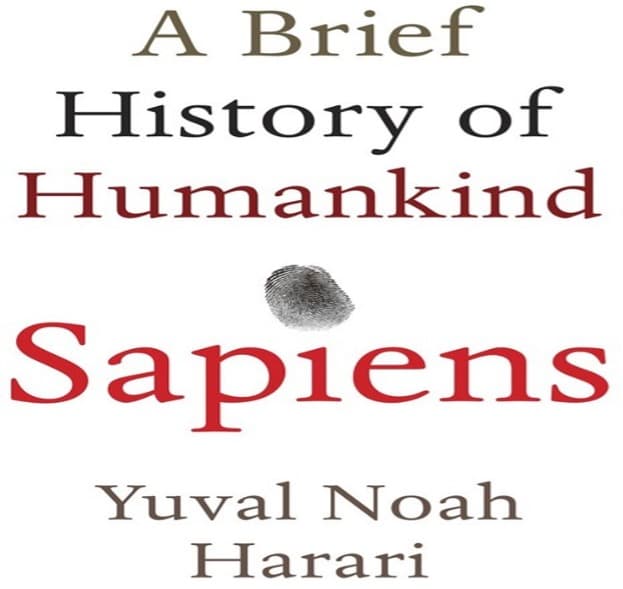
Overview
Sapiens: A Brief History of Humankind surveys the whole of human history through the lens of three revolutions. The Cognitive Revolution, about 70,000 years ago, gave Homo sapiens a language able to describe things that do not exist, and with it the capacity to cooperate flexibly in large numbers through shared fictions such as gods, nations, corporations like Peugeot, and human rights. The book follows foragers as they spread across the globe, displace or absorb other human species, and cause mass extinctions in Australia and the Americas. It treats forager life as varied and in some respects better than what followed.
The Agricultural Revolution, about 12,000 years ago, is presented as a trap: wheat and other crops "domesticated" Sapiens, producing larger populations, harder labour, hierarchies and, for domesticated animals, great suffering. The book argues that large societies rest on "imagined orders" sustained by belief, coercion and education, and illustrates this by contrasting the Code of Hammurabi with the American Declaration of Independence. It then covers the invention of writing and bureaucracy, and examines hierarchies of caste, race and gender as products of chance history that present themselves as natural, including the open puzzle of why patriarchy is so nearly universal.
The third part traces the unification of humankind through money, empires and universal religions, each of which makes the world a single arena. It explains how money rests on trust, redefines empire as a political order defined by cultural diversity and flexible borders, and classifies religions as animist, polytheist, monotheist, dualist and natural-law, extending the category to modern ideologies such as humanism and communism. It also argues that history is unpredictable and does not move toward human benefit.
The final part follows the Scientific Revolution, founded on admitted ignorance and tied to European empires and capitalism through credit, growth and the reinvestment of profit. It covers the Industrial Revolution, consumerism, the replacement of family and community by state and market, and the decline of violence since 1945. The book then asks whether people have become happier, comparing material, biochemical, meaning-based and Buddhist views of happiness. It closes by considering a future in which biological engineering, cyborgs and inorganic life could replace natural selection with intelligent design and end Homo sapiens as we know it. An afterword describes the species as a dissatisfied, irresponsible god that does not know what it wants.
The Manuscript
How the book is built — structure, themes, audience and positioning.
The book's central message is that Homo sapiens came to dominate the planet through a capacity for collective fiction: "imagined realities" such as gods, money, empires and human rights let millions of strangers cooperate, and this made us "the masters of creation" while history stopped being a matter of biology. But that power has been indifferent to well-being: "history's choices are not made for the benefit of humans," and the Agricultural Revolution, the empires, and industrial capitalism all enlarged the species' collective power while often worsening individual lives, especially those of other animals ("History's Biggest Fraud"). Now that science is beginning to replace natural selection with "intelligent design," Harari asks whether the "dissatisfied and irresponsible gods who don't know what they want" will decide what they want to become before they remake themselves.
Harari's voice is that of a confident, wry lecturer who treats enormous subjects as stories told to an intelligent friend. He favours short declarative sentences for punch ("Wheat didn't like rocks and pebbles, so Sapiens broke their backs clearing fields") and then lengthens them into catalogues that build momentum, as in the list of tasks wheat imposed. This alternation gives the prose a brisk, conversational rhythm. Rhetorical questions ("Who's the one living in a house? Not the wheat.") and direct address ("Take a dollar bill and look at it carefully") keep the reader engaged.
His concrete detail is carefully chosen and often comic. The Stadel lion-man leading into Peugeot's hood ornament, the Auschwitz cigarette economy, Edward I's sixteen children listed one by one, and the Mesopotamian student caned for "Your handwriting is no good!" all turn abstractions into vivid images. Metaphors recur and are memorable: Sapiens as "a banana republic dictator," the economy "like a hormone-soused teenager," the future "heaven and hell… gateway of the one and the anteroom of the other."
The style suits a general reader and a sweeping subject; its accessibility is its strength.
Two weaknesses. First, the confident tone sometimes flattens real scholarly disagreement into assertion. "The Agricultural Revolution was history's biggest fraud" and "Just do it!" style summaries ("Egoism is altruism") are catchy, but the swagger can outrun the evidence, and hedges like "most scholars agree" go unsupported. Second, the rhetorical devices grow predictable. The pattern of a bold claim, a comic analogy, then a reversal ("Hocus pocus – the bread turned into Christ's flesh") appears so often that it begins to feel formulaic, and the later chapters repeat the "is it really so?" question-and-answer move.
One improvement: when making a provocative claim, follow it immediately with one sentence naming the strongest opposing view or the source of uncertainty. That would keep the punchy voice while earning the confidence of its conclusions.
The argument flows well at the macro level. Each part hands off to the next with a stated bridge: Chapter 2 closes by asking "What did they do when they woke up in the morning?" and Chapter 3 answers it; Chapter 5 ends on suffering versus "evolutionary success," a theme Chapter 20 revives. Recurring devices (imagined orders, "There is no justice in history," the Gilgamesh and Neanderthal motifs) keep a single thesis visible across four parts. Register stays accessible throughout, with anecdotes (Peugeot, Kushim, Samuel Greedy's bakery) softening abstract points.
Negative 1: Abrupt shifts in scale and tone. Chapter 12 moves from comparative religion into a long account of Nazi evolutionary humanism and a table of "Humanist Religions," then Chapter 13 jumps to chaos theory ("level two" systems) and Mubarak's algorithm. Chapter 14's detour into Scottish Widows actuarial figures ("£2 12s. 2d. a year") is likewise far more granular than its surroundings, and Chapter 19 lurches from serotonin air-conditioning to Buddhist waves.
Negative 2: Repetition and loose connection between chapters. The animal-suffering argument appears in Chapter 5 (calves, Nuer, Tuareg), again in Chapter 17 (hens, Harlow's monkeys), and in Chapter 19's "greatest crime in history," each time reintroduced at length. Likewise, the Chapter 8 section on gender ends unresolved ("what accounts for the universality and stability of this system?") and Part Three never returns to it, so a promised thread simply drops.
Improvement: Add short signposting paragraphs at part openings that state what earlier thread is being resumed, and consolidate the animal material into one cumulative treatment. For example, at the start of Chapter 17 the cruelty discussion could explicitly refer back to Chapter 5's "Victims of the Revolution" and advance it rather than restating it, which would tie the sections together and cut the sense of detour.
Harari's personality is present on almost every page, and it is the book's main engine. The voice is wry, confident and mischievous, and it suits a general reader who wants an intellectual adventure rather than a textbook.
The humour is the clearest signal. He calls Sapiens "more like a banana republic dictator," describes the Agricultural Revolution as "history's biggest fraud," and says wheat "domesticated us." He turns lawyers into sorcerers: "hocus pocus – a new company was incorporated." Everyday asides keep the tone conversational: "a tub of Ben & Jerry's," "a jumbo Coke," the imagined shoemaker who wants "a divorce" instead of apples. These touches make abstractions feel lived-in and lower the barrier for non-specialists.
Passion shows most in the moral sections. The treatment of farm animals shifts from wit to something close to anger: "perhaps the greatest crime in history." The Tasmanian passage, ending "Truganini is no less important than Homer Simpson," shows him pairing seriousness with a pop-culture jolt, a signature move. The closing question, "Is there anything more dangerous than dissatisfied and irresponsible gods who don't know what they want?", lands because the earlier tone has trained us to expect both play and warning.
The risk is that confidence sometimes outruns evidence. Phrases like "Nobody agreed to this deal: the Agricultural Revolution was a trap" or "Consistency is the playground of dull minds" are vivid but assertive, and a sceptical reader may feel steered. He partly offsets this with candour about uncertainty: "Frankly, we don't know," "We just don't know." The repeated admissions make his bolder claims more credible.
Overall the tone fits a popular audience well: authoritative but approachable, provocative rather than pompous, with enough humility to earn trust.
The prose is highly accessible and rarely tips into either jargon or simplification. Technical terms arrive with a gloss attached: "Animism (from 'anima', 'soul' or 'spirit' in Latin)", "Theism (from 'theos', 'god' in Greek)", and a partial script is defined against a full script before it is used. Even the "level two chaotic system" is explained through the oil-price and Mubarak examples rather than left abstract.
Sentences are mostly short or medium, declarative, and often end on a quotable turn: "Sapiens by contrast is more like a banana republic dictator." Rhetorical questions ("Who's the one living in a house? Not the wheat.") and wry asides ("Alas, such contractors are rare breeds") keep abstract arguments conversational. Everyday analogies do the explanatory work: the bakery loan for fractional-reserve credit, football for shared fictions, the clerk in a room of clay tablets for archiving.
The risk lies in the other direction. Some claims are compressed into slogans that flatten complexity: "The Agricultural Revolution was history's biggest fraud", "Egoism is altruism", "Biology enables, Culture forbids". The Declaration of Independence "translated into biological terms" is vivid but deliberately reductive, as is the claim that "Money is more open-minded than language." Personification, such as wheat "manipulating" humans, or cultures as "mental parasites", is vivid but can read as explanation when it is metaphor.
Overall the register is popular rather than simplistic. Difficult ideas (inter-subjectivity, syncretism, probability) are handled with real care, while the confident, aphoristic tone occasionally outruns the nuance of the underlying scholarship.
Most chapters open with a concrete hook and close by pointing to the next chapter. Chapter 10 opens with Cortés and the Aztecs, "a disease of the heart which can be cured only with gold", and ends by pivoting: "we cannot disregard the equally crucial role of steel." Chapter 1 closes on "its unique language", which sets up Chapter 2. Short, descriptive subheadings ("The Luxury Trap", "Silencing the Lambs") break the text into digestible units, and subsections usually flow by posing a question the next one answers. Some chapters end more abruptly, however. Chapter 17 finishes on "We've seen it on television", a punchline rather than a synthesis.
Not in any systematic sense. Harari offers no program or step-by-step plan; the book is descriptive, and he says as much about history's purpose: "We study history not to know the future but to widen our horizons." Still, a few implicit calls to action surface, and the closing chapters come closest to naming them:
Think about what we want to become, and want to want. In the final chapter he writes: "we members of one of its final generations should devote some time to answering one last question: what do we want to become?" He then refines it: "perhaps the real question facing us is not 'What do we want to become?', but 'What do we want to want?'" He adds that "The only thing we can try to do is to influence the direction scientists are taking."
Become more mindful of other species and the ecosystem. He urges that awareness of past extinctions should change behaviour: "If we knew how many species we've already eradicated, we might be more motivated to protect those that still survive." Later he suggests that industrial farming "might well be the greatest crime in history," and that "it is wrong to consider only the happiness of humans."
Study the history of happiness and ask better questions about it. He calls this "the biggest lacuna in our understanding of history. We had better start filling it," and says "What is important is to get to know as many different approaches as possible and to ask the right questions."
These are invitations to reflect rather than concrete tasks. The "Don't go out just yet to buy liability insurance" line even disclaims any practical advice.
Yes, the concepts are consistently easy to follow, and the main reason is the author's habit of anchoring abstractions in concrete, memorable scenarios. The idea of imagined realities becomes graspable through the Peugeot chapter ("hocus pocus – a new company was incorporated"). The limits of barter are made vivid by the apple grower and shoemaker, and credit by the bakery example with Greedy, Stone and McDoughnut. Difficult terms are defined plainly and then reused: "inter-subjective" is set against "objective" and "subjective" using radioactivity and an imaginary friend. Chapters open with a story (Cortés, Numantia, Samarkand) before turning to the argument, and short subheadings such as "Guilty as Charged" or "The Luxury Trap" signpost each step.
The devices are used well, though sparingly. The Cognitive Revolution table ("New ability / Wider consequences") condenses a long argument into a scannable form. The numbered three-part lists work well too: three reasons the brain is a poor data store, three factors that hide the imagined order, three ways to replace natural selection. The humanism table clarifies three sects that the prose has just described. Captions do real interpretive work rather than merely labelling, for example the Lascaux caption calling the painting "a Rorschach test", and the Salviati map caption asking "What's beyond this point?"
The weakest spots are some diagrams. The "magic circle" and "Imperial Cycle" graphics appear in the text only as headings or fragments, so their content is hard to follow.
Deep Dive
Readability metrics, an AI-generated summary and tailored recommendations for every chapter.
1. Humans were once insignificant animals, and we were not the only human species
Main idea: For most of their 2.5 million years, humans were marginal creatures in the middle of the food chain, and they shared the planet with several other human species. The linear picture of one species begetting the next is a fallacy.
Supporting evidence: "The truth is that from about 2 million years ago until around 10,000 years ago, the world was home, at one and the same time, to several human species."
Significance: This resets the reader's assumptions about human exceptionalism and makes Sapiens' later dominance something that needs explaining, not something inevitable. It sets up the book's central question of how one marginal species came to rule the planet.
2. Sapiens' sudden rise to the top of the food chain made us dangerous
Main idea: Large brains, upright walking, premature births and the domestication of fire gave humans advantages, but they stayed weak for millennia. When Sapiens leapt to the top of the food chain, ecosystems had no time to adjust, and humans carried the anxieties of former underdogs.
Supporting evidence: "Sapiens by contrast is more like a banana republic dictator. Having so recently been one of the underdogs of the savannah, we are full of fears and anxieties over our position, which makes us doubly cruel and dangerous."
Significance: This introduces a recurring theme of the book, that human power has outrun human wisdom, and it frames later calamities such as wars and ecological catastrophe as products of that hasty ascent.
3. Sapiens replaced the other humans, with limited interbreeding, and probably through violence
Main idea: Genetic evidence from 2010 showed that Sapiens interbred with Neanderthals and Denisovans, but only rarely. The other human species then vanished soon after Sapiens arrived, whether through competition or genocide. Language is offered as the likely key to Sapiens' success.
Supporting evidence: "It may well be that when Sapiens encountered Neanderthals, the result was the first and most significant ethnic-cleansing campaign in history."
Significance: This establishes Sapiens as an ecological and moral disruptor from the start, with consequences for how we understand race and our own identity. It also leads directly into the next chapter's account of the Cognitive Revolution and language.
1. Writing style and flow: Tighten the chapter's opening and the "Skeletons in the Closet" terminology
The issue: The terminology is introduced mid-argument and is slightly inconsistent: "To clarify this point, I will often use the term 'Sapiens' to denote members of the species Homo sapiens, while reserving the term 'human' to refer to all extant members of the genus Homo." "Extant" contradicts the whole point, since these other humans are extinct, and the text then shifts between "humans," "men," "man," "Homo" and "Sapiens" (for example "the first humans specialised in extracting marrow," "man jumped to the top of the food chain").
Why it matters: The reader is asked to hold a definition the prose itself does not honour. Having to decide whether "man" means Sapiens or the genus slows the argument at the very point where it depends on that distinction.
How to implement: Replace "extant" with "all members, living or extinct, of the genus Homo," and move the definition to the first use of "human" in the opening pages. Then audit the chapter so "Sapiens" means only our species, "humans" means the genus, and "man/men" is dropped except in the Latin translations.
2. Storytelling and impact: Build the "from the middle to the top" payoff into a concrete scene
The issue: The marrow passage opens with real narrative energy ("suppose you observe a pride of lions take down and devour a giraffe. You wait patiently until they're done") but is then abandoned for abstraction: "That spectacular leap from the middle to the top had enormous consequences." The chapter also ends on a flat assertion, "Homo sapiens conquered the world thanks above all to its unique language," after the vivid Neanderthal "what ifs." The extinction itself is only a hypothetical ("Imagine a Sapiens band reaching a Balkan valley").
Why it matters: The strongest emotional hook, an anxious, scavenging animal that became a dictator, is stated rather than dramatised. The closing line deflates the suspense built by "Why couldn't even the strong, brainy, cold-proof Neanderthals survive our onslaught?"
How to implement: Extend the carcass scene to a short continuation showing the band's fear and the later reversal, perhaps contrasting it with a hunting scene 100,000 years on. Close the chapter by returning to that image, so the language "answer" arrives as a turn in the story (what language let a frightened scavenger band do), rather than a one-sentence verdict.
3. Literary and analytical criteria: Calibrate certainty and support the large causal claims
The issue: Several inferences are presented more firmly than the evidence shown allows. "Perhaps this is exactly why our ancestors wiped out the Neanderthals. They were too familiar to ignore, but too different to tolerate" and "it may well be that... the result was the first and most significant ethnic-cleansing campaign in history" rest on speculation, while the text itself notes interbreeding and says "We don't know" what drove brain growth. The "banana republic dictator" thesis ("Many historical calamities, from deadly wars to ecological catastrophes, have resulted from this over-hasty jump") is asserted without a single example. The cooking-brain link is supported only by a footnote marker ("Neanderthals and Sapiens.1").
Why it matters: Readers who notice the gap between hedged evidence and confident rhetoric may distrust the book's bolder claims, and the best-supported material (Neanderthal DNA at "1–4 per cent") is undersold by comparison.
How to implement: Mark speculation consistently ("one hypothesis holds") and present the extinction explanations (competition, violence, climate, disease) as a fair set of alternatives, including evidence for and against genocide. Add one or two concrete examples, such as a documented ecological collapse, to back the "over-hasty jump" thesis, and state in the text, not only a note, who proposed the cooking-and-gut hypothesis and how strong the evidence is.
1. Sapiens' distinctive trait is the ability to speak about fictions
Main idea: The Cognitive Revolution did not give Sapiens language itself, or even vocal language, but the ability to talk about things that do not exist, such as spirits, nations and companies. This, more than information-sharing or gossip, is what set Sapiens apart.
Supporting evidence: "Rather, it's the ability to transmit information about things that do not exist at all. As far as we know, only Sapiens can talk about entire kinds of entities that they have never seen, touched or smelled."
Significance: This claim anchors the book's account of why Sapiens, and not Neanderthals or chimpanzees, came to dominate the planet, and it introduces the "imagined reality" concept that the later chapters on money, empire and religion build on.
2. Shared myths let strangers cooperate in large numbers
Main idea: Instinct and gossip limit groups to about 150 people. Common myths (religious, national, legal, corporate) let millions of strangers cooperate flexibly, and the Peugeot corporation shows that modern institutions work on the same basis as tribal spirits.
Supporting evidence: "Any large-scale human cooperation – whether a modern state, a medieval church, an ancient city or an archaic tribe – is rooted in common myths that exist only in peoples collective imagination."
Significance: It explains how Sapiens crossed the 150-person threshold to build cities, empires and economies, and it frames the later history of human societies as the history of the stories that hold them together.
3. Changing the myths bypasses genetic evolution and makes history independent of biology
Main idea: Because cooperation rests on stories, Sapiens can change their social behaviour within a decade or two without any genetic change. This opened a "fast lane" of cultural evolution and marks the point where history separates from biology, with biology setting the arena and culture the games played in it.
Supporting evidence: "This opened a fast lane of cultural evolution, bypassing the traffic jams of genetic evolution."
Significance: It justifies treating Sapiens history as the interaction of ideas, images and fantasies, not merely of genes, and it sets up the following chapters, which explore the games Sapiens played, from foraging to agriculture and beyond.
1. Writing style and flow: Tighten the opening recap and the stacked theories before the thesis lands
The issue: The chapter opens with a long recap ("In the previous chapter we saw that...") and then runs through the green-monkey, "supple language" and gossip theories before reaching its real claim, "Rather, it's the ability to transmit information about things that do not exist at all." The hinge sentence "Most likely, both the gossip theory and the there-is-a-lion-near-the-river theory are valid" is easy to miss. The "Cognitive Revolution" label and the "Tree of Knowledge mutation" label are also introduced in quick succession with little signposting.
Why it matters: Readers wade through about a dozen paragraphs of preliminaries before the central idea, so the momentum of the argument is diluted and the pivot to fiction reads as an afterthought.
How to implement: Cut the recap to one or two sentences. Lead with the question "What was so special about our language?" and state the fiction thesis in a sentence up front. Then present the lion-warning and gossip theories as brief foils, each in one paragraph. Open the fiction section with a clear transition such as "Both theories are true, but neither explains our conquest."
2. Storytelling and impact: Replace the abstract Peugeot walkthrough's repetition with a sharper human thread
The issue: The Peugeot section makes its point through a long run of hypotheticals ("Even if every Peugeot in the world were simultaneously junked...", "A disaster might kill every single one of Peugeot's employees...", "All the managers could be dismissed and all its shares sold..."). The human stories in the chapter are glimpsed rather than developed: Jean the wagon-maker, the Berlin woman born in 1900, the monkey who fakes a lion call. The Stadel lion-man is mentioned repeatedly but never imagined as a scene.
Why it matters: Stacked hypotheticals feel like a legal brief, and the emotional payoff of the idea (strangers risking their lives for a flag, a company outliving its founder) is spent on explanation rather than felt. The best material is rationed out in a single paragraph each.
How to implement: Compress the three "even if" scenarios into one, then spend the saved space on one fully told scene. For example, narrate the Berlin woman's century in a few vivid lines, or open the chapter with the lion-man carver in Stadel Cave imagining a creature that does not exist, and return to him when you reach Peugeot's lion emblem so the two images frame the argument.
3. Literary and analytical criteria: Support the central causal claim with evidence and address its obvious counterarguments
The issue: The chapter asserts that fiction explains Sapiens' victory ("That's why Sapiens rule the world, whereas ants eat our leftovers") and that Neanderthals "probably could not tell – and revise – stories about tribal spirits." The evidence is indirect: shells and obsidian are said to have been traded, and "in all likelihood" and "it stands to reason" carry the inference to belief in shared fictions. The claim that "all the Sapiens trade networks about which we have detailed evidence were based on fictions" is stated without a source. The "150" figure is credited only to "sociological research", and the text itself concedes "We're not sure" about the cause of the Cognitive Revolution.
Why it matters: Speculation is presented with the same confidence as established fact. A skeptical reader will see the gaps: trade could rest on reciprocity and kinship rather than myth, and Neanderthals' cognition is unknowable, so the argument can seem circular. The strongest claim in the book is thus the least defended.
How to implement: Separate the evidence tiers explicitly: what archaeology shows (the shells, the obsidian, the herd-driving sites), what is inferred, and what is conjecture. Name the source for the 150 figure and for the claim about trade. Add a short paragraph engaging alternative explanations, such as kinship-based exchange or Neanderthal symbolic behaviour, and explain why fiction-based cooperation remains the better account.
1. There was no single "natural" forager way of life
Main idea: Ancient foragers were culturally diverse, and the evidence (perishable artefacts, unrepresentative modern foragers) is too thin to settle debates about our "natural" sexuality or social structure, so the evolutionary-psychology fights over monogamy versus communes miss the point.
Supporting evidence: "Ever since the Cognitive Revolution, there hasn't been a single natural way of life for Sapiens. There are only cultural choices, from among a bewildering palette of possibilities."
Significance: It ties the chapter to the book's central claim that imagined realities, made possible by fiction, let Sapiens vary their norms far beyond what DNA dictates, and it warns readers against biological determinism.
2. Foragers lived better, more skilled lives than their farming and industrial descendants, though not idyllic ones
Main idea: Foragers had varied diets, fewer infectious diseases, shorter working weeks and deep individual knowledge, which makes them "the original affluent society." Their world was also harsh, as the Aché's killing of children and the elderly shows, so they should be neither idealised nor demonised.
Supporting evidence: "But at the individual level, ancient foragers were the most knowledgeable and skilful people in history."
Significance: It undermines the assumption that agriculture and industry mean straightforward progress, which prepares the ground for the book's later argument that the Agricultural Revolution was a trap.
3. The deep past is largely hidden behind a "curtain of silence," yet it mattered enormously
Main idea: Beliefs, politics, violence and events of the forager era leave little trace. Evidence such as the Sungir burials and the contrasting skeletal surveys shows variety and invented social codes, and the unanswerable questions still need asking so that 60,000 of 70,000 years are not dismissed as unimportant.
Supporting evidence: "Yet it is vital to ask questions for which no answers are available, otherwise we might be tempted to dismiss 60,000 of 70,000 years of human history with the excuse that 'the people who lived back then did nothing of importance'."
Significance: It sets out the book's method of reasoning honestly under uncertainty, and it leads into the next chapter's claim that foragers reshaped the planet's ecology long before farming.
1. Writing style and flow: Tighten the chapter's opening and its false start on "gorging genes"
The issue: The chapter opens with a long evolutionary-psychology setup and the ice-cream example ("That's what makes us spoon down an entire tub of Ben & Jerry's"), then pivots through the "ancient commune" and "eternal monogamy" debates, and only afterward admits that "there are few certainties regarding the lives of our forager ancestors." The reader is led through two confident-sounding arguments before being told the evidence is "flimsy," and the path to the chapter's real subject (what we can and cannot know about foragers) is slow and winding.
Why it matters: The early pages build momentum around claims the chapter then undercuts, so the transitions feel like reversals rather than a deliberate argument. The key sentence, "Ever since the Cognitive Revolution, there hasn't been a single natural way of life for Sapiens," arrives well after the reader has been invested in the question it dismisses.
How to implement: Compress the evolutionary-psychology preamble and add a signpost sentence early, such as "Two examples show why this field is both illuminating and unreliable." Then label the gorging gene as the well-supported case and the commune/monogamy dispute as the contested one. This lets the later pivot ("Unfortunately, there are few certainties…") read as the planned payoff of the setup.
2. Storytelling and impact: Give the "curtain of silence" a human scene instead of only hypotheticals
The issue: The most powerful ideas are delivered as lists of conjecture: "The foragers may have had their all-conquering Napoleons… gifted Beethovens… and charismatic prophets." Likewise the Oxford/Cambridge band comparison ("The Cantabrigians might have spent long hours carving wooden statues…") and the claim that the forager "might leave camp with her companions at, say, eight in the morning" stay generic. By contrast, the Sungir children and the Aché "Vulture Droppings" anecdote are vivid precisely because they are concrete.
Why it matters: The chapter's emotional peak should be the sense of lost, unrecoverable lives, but a string of "may have" and "perhaps" sentences reads as clever rhetoric rather than felt loss. The reader remembers the buried children, not the imagined Napoleons, so the closing does not land with the force of the middle.
How to implement: Rebuild the "Curtain of Silence" section around one concrete, evidence-based image, such as the Hands Cave handprints ("It looks as if these long-dead hands are reaching towards us from within the rock") or the Sungir children, and use it to illustrate what is lost. Keep a single compact conjecture (the Beethoven with a bamboo flute) rather than a stack, and return to the specific scene in the final paragraph before the pivot to the next chapter.
3. Literary and analytical criteria: Reconcile the "original affluent society" claims with the chapter's own warnings about evidence
The issue: The chapter insists that modern forager analogies are unreliable ("it's risky to assume that what is true of them was also true tens of thousands of years ago") and that Kalahari groups "may well provide a very misleading model." Yet it then leans on exactly those groups for confident claims: "hunter-gatherers living today in the most inhospitable of habitats – such as the Kalahari Desert – work on average for just thirty-five to forty-five hours a week," and "ancient foragers were less likely to suffer from starvation or malnutrition." It also declares that "foraging provided ideal nutrition" and describes the Chinese forager's afternoon as leisure, while later admitting "Periods of want and hardship were not uncommon." The brain-size remark about "niches for imbeciles" is similarly offered as a one-line inference with a single endnote.
Why it matters: The chapter's credibility rests on its epistemic caution, so selective confidence invites the charge that it idealises foragers when convenient. The tension between "we know next to nothing" and "foragers enjoyed a more comfortable and rewarding lifestyle" is never acknowledged, which weakens the rigor of the whole argument.
How to implement: Add a short passage that explicitly flags the affluence claims as inferences from modern, marginal-habitat foragers and from skeletal evidence, and state which are well supported (skeletal height, disease origins in domesticated animals) and which are speculative (working hours, "more interesting lives"). Replace absolutes such as "ideal nutrition" with qualified wording, and give the brain-size claim a proper explanation of the evidence and its limits, or cut it.
1. Sapiens' arrival in Australia marked a turning point in humanity's power over nature
Main idea: The sea crossing to Australia about 45,000 years ago was the first time humans left the Afro-Asian ecosystem, and the first time they transformed an ecosystem rather than merely adapting to it. Sapiens became the dominant, and most destructive, species on a whole landmass.
Supporting evidence: "The settlers of Australia, or more accurately, its conquerors, didn't just adapt, they transformed the Australian ecosystem beyond recognition."
Significance: It sets up the book's central claim that the Cognitive Revolution gave Sapiens unprecedented capabilities, including seafaring, and that those capabilities reshaped the planet long before agriculture or industry.
2. The evidence points to human guilt for the megafauna extinctions, not climate change
Main idea: Three arguments weaken the climate alibi: the climate shift was unremarkable, marine fauna were spared, and the same extinctions recurred wherever humans arrived (New Zealand, Wrangel Island, the Americas). Plausible mechanisms are slow-breeding prey, animals with no fear of humans, and fire-driven habitat change.
Supporting evidence: "Were the Australian extinction an isolated event, we could grant humans the benefit of the doubt. But the historical record makes Homo sapiens look like an ecological serial killer."
Significance: The argument rests on a pattern across continents and islands, which gives the book a causal account of Sapiens' ecological impact and establishes the chapter's moral tone.
3. Extinction came in three waves, and our ancestors were not ecological innocents
Main idea: Foragers caused the First Wave (roughly half of the world's large terrestrial mammal genera), farmers the Second, and industry the Third that is under way now. Seeing this continuity should undercut the myth of early harmony with nature and make us take present extinctions more seriously.
Supporting evidence: "Don't believe tree-huggers who claim that our ancestors lived in harmony with nature. Long before the Industrial Revolution, Homo sapiens held the record among all organisms for driving the most plant and animal species to their extinctions."
Significance: It links the Cognitive Revolution to the Agricultural Revolution that follows and to the modern era, framing the book's whole account of Sapiens as a story of growing power with heavy ecological costs.
1. Writing style and flow: Clean up the garbled sentences and the chronology that keeps shifting
The issue: Several sentences are broken or contradict their neighbours. "they had already mastered fire agriculture" is a malformed phrase, and the text later calls it "fire agriculture" again as if the term were settled. Dates also wobble: America is settled "about 16,000 years ago, that is in or around 14,000 BC," and the section then moves between "BC", "years ago" and "AD" in the same paragraph, for example "Samoa and Tonga (1200 BC); the Marquis Islands (AD 1)."
Why it matters: A reader stops to decode the phrase or to convert the dates, and the momentum of an otherwise fast narrative is lost. "Fire agriculture" also implies farming, which contradicts the hunter-gatherer picture the passage builds.
How to implement: Replace "fire agriculture" with a plain description such as "fire-stick burning" or "deliberate landscape burning," and use it consistently. Pick one dating convention per section and give conversions only once. Correct "Marquis" to "Marquesas," and "ma r k" to "mark."
2. Storytelling and impact: Use the Wrangel and Madagascar cases to put a human face on the killing
The issue: The text asserts human guilt more than it dramatizes it: "Within a few thousand years, virtually all of these giants vanished," "the historical record makes Homo sapiens look like an ecological serial killer." The best scenes are the diprotodon that "gave it one glance and then went back to chewing leaves" and the three-act island tragedy. Yet the island cases are told in summary, for example "suddenly vanished about 1,500 years ago – precisely when the first humans set foot on the island," and the Wrangel mammoths get only a couple of sentences.
Why it matters: The emotional payoff of the chapter, the naive animal meeting its first human, appears once and is then dropped in favour of lists of dates and genera. The closing appeal ("they'd be less nonchalant about the Third Wave") therefore lands as moralizing and not as something the reader has felt.
How to implement: Expand one island case, such as the last Wrangel mammoths or an elephant bird on Madagascar, into a short scene in the manner of the diprotodon passage. Place the Galapagos tortoises, "which, like the ancient diprotodons, show no fear of humans," as a living echo near the end, so the closing warning rests on an image the reader remembers.
3. Literary and analytical criteria: Calibrate the certainty of the claims and engage the counter-evidence
The issue: The argument swings between hedged and absolute. The Australian case is honestly left open ("Without further evidence, there's no way of deciding between the three scenarios"), yet the American case is declared closed: "the dung ball cannot be dodged. We are the culprits. There is no way around that truth." The Wrangel claim, that mammoths vanished "just when the first humans reached the island," is stated as fact. The tone also shifts to the polemical: "Don't believe tree-huggers who claim that our ancestors lived in harmony with nature." The climate counter-argument is also dismissed as a "scapegoat" without being weighed seriously.
Why it matters: Overstatement invites skeptics to discount the strong parts of the case, such as the sea-versus-land asymmetry and the Caribbean sloth dates. Caricaturing opponents weakens the credibility of a chapter whose strength is its pattern of evidence.
How to implement: State the strongest version of the climate and overkill-versus-combined-cause positions, then explain why the pattern across islands tips the balance. Replace "There is no way around that truth" with a statement of how the evidence converges. Qualify the Wrangel and Madagascar timings, and replace "tree-huggers" with a precise claim about what the archaeological record shows of pre-industrial impact.
1. The Agricultural Revolution as history's biggest fraud
Main idea: Farming enlarged the total food supply but made the average person's life harder, less secure and less healthy than a forager's. The gains went to population growth and elites, not to individuals.
Supporting evidence: "The average farmer worked harder than the average forager, and got a worse diet in return. The Agricultural Revolution was history's biggest fraud."
Significance: It overturns the story of history as steady progress and sets up the book's recurring question of whether collective power makes individuals better off.
2. The luxury trap: small, rational choices produced an irreversible and unintended outcome
Main idea: Early farmers did not plan the revolution. A series of small improvements led to larger populations, and those populations made returning to foraging impossible. Luxuries became necessities and created new obligations, a pattern the author says still applies today.
Supporting evidence: "One of history's few iron laws is that luxuries tend to become necessities and to spawn new obligations."
Significance: It gives the book a model of historical causation in which cumulative, unforeseen consequences matter more than intention. Wheat "domesticating" humans is the vivid illustration, and the model is applied again to modern life.
3. Evolutionary success is not the same as individual well-being
Main idea: Measured by DNA copies, wheat, cattle, chickens and Sapiens all flourished. But the individuals involved, especially domesticated animals, often suffered greatly. The chapter calls this gap its most important lesson.
Supporting evidence: "This discrepancy between evolutionary success and individual suffering is perhaps the most important lesson we can draw from the Agricultural Revolution."
Significance: It supplies the ethical yardstick for the rest of the book, which keeps asking whether growth in collective power has brought individual happiness or suffering. The author announces this directly: "we will see time and again how a dramatic increase in the collective power and ostensible success of our species went hand in hand with much individual suffering."
1. Writing style and flow: Tame the rhetorical overreach and the stray asides
The issue: Strong claims are delivered in slogan form and then repeated with slight variations: "The Agricultural Revolution was history's biggest fraud," "These plants domesticated Homo sapiens, rather than vice versa," and later "We did not domesticate wheat. It domesticated us." The wheat-as-agent conceit also slides into jokey asides like "Voilà! Mary had a little lamb," which break the sober tone of the surrounding argument.
Why it matters: The same punchline is delivered three times, which dulls its force. The nursery-rhyme joke undercuts the gravity of the passage on animal selection that follows it.
How to implement: Keep one "domesticated us" line, at the point where the Latin domus etymology pays it off, and cut or fold the earlier statements into plain claims. Delete the "Voilà!" sentence and let the selection process ("The most aggressive and unruly lambs were first to the slaughter") carry its own weight.
2. Storytelling and impact: Give the human cost a concrete face, then keep it consistent
The issue: The emotional centre of the chapter is one hypothetical: "a three-year-old girl dying from malnutrition in first-century China." Elsewhere the human suffering is told in aggregate statistics ("child mortality soared," "peasants died by the thousands and millions"), while the animal section has vivid, specific images (the Nuer smearing stuffed calves with urine, the gouged pigs' eyes). The early farmers themselves never get a comparable scene.
Why it matters: The "trap" thesis depends on the reader feeling how it closed on real people, yet the people are the least vivid figures in the chapter. The girl is also dated to the first century AD, long after the transition the argument is about, so the emotional anchor does not match the period under discussion.
How to implement: Add one grounded scene from the transition itself, such as a Jericho family around 8500 BC deciding to plant another field as another child is born, and use it to dramatise "Every generation continued to live like the previous generation." Keep the Chinese girl only as a later echo, or replace her with this earlier figure.
3. Literary and analytical criteria: Qualify the central claims and reconcile the competing explanations
The issue: The chapter asserts "The average farmer worked harder than the average forager, and got a worse diet in return" and "Hunter-gatherers... were less in danger of starvation and disease" as settled fact, with no sources in the text beyond a footnote marker. It also offers two rival causes, the miscalculating "luxury trap" and the Göbekli Tepe temple hypothesis ("It may well be that foragers switched... to support the building and running of a temple"), without saying how they relate. The temple case rests on one site and proximity: "This can hardly be a coincidence." The comparison is further weakened by treating all farmers and all foragers as uniform, even though the text itself notes the Natufians were settled foragers who stored grain.
Why it matters: Readers who know the contested literature will see the evidence as thinner than the confidence of the tone. The two explanations sit side by side as if they were alternatives, when the temple theory arguably contradicts the claim that "Nobody plotted the Agricultural Revolution."
How to implement: Name the kinds of evidence behind the health and workload claims (skeletal studies, ethnographic foragers) and note where they are disputed or regionally variable. Soften "can hardly be a coincidence" to a hedged inference. Then add a short passage explaining whether the temple motive replaces the luxury trap, or whether a ritual impulse could have started the process and the trap locked it in.
1. Large-scale cooperation rests on imagined orders, not instinct
Main idea: Humans evolved for small bands, so the cities, kingdoms and empires that followed agriculture could only work because strangers shared myths that coordinated their behavior. Hammurabi's hierarchy and Jefferson's equality are the paired examples: both claim universal principles, and neither has objective validity.
Supporting evidence: "Yet the only place where such universal principles exist is in the fertile imagination of Sapiens, and in the myths they invent and tell one another. These principles have no objective validity."
Significance: This is the chapter's central thesis and the book's explanation for how Sapiens came to dominate: fictions scale cooperation far faster than biology could, so human history is driven by shared belief rather than by evolution.
2. Imagined orders are sustained by concealment, belief and enforcement
Main idea: Because myths vanish when belief fades, an imagined order must be defended by coercion and, more importantly, by true believers, including elites and soldiers. It is also protected by three mechanisms: it is denied as imagined, built into the material world, and made to shape our very desires.
Supporting evidence: "First, you never admit that the order is imagined. You always insist that the order sustaining society is an objective reality created by the great gods or by the laws of nature."
Significance: This shows why imagined orders feel natural and endure, and it extends the argument beyond ancient empires to modern individualism, romantic consumerism and capitalism, making the book's thesis a critique of the reader's own world.
3. The inter-subjective category makes the imagined order inescapable
Main idea: Money, law, nations and companies are neither objective facts nor private fantasies but inter-subjective realities that exist in the shared beliefs of many people. Changing them therefore requires mobilizing millions through some rival shared myth, so we only ever move from one imagined order to another.
Supporting evidence: "There is no way out of the imagined order. When we break down our prison walls and run towards freedom, we are in fact running into the more spacious exercise yard of a bigger prison."
Significance: This supplies the conceptual vocabulary the book relies on to treat gods, money and human rights as real in their effects without being real in biology, and it frames the ethical question of whether any order can be justified beyond its usefulness for cooperation.
1. Writing style and flow: Untangle the chapter's opening and its cross-references
The issue: The chapter opens with a sprawling census paragraph ("Around 10,000 BC, before the transition to agriculture, earth was home to about 5–8 million nomadic foragers") and then slides into the "imagined order" argument without a bridge. The text also leans on unmarked back-references: "We have already discussed one such example: Peugeot" and "Henceforth, attachment to 'my house' and separation from the neighbours became the psychological hallmark of a much more self-centred creature." A reader who meets this section on its own has no idea where Peugeot was discussed, and the pivot from "The Coming of the Future" to "An Imagined Order" arrives abruptly.
Why it matters: The prose is lively, but the argument's joints are hidden. Readers must reconstruct how the farmers' anxiety about the future leads to the claim that myths enable mass cooperation, and the unexplained Peugeot reference breaks the flow just as the argument gets abstract.
How to implement: Add a two-sentence transition at the head of "An Imagined Order" that links the two halves, for example: peasant surplus created cities, but surplus alone could not make strangers cooperate. Replace "We have already discussed one such example: Peugeot" with a one-line reminder of what the example showed, such as a company existing only as a shared legal story. Split the opening census paragraph so the population figures stand apart from the claim about psychology.
2. Storytelling and impact: Give the human stakes to the Hammurabi and Declaration comparison
The issue: The comparison is the chapter's centrepiece, yet it is delivered largely as exposition and a long block of numbered laws. The most vivid detail, "If that woman should die, they shall kill his daughter", is passed over in a quick explanation: "To us it may seem strange that the killer remains unharmed whereas his innocent daughter is killed, but to Hammurabi and the Babylonians this seemed perfectly just." The "biological translation" of Jefferson's sentence is clever, but it is mostly argument rather than scene. The Declaration side has no corresponding human consequence.
Why it matters: The chapter's emotional payoff, that our own deepest convictions are as constructed as the ones we find shocking, is blunted. The reader is told to feel unsettled rather than being put in a position to feel it, and the chapter's strongest image, "the more spacious exercise yard of a bigger prison", arrives after a long stretch of abstract definition.
How to implement: Trim the quoted judgements to two or three, and build one short scene around the daughter's execution, imagining the father and the daughter inside the Babylonian system and how each would have understood it as just. Match it with one concrete modern case of a right that people were once ready to deny, so the parallel is felt on both sides. Then foreshadow the prison metaphor earlier, perhaps in the "Prison Walls" section opening, so the final line closes a motif rather than appearing suddenly.
3. Literary and analytical criteria: Defend the central claims against their obvious objections
The issue: Several claims are asserted more confidently than they are supported. "In fact, they are both wrong" treats equality and hierarchy as symmetrical fictions, then concedes that "Hammurabi might have defended his principle of hierarchy using the same logic", without saying what, if anything, distinguishes the two orders. The claim that "Imagined orders ... are the only way large numbers of humans can cooperate effectively" is stated flatly. The assertion that "a cynic who believes in nothing is unlikely to be greedy" rests on the Diogenes anecdote, and the line "It was not food shortages that caused most of history's wars and revolutions" rests on three examples. The biological "translation" of "liberty" and "rights" also assumes that biology is the only valid standard of objective reality.
Why it matters: A sceptical reader can accept the inter-subjective concept and still reject the sweeping conclusions. Without engagement with counterarguments, the moral relativism implied by "both wrong" reads as a rhetorical sleight of hand, and the cynic argument as a neat quip rather than a demonstration.
How to implement: Add a short passage after the Hammurabi comparison that asks whether all imagined orders are equally defensible, and answer it by distinguishing "not objectively true" from "not morally comparable", for instance by judging orders by the suffering or freedom they produce. Qualify "the only way" with an acknowledgement of kinship, trade and institutional incentives, and say why shared stories still matter most. Back the war-and-revolution claim with one more systematic observation or soften it to "many". Note that a norm can be inter-subjective yet constrained by material realities, which preserves the framework while answering its critics.
1. Imagined orders outgrow the human brain
Main idea: Large-scale cooperation rests on shared imagined rules, and unlike bees' genetically encoded hives, these rules must be consciously stored and transmitted. Once societies reached empire scale, they needed more numerical data than any brain could hold, which capped the size of early human collectives.
Supporting evidence: "Because the Sapiens social order is imagined, humans cannot preserve the critical information for running it simply by making copies of their DNA and passing these on to their progeny."
Significance: It frames the book's central claim that Sapiens power comes from shared fictions, and it explains why external information storage became the precondition for cities, kingdoms and empires.
2. Writing began as bureaucratic data-processing, not as speech
Main idea: Sumerian writing was invented around 3500–3000 BC as a partial script for tax and property records, not to transcribe spoken language. Only later did it grow into full scripts, while partial scripts such as quipus kept handling the mathematical data that states depend on.
Supporting evidence: "They didn't invent it in order to copy spoken language, but rather to do things that spoken language failed at."
Significance: It overturns the romantic view of writing as a vehicle for literature and wisdom, tying it instead to administration and power, and it sets up the chapter's later claim that the same logic continues in modern numerical scripts.
3. Script reshapes human thought and shifts authority toward numbers and machines
Main idea: Archives only work with cataloguing and trained clerks, which taught people to think in compartmentalised, non-human ways. That trajectory runs through Arabic numerals to binary code, as thought increasingly happens in external systems and humans learn to speak the language of computers.
Supporting evidence: "Writing was born as the maidservant of human consciousness, but is increasingly becoming its master."
Significance: It carries the book's argument that human-made information systems feed back on their makers, and it points toward the later themes of science, capitalism and artificial intelligence.
1. Writing style and flow: Repair the garbled partial-script passage and the misplaced paragraph
The issue: The definition of partial script arrives before the term has been introduced: "Partial script cannot express the entire spectrum of a spoken language, but it can express things that fall outside the scope of spoken language. Partial scripts such as the Sumerian and mathematical scripts cannot be used to write poetry..." It sits between the Kushim discussion and the "Only one other type of text survived" paragraph. That next paragraph then defines the term again ("Partial script, on the other hand, is a system of material signs that can represent only particular types of information"). The scattered captions, such as "A clay tablet with an administrative text from the city of Uruk" and "An equation for calculating the acceleration of mass i", also interrupt sentences mid-argument. The paragraph "Writing is a method for storing information through material signs" similarly breaks off before its own illustration.
Why it matters: The reader meets the concept, a half-definition and then a full definition in three separate places, which feels like drafting residue rather than a built argument. Caption text fused into body paragraphs makes the flow stumble.
How to implement: Delete the stand-alone "Partial script cannot express the entire spectrum..." paragraph and keep only the later full/partial contrast, adding its "things spoken language failed at" idea to that passage. Set every caption apart from the body text, and make sure no sentence is split by an image note, as in "When Kushim's neighbours called out / to him".
2. Storytelling and impact: Carry the Jacob and Esau scene through to a resolution and tie it to the stakes
The issue: The best scene in the text, the archive dispute ("Imagine for a moment that it's 1776 BC. Two Marians are quarrelling over possession of a wheat field"), ends with a string of rhetorical questions: "If he can't find it, does that prove that Esau never sold or rented out the field? Or just that the document got lost, or turned to mush when some rain leaked into the archive?" The scene is then dropped for a flat statement: "Clearly, just imprinting a document in clay is not enough." The closing section does something similar. The AI passage ("Science-fiction movies such as The Matrix and The Terminator tell of a day when the binary script throws off the yoke of humanity") rests on film clichés rather than on anything the chapter has built up.
Why it matters: The vivid human drama of Jacob, Esau and the sour-faced clerk is the emotional high point, yet it leaves no consequence behind. The ending trades the chapter's own evidence, such as the quipu experts who could "mislead and cheat their overlords", for pop-culture shorthand, so the warning that "writing... is increasingly becoming its master" lacks weight.
How to implement: Add two or three sentences that finish the story. For instance, let the clerk fail to find the tablet, so that the dispute is settled by whoever shouts loudest or bribes best, and then use that outcome to introduce cataloguing as the real invention. For the ending, replace the Terminator reference with a concrete example in the chapter's own register, such as a person whose credit rating decides their life, so the "master" claim is dramatised by a case instead of a movie.
3. Literary and analytical criteria: Qualify the sweeping causal claims about the brain and about script
The issue: Several large claims are stated as settled fact. "So human brains did not adapt to storing and processing numbers" and "most human brains overdosed or fell asleep" present a flat evolutionary conclusion with a joke where evidence should be. "Since the human brain could not do it, the system collapsed. For thousands of years after the Agricultural Revolution, human social networks remained relatively small and simple" treats a single cause as the whole explanation. "The most important impact of script on human history is precisely this: it has gradually changed the way humans think" is likewise asserted with no evidence of changed cognition. The quipu section also undercuts itself by saying "many people would argue it wasn't a script at all" and then using it as a core example of partial script without engaging that objection.
Why it matters: A skeptical reader will notice that the argument leans on assertion and tidy dichotomies (free association versus bureaucratic compartmentalisation, brain versus tablet). Without acknowledging complications, the chapter reads as persuasive storytelling rather than rigorous analysis, and it risks losing informed readers.
How to implement: Add brief hedges and one piece of supporting evidence for each major claim. For example, note that oral cultures had mnemonic techniques that handled some numerical data, and that writing was one factor among several (irrigation, trade, ideology) in scaling up states. Briefly state the case for and against calling quipus a script before relying on them, and soften "the most important impact" to something like "one of the most profound impacts", backed by the clerk-versus-brain contrast you already draw.
1. Imagined hierarchies disguise themselves as natural
Main idea: Every large society organises strangers through invented hierarchies (caste, race, class, gender) and then denies their fictional origins by claiming they are natural, divinely ordained or biologically grounded.
Supporting evidence: "it is an iron rule of history that every imagined hierarchy disavows its fictional origins and claims to be natural and inevitable."
Significance: This extends the book's central thesis about imagined orders, showing that the cooperation networks that let Sapiens scale up also carry built-in injustice, and why history rather than biology is needed to explain human society.
2. Chance origins harden into rigid systems through vicious circles
Main idea: Hierarchies such as caste in India and race in America begin in accidental historical circumstances, then perpetuate themselves as myths, laws and unequal opportunity make the original disadvantage look like proof of innate inferiority.
Supporting evidence: "blacks were not hired for white-collar jobs because they were deemed unintelligent, and the proof of their inferiority was the paucity of blacks in white-collar jobs."
Significance: It supplies the book's mechanism for how contingent events become entrenched structures, and it explains why discrimination tends to worsen with time and why "the events, circumstances, and power relations" must be studied.
3. Gender is cultural, yet patriarchy's universality remains unexplained
Main idea: "Sex" is biological while "gender" is a cultural construct, and the chapter rejects the muscle-power, aggression and evolutionary-strategy explanations for male dominance. Yet because patriarchy is so universal, it cannot be the product of a single chance vicious circle, and its cause stays an open question.
Supporting evidence: "How did it happen that in the one species whose success depends above all on cooperation, individuals who are supposedly less cooperative (men) control individuals who are supposedly more cooperative (women)? At present, we have no good answer."
Significance: It applies the imagined-order framework to the most pervasive hierarchy, and by openly admitting the limits of current explanation it shows that the book's argument has gaps as well as conclusions.
1. Writing style and flow: Tighten the rhetorical drift and the stray asides
The issue: The argument repeatedly pauses for jokes and tangents that break the thread, as in "Next time a mosquito buzzes in your ear, accuse her of unnatural behaviour" and "if we are Rambo, to pull the pins out of hand grenades". Several transitions also leave a gap in the logic, such as "Sex is child's play; but gender is serious business", which arrives right after the Louis XIV and Obama captions, and the abrupt "Part Three / The Unification of Humankind" ending right after an unanswered question.
Why it matters: The wit is engaging, but the natural/unnatural section (mouths, wings, chimpanzees) runs so long that readers lose track of the point it serves, which is the "Biology enables, Culture forbids" rule. Captions and asides also interrupt the main sentences.
How to implement: Trim the wing-evolution illustration to two or three sentences and keep one comic image. Restate the rule right after the examples. Move captions out of the running text, and add a one-sentence bridge before each new subsection (for example, before "Muscle Power") saying which theory is next and why it is being tested.
2. Storytelling and impact: Replace generalisations with individual human stories
The issue: The most powerful material is one-off, such as "Clennon King, a black student who applied to the University of Mississippi in 1958, was forcefully committed to a mental asylum" and Lady Hao's "Not lucky. It was a girl." Yet most of the chapter is abstract summary: "Unjust discrimination often gets worse, not better, with time. Money comes to money, and poverty to poverty."
Why it matters: The vicious circle is told through a hypothetical "black person born in Alabama in 1865" and a generic "average white citizen". The reader understands the mechanism but does not feel its cost, so the persuasion rests on assertion more than on emotional force.
How to implement: Follow a real family or individual across the generations of the Alabama example, naming the barriers at each stage (schooling, the bank teller job, Jim Crow). Do the same for one woman under a patriarchal system, as with Lady Hao. Keep the abstract statement as the closing line of each story, not as its replacement.
3. Literary and analytical criteria: Qualify the sweeping claims and resolve the patriarchy argument fairly
The issue: Strong claims are asserted flatly, such as "it is an iron rule of history that every imagined hierarchy disavows its fictional origins", "Notably, this was the first and only time in history that slaveholding societies voluntarily abolished slavery", and "it is a proven fact that most rich people are rich for the simple reason that they were born into a rich family". The patriarchy section dismisses three theories and concludes "We just don't know", while having claimed that "Since patriarchy is so universal, it cannot be the product of some vicious circle", which contradicts the chapter's own thesis that hierarchies come from chance events. The "Maybe males… [have] superior social skills" aside is also left unexamined.
Why it matters: Unsupported absolutes invite easy rebuttal. The abolition claim, for instance, glosses over the role of slave resistance and war. The patriarchy argument leaves the reader without a framework, and it undercuts the rejection of biological explanations, since universality is offered as evidence for biology and then biology is also dismissed.
How to implement: Soften the absolutes ("in nearly every known case") and cite evidence or a source for the abolition and wealth claims. In the patriarchy section, add a paragraph on non-biological explanations that could produce universal patterns, such as property inheritance, warfare, and control of reproduction under agriculture, or explicitly reconcile the "chance" and "universal" claims. Also acknowledge counterexamples or nuance, such as matrilineal societies, so that "we have no good answer" reads as rigorous rather than evasive.
1. Contradiction as the engine of culture
Main idea: Cultures are never fixed or harmonious; their internal contradictions, and the human capacity to hold conflicting beliefs, are what drive change and creativity.
Supporting evidence: "Such contradictions are an inseparable part of every human culture. In fact, they are culture's engines, responsible for the creativity and dynamism of our species."
Significance: It replaces the older view of cultures as static essences and gives the book a mechanism for historical change that does not depend on outside forces, which the medieval and modern political examples then illustrate.
2. History moves toward unity, visible only from the long view
Main idea: Despite local fragmentations, the number of separate human worlds has shrunk from thousands to one global system, a trend that appears only from a millennia-scale vantage point.
Supporting evidence: "From such a vantage point it becomes crystal clear that history is moving relentlessly towards unity. The sectioning of Christianity and the collapse of the Mongol Empire are just speed bumps on history's highway."
Significance: This is the book's answer to whether history has a direction, and it frames the rest of the narrative as the story of how isolated worlds merged into the single global culture of today.
3. No culture is authentic, and universal orders made unification possible
Main idea: Globalisation has so thoroughly reshaped every culture that none remains independent or pristine, and the first-millennium BC rise of universal orders (money, empire, universal religion) supplied the ideological foundation by dissolving the "us versus them" division.
Supporting evidence: "if by 'authentic' we mean something that developed independently, and that consists of ancient local traditions free of external influences, then there are no authentic cultures left on earth."
Significance: It undermines nostalgic notions of pure cultures and sets up the next three chapters on money, empires and religions as the forces that built the unified world.
1. Writing style and flow: Untangle the chapter's seams and the stray scaffolding
The issue: The prose lurches between topics without bridges, and some transitions are muddled. The pivot from culture to direction of history, "Is this flux completely random, or does it have some overall pattern?", arrives only after a loose closing example about "a Christian" and "the Muslims who attend that mosque down the street." The "Spy Satellite" section then mixes metaphors, calling the bird's-eye view "too myopic," although birds see broadly and myopia means near-sightedness. The text also carries distracting leftovers: a stray "10" at the end, "scume" (for "scream"), and "Valence" for "Valens."
Why it matters: Metaphor errors and typos undercut the authority of a sweeping argument. Readers who stumble on "bird's-eye view... too myopic" start doubting the precision of the claims that follow.
How to implement: Replace the metaphor with a consistent scale image, for example "the bird's-eye view is too close to the ground; we need the satellite's." Add one bridging sentence between the cognitive-dissonance passage and "The Spy Satellite," such as "If cultures are always shifting, does the shifting lead anywhere?" Then proofread out the stray "10", "scume" and "Valence".
2. Storytelling and impact: Give the global-unification argument a human anchor
The issue: The strongest passages are concrete: the nobleman who hears the priest in the morning and joins the banquet where "the wine flowed like water," and the spaghetti, chilli and "steak... from a llama" examples. The central section on the "Afro-Asian giant" instead becomes a list: "The Mesoamerican World... The Andean World... The Australian World... The Oceanic World," followed by dates of conquest. The Ibn Battuta map caption gestures at a person but never turns him into a narrative thread, and the Tasmanians, who "lived in a world of their own," disappear after one paragraph even though their fate closes the sequence.
Why it matters: The chapter's emotional payoff is the loss of whole worlds, and a dated catalogue flattens it. Readers remember the nobleman and the tomato, not the bulleted list.
How to implement: Open the "Afro-Asian giant" passage with Ibn Battuta's journey as a short scene, and return to the Tasmanians at the close of the sequence to show what "the last autonomous human world" meant. Turn at least one bullet, such as the Inca of 1532, into a brief vivid moment rather than a one-line definition.
3. Literary and analytical criteria: Qualify the sweeping claims and test the thesis against counter-evidence
The issue: Several claims are stated with more certainty than the evidence supports. "From such a vantage point it becomes crystal clear that history is moving relentlessly towards unity" and "these break-ups are temporary reversals in an inexorable trend" assume the conclusion, dismissing the Mongol, Christian and Latin fragmentations as mere "speed bumps." The claim that scholars of the early twentieth century taught every culture was "complete and harmonious" is also painted with a broad brush, and "Consistency is the playground of dull minds" is an aphorism standing in for an argument. The assertion that rivals share a common language, "A real 'clash of civilisations' is like the proverbial dialogue of the deaf," is never tested against cases where shared concepts coexist with deep incomprehension.
Why it matters: A thesis that treats every counterexample as noise is unfalsifiable, and skeptical readers will see this as rhetoric rather than analysis. Overconfidence weakens an otherwise compelling insight.
How to implement: State a criterion for what would count as a reversal, for example whether fragmentation inside a mega-culture still leaves its parts sharing a common system. Replace "inexorable" and "crystal clear" with argued language, and add a short paragraph acknowledging that the unity is one of shared systems, not of values. Support the "dialogue of the deaf" line with a concrete example of where shared vocabulary still masks disagreement.
1. Money Is a Shared Fiction Built on Trust
Main idea: Money has no material or inherent value; it is a psychological, "inter-subjective" construct that works only because people collectively trust it, and that trust is backed by political, social and religious institutions.
Supporting evidence: "Trust is the raw material from which all types of money are minted. ... Money is accordingly a system of mutual trust, and not just any system of mutual trust: money is the most universal and most efficient system of mutual trust ever devised."
Significance: This fits the book's larger argument that large-scale human cooperation rests on imagined orders, so money joins religion, law and empire as a fiction that lets strangers cooperate.
2. Money Solved the Limits of Barter and Allowed Complex Economies
Main idea: Once cities and specialisation appeared, favour-economies and barter could not coordinate strangers. Money's convertibility, storability and portability let it replace both and made complex markets possible.
Supporting evidence: "Because money can convert, store and transport wealth easily and cheaply, it made a vital contribution to the appearance of complex commercial networks and dynamic markets."
Significance: It explains how human societies grew beyond small bands and villages, and why economic specialisation and trade became engines of the unification of humankind.
3. Money Unifies Humanity Across Cultures, but at a Cost
Main idea: Because money asks people only to believe that others believe in it, gold and silver bridged religious and cultural divides and created a single global monetary zone. The same universal convertibility erodes "priceless" communal values, though communities keep building dams against it.
Supporting evidence: "whereas religion asks us to believe in something, money asks us to believe that other people believe in something."
Significance: It presents money as one of the three great unifying forces (alongside empire and religion) in history's movement toward a global society, and it warns that this unification is neither purely economic nor free of moral cost.
1. Writing style and flow: Tighten the section's signposting and stop the chapter from drifting in its final third
The issue: The material that follows "The Gospel of Gold" moves through several loosely connected steps with little signposting: the denarius's spread to India, the Chinese system, the conquistadors' silver, the supply-and-demand hypothetical, tolerance, and then the "Price of Money" dams. The sentence "Be that as it may, money is also the apogee of human tolerance" and the abrupt closing line "we cannot disregard the equally crucial role of steel" arrive without enough preparation. The prose also leans on stacked, repetitive formulas, such as "Money is more open-minded than language, state laws, cultural codes, religious beliefs and social habits."
Why it matters: The reader has to work to see how each paragraph builds on the last. The steel line reads as a sudden pivot that points to the next chapter rather than closing this one, so the argument loses momentum just where it should land.
How to implement: Open each subsection with a one-sentence thesis that links back to the previous one (for example, "Trust in coins crossed borders; the question is why."). Trim the list-style piling in the tolerance paragraph to one or two sharp examples. Prepare the steel ending earlier, with a sentence in "The Price of Money" noting that dams are built by force as well as by sentiment, so the final line completes a thread instead of introducing a new one.
2. Storytelling and impact: Return to the opening scene and give the dark-side argument a human story
The issue: The chapter opens with Cortés's vivid line, "a disease of the heart which can be cured only with gold," and the Muslim-Arabic millares coins. Neither is picked up again until one passing echo ("the same 'disease of the heart' that afflicted Cortés"). The most emotionally important section, "The Price of Money," is abstract: "Parents have been reduced to selling some of their children into slavery in order to buy food for the others" is stated in a single sentence with no scene, person, or place.
Why it matters: The opening promises a story about strange, irrational desire and unlikely tolerance, but the ending delivers a general moral. The emotional high point, money corroding love and loyalty, never gets the concrete detail that made the shoemaker and the Auschwitz cigarettes memorable, so it persuades less than it could.
How to implement: Close the "Gospel of Gold" or "Price of Money" section by returning to the Aztecs' bewilderment and asking whether Cortés's "disease" was in fact the healthiest-looking symptom of a shared belief. Replace one of the abstract examples in the dams paragraphs (the children sold into slavery, or the knight auctioning allegiance) with a short, specific case, named and dated, told in three or four sentences.
3. Literary and analytical criteria: Qualify the claims that money is the ultimate tolerant and universal trust system
The issue: The text makes sweeping assertions: "money is the most universal and most efficient system of mutual trust ever devised," "Money is the only trust system created by humans that can bridge almost any cultural gap, and that does not discriminate on the basis of religion, gender, race, age or sexual orientation," and "we do not trust the stranger… we trust the coin they hold." Yet the chapter's own evidence cuts against this: Hammurabi's pay scale gives "a male labourer… sixty silas a month, a female labourer thirty," and the same passage shows slave women priced in silver. The supply-and-demand argument for why everyone believes in gold also rests on a "hypothetical case" with no historical test. The Soviet and Inca examples of non-monetary exchange are dismissed in a few lines.
Why it matters: Money plainly does discriminate, through wages, wealth, and access, and a skeptical reader will notice the contradiction. Unsupported absolutes and a hypothetical standing in for evidence weaken the intellectual rigor of an otherwise strong argument.
How to implement: Rework the tolerance claim to say that money is indifferent to belief in the act of exchange while still encoding and amplifying existing inequalities, using the Sumerian wage gap as the example. Back the gold-equalization argument with one documented case, such as the Roman-Indian gold trade or silver flowing from the Americas to China. Give the Inca and Soviet cases a fuller comparison that explains why central distribution succeeded or failed, rather than a passing contrast.
1. Empire is defined by diversity and flexible borders, and it has been history's dominant, stable political form
Main idea: Harari defines an empire solely by rule over many distinct peoples and by borders that can expand without changing the state's identity. He argues that empire has been the most common and durable form of government, and that the claim "empires do not work" is historically false.
Supporting evidence: "The truth is that empire has been the world's most common form of political organisation for the last 2,500 years. Most humans during these two and a half millennia have lived in empires."
Significance: This reframes empire as a central engine of history rather than an aberration. It also explains how empires fused many small cultures into a few large ones, which is the unification story the book tells.
2. Empires justified themselves as benevolent, and in doing so spread a hybrid culture that conquered peoples came to own
Main idea: From Cyrus onward, imperial ideology claimed to rule the whole world for the benefit of all, which overcame the instinctive "we/they" divide. Empires spread common laws, languages and ideas, often absorbing the cultures of the conquered. Over time, subjects assimilated and claimed equal membership, as with Rome, the Arab Empire, China and the post-colonial world.
Supporting evidence: "'We are conquering you for your own benefit,' said the Persians."
Significance: This is the book's mechanism for how humanity's many cultures merged. It also shows that universalist, inclusive ideas, later turned against their own colonial sponsors, were first carried by empire.
3. Imperial legacies cannot be cleanly purged, so history cannot be divided into good guys and bad guys, and a global empire may be emerging
Main idea: Empires were built on slaughter and exploitation, yet nearly every modern culture is built on their legacies, so rejecting them wholesale is naïve. Harari extends this logic to the present, arguing that nation-states are losing independence and that a multi-ethnic, global empire is taking shape.
Supporting evidence: "All human cultures are at least in part the legacy of empires and imperial civilisations, and no academic or political surgery can cut out the imperial legacies without killing the patient."
Significance: This is the chapter's moral and predictive payoff. It asks readers to drop purity narratives and prepares the book's argument that history is moving toward a single global political order.
1. Writing style and flow: Untangle the abrupt transitions and stray fragments that interrupt the argument
The issue: The prose repeatedly lurches between registers and loses its thread. In the Numantia opening, the aside "don't miss that first word" interrupts a sentence about the Catholic Church and gives no sense of what the reader should notice. Likewise, "It's not our kind of story. We like to see underdogs win." arrives without a bridge from the Cervantes and El Jabato material. The section "The Imperial Cycle" contains only two sentences and sits under a heading that implies more, so it reads like a fragment. The text also has a few places where the grammar slips ("all the empires inhabitants", "the empire's eviscerated carcass") and where the writing goes slack, as in "Unless, of course, we are willing to admit that we usually follow the lead of the bad guys."
Why it matters: These small jolts make the reader stop and reconstruct the logic. The cleverness of the quips competes with the argument they are meant to serve, and the argument loses momentum and authority.
How to implement: Add one bridging sentence after the Numantia paragraphs, for example one that turns "the victors co-opted the very memory of the vanquished" into the claim that history favours empires. Either explain or cut "don't miss that first word". Merge "The Imperial Cycle" into the preceding section or expand it into a full paragraph that states the cycle (conquest, adoption, claim to equality, inheritance). Proofread for the grammatical slips, and rewrite the closing sentence of the good-guys section so it states a clear point rather than a flip aside.
2. Storytelling and impact: Carry the human narrative of the opening and the Iberian merchant through the later sections and end on a scene
The issue: The strongest passages are concrete and human. They include the burning of Numantia, the Iberian cattle merchant who "can recite Book III of Virgil's Georgics by heart" yet cannot get "one of the really good seats in the amphitheatre", and Gandhi thrown off the train. The later material abandons them. The closing section on "The New Global Empire" is a run of abstractions: "Immensely powerful currents of capital, labour and information turn and shape the world", "More and more choose the empire." It names no individuals, places or scenes, and it ends on an unsupported assertion. The text never returns to Numantia, though its first paragraphs promise a frame.
Why it matters: The emotional pull of the early pages fades just as the author makes the boldest claim, that a global empire is forming. The reader is asked to accept the thesis on assertion at the point where it most needs vivid support, and the chapter ends flatly instead of resonating.
How to implement: Build the final section around one or two concrete figures, such as an engineer or lawyer choosing between a national loyalty and a global career, with specific details in the manner of the Iberian merchant. Then close by returning to Numantia, asking whether a modern holdout against the global order would be remembered, and by whom, in the empire's language. That would complete the frame and give the ending the emotional weight the opening has.
3. Literary and analytical criteria: Support the sweeping claims and address the counterarguments that the text brushes aside
The issue: Several central claims are stated with more confidence than the evidence offered. "From a historical perspective, the first statement is plain nonsense" dismisses the view that empires do not work, even though the text itself concedes that empires fell by "external invasion or by a split within the ruling elite", which are ways of failing. The claim that "Most empires have found it alarmingly easy to put down rebellions" has no examples. The argument that "states are fast losing their independence" and that "The colour of the global empire may well be green" stretches the definition given earlier, which requires rule over "a significant number of distinct peoples" with "flexible borders". Markets, NGOs and a multi-ethnic elite are not a political order of that kind. The text also never tests its claim that imperial rulers "earnestly believed" in their benevolence against evidence from the conquered, and it relies on tidy lists of the Cyrus-to-America lineage ("from Cyrus and the Persians to Alexander the Great… eventually even to Soviet premiers and American presidents") that blur very different ideologies.
Why it matters: The core argument, that empires are durable, culturally productive and the model for our future, is provocative. As it stands it can be read as apologetics, or as a definition stretched to fit a conclusion. Skeptical readers will see the gaps and discount the whole.
How to implement: Replace "plain nonsense" with a short, evidenced case, giving two or three examples of failed or successful rebellions, and acknowledge the cases of empires that collapsed. After the definition, add a paragraph that states what would make a global order an empire (distinct peoples under a single authority) and admit where the analogy is weak, since no central ruling power exists. Add a brief counterpoint on the costs and the voices of the conquered, using the Calgacus episode, where Tacitus is the only source, as a model for how the book handles sources written by the victors.
1. Religion Is Defined by a Superhuman Order, and Only Universal, Missionary Versions Unify Humankind
Main idea: Harari defines religion as human norms and values founded on belief in a superhuman order, which gives fragile imagined hierarchies unchallengeable legitimacy. To unify large territories, a religion must also be universal and missionary, which is why it ranks alongside money and empires as a great unifier.
Supporting evidence: "Religion can thus be defined as a system of human norms and values that is founded on a belief in a superhuman order."
Significance: This definition is the chapter's analytical tool, and it ties religion to the book's argument that large-scale cooperation rests on shared imagined orders, in the same way as money and empire.
2. Religions Evolve by Layering: Animism, Polytheism, Monotheism and Dualism Persist Within One Another
Main idea: Belief systems moved from animism to polytheism to monotheism and dualism, in step with agriculture, kingdoms and trade. Each stage never fully replaced the last, so real religions are syncretic mixtures of earlier legacies, and tolerant polytheism contrasts with fanatical, missionary monotheism.
Supporting evidence: "In fact, monotheism, as it has played out in history, is a kaleidoscope of monotheist, dualist, polytheist and animist legacies, jumbling together under a single divine umbrella."
Significance: It shows that religious ideas are shaped by material and political conditions, and it undercuts the assumption that doctrinal purity describes how people actually believe.
3. Modern Ideologies Are Natural-Law and Humanist Religions, and Humanism Is Now Under Strain from Science
Main idea: Godless creeds such as Buddhism, Communism and the humanist sects (liberal, socialist and evolutionary) qualify as religions because they rest on a superhuman order of natural law or sacred humanity. Liberal humanism's belief in a sacred individual soul is a monotheist inheritance that the life sciences now contradict.
Supporting evidence: "If a religion is a system of human norms and values that is founded on belief in a superhuman order, then Soviet Communism was no less a religion than Islam."
Significance: Calling modern ideologies religions sets up the book's later questions about the future of humanism, biological enhancement and the fate of liberal values in an age of science.
1. Writing style and flow: Tighten the definition of religion and stop re-stating it
The issue: The definition is stated, tested and restated at length. It first appears as "Religion can thus be defined as a system of human norms and values that is founded on a belief in a superhuman order." It returns in the humanism section in nearly identical words: "Religion is a system of human norms and values that is founded on belief in a superhuman order." The football example also appears twice, first as "Professional football is not a religion, because despite its many laws, rites…" and later as "Football is not a religion because nobody argues that its rules reflect superhuman edicts."
Why it matters: The second statement arrives after a long detour through Buddhism and Communism, so it reads as a reminder rather than a new step. Readers feel they are being re-taught what they already accepted, and the momentum of the Communism-as-religion argument stalls.
How to implement: Keep the full definition and the football example in the opening section only. In the Communism passage, replace the repeated paragraph with one sentence that refers back, such as "By the definition above, Communism qualifies." Keep the useful new material from that paragraph: the superhuman/supernatural distinction in the parenthesis. Fold it into the Buddhism-and-Communism comparison.
2. Storytelling and impact: Give the Nazi and humanist sections the concrete scenes that earlier sections get
The issue: The opening is vivid: "Syrian merchants ran their hands over fine Chinese silks," and "drunken Korean auxiliaries picked fights with tattooed sailors." The Buddhism section has Gautama slipping "away from his palace in the middle of the night." The three-sect humanism section is mostly abstract exposition: "'Humanity' is individualistic and resides within each individual Homo sapiens." The passage on liberalism and execution, "By defending the murderer, we right what the murderer has wronged," is a striking claim, but it is not grounded in any human story. The chapter ends on a rhetorical question, "how long can we maintain the wall separating the department of biology from the departments of law and political science?", with no scene behind it.
Why it matters: The chapter's most provocative claim is that liberalism and socialism are religions. It is also the one the reader is most likely to resist, yet it receives the least narrative support. The chapter's emotional energy drops just where the stakes for the reader's own beliefs are highest.
How to implement: Add one short, specific scene to each humanist sect. For liberalism, open with a spectator at a London or Paris execution in Shakespeare's or Molière's time, then contrast it with a modern prison. For the closing gulf between biology and law, use a single courtroom case in which a defendant's lawyer argues that genes or hormones, not free will, drove the crime. Then let the closing question follow from that scene.
3. Literary and analytical criteria: Qualify the sweeping claims and the thin evidence behind them
The issue: Several large claims are asserted without evidence or caveats. "Syncretism might, in fact, be the single great world religion." "Polytheism is inherently open-minded, and rarely persecutes 'heretics' and 'infidels'." "nobody in history has had the stomach for such a belief" (an evil omnipotent God). The Roman persecution figure, "no more than a few thousand Christians", is supported only by a footnote marker. The Nazi biology section moves from "Given the state of scientific knowledge in 1933, Nazi beliefs were hardly outside the pale" to a suggestion that liberalism's foundations are being eroded, without addressing the obvious objection that philosophical defenses of rights do not rest on a soul. The Akhenaten date, "c.350 BC", is also wrong, since he reigned in the fourteenth century BC.
Why it matters: The chapter's central thesis, that ideologies are religions, is persuasive but rests on a loose definition that lets almost any value system qualify. Overconfident generalisations and factual slips invite sceptical readers to doubt the argument as a whole, when a stronger case would survive scrutiny.
How to implement: Correct the Akhenaten date. Soften absolutes ("rarely," "nobody") to "seldom" or "few" where counterexamples exist, and name the evidence for the Roman death toll in the text instead of relying on a footnote marker. Add a paragraph after the Communism section that states the strongest objection to the "ideology equals religion" argument, for example that the definition is too elastic, and answers it, perhaps by saying what would fail the test beyond football and relativity. Likewise, before the closing question, acknowledge that liberal thinkers have defended rights without appeal to a soul, then explain why you think the tension remains.
1. History is chaotic, so hindsight makes outcomes look inevitable
Main idea: The global society we have was not predetermined. Every moment is a crossroads, and people who know a period best see the roads not taken, while those with superficial knowledge tell "just-so" stories.
Supporting evidence: "It is an iron rule of history that what looks inevitable in hindsight was far from obvious at the time."
Significance: It undercuts the assumption that nation states, capitalism and human rights are natural products of history, and it prepares the question of why the Scientific Revolution happened when and where it did.
2. History is a level-two chaotic system and cannot be predicted
Main idea: Unlike the weather, history reacts to predictions about it, so accurate forecasting is impossible in principle. The value of studying history therefore lies in widening our sense of what is possible, not in predicting the future.
Supporting evidence: "Level two chaos is chaos that reacts to predictions about it, and therefore can never be predicted accurately."
Significance: It defines what history is for ("to understand that our present situation is neither natural nor inevitable") and justifies the book's method of questioning the present rather than forecasting it.
3. History's choices are not made for human benefit
Main idea: There is no objective yardstick showing that successful cultures are better for humans. Cultures spread like parasites, whether described through memetics, postmodern discourse or game theory, regardless of the welfare of their human hosts.
Supporting evidence: "There is no basis for thinking that the most successful cultures in history are necessarily the best ones for Homo sapiens."
Significance: It challenges the idea of historical progress, a theme that carries into the Scientific Revolution, introduced here as history's "most momentous choice" and a path that might never have been taken.
1. Writing style and flow: Fix the terminology drift around "chaos" and "order"
The issue: The passage introduces "'level two' chaotic system," then later says "Politics, too, is a second-order chaotic system," switching from "level" to "order" without comment. The definitions also arrive in a muddled sequence: "Level one chaos is chaos that does not react to predictions about it" is followed by the weather example before level two is defined.
Why it matters: Readers meeting a new technical concept need one stable label. The shift from "level two" to "second-order" makes them wonder whether a different idea is being introduced, which breaks the flow of an otherwise clean argument.
How to implement: Choose "level two" and use it every time, including in the politics sentence ("Politics, too, is a level two chaotic system"). Give both definitions in adjacent sentences, then follow with the weather and oil examples, so the contrast is clear before the illustrations begin.
2. Storytelling and impact: Build the Constantine opening into a sustained narrative thread
The issue: The Constantine scene is vivid ("Why did he opt for Jesus?"), but it is quickly buried under a run of one-line examples: "In October 1913, the Bolsheviks were a small radical Russian faction... In AD 600, the notion that a band of desert-dwelling Arabs..." Each is dropped after a sentence or two, and the chapter ends flatly on "just as it is conceivable to imagine history without Christianity, without a Roman Empire, and without gold coins" before the abrupt Oppenheimer epigraph.
Why it matters: The best argument in the chapter, that the improbable keeps happening, is delivered as a list rather than felt as a story. The ending trails off instead of landing, so the chapter's most momentous claim, the Scientific Revolution as history's biggest fork, gets little emotional weight.
How to implement: Pick one example, probably the Arab conquests, and dramatise it: place the reader in a Byzantine or Persian court around AD 600, dismissing the news from the desert. Keep the others as brief echoes. Then rewrite the close so it ends on the Scientific Revolution's unexplained arrival, setting up the Oppenheimer epigraph as a payoff rather than a jolt.
3. Literary and analytical criteria: Reconcile the determinism, memetics and "no proof" claims
The issue: The chapter opens by saying a global society was "probably an inevitable result of the dynamics of human history," then argues that "history cannot be explained deterministically." It later asserts "There is no proof that Christianity was a better choice than Manichaeism," and adopts the parasite model ("cultures are mental parasites that emerge accidentally") while conceding that "Most scholars in the humanities disdain memetics." Yet it lumps memetics, postmodernism and game theory together as if they were one view: "No matter what you call it."
Why it matters: The tension between inevitable unification and unpredictable particulars is never explicitly resolved, and the claim that no yardstick exists for human benefit sits uneasily with the confident judgement that arms races "harm everyone" and that nationalism is "a deadly plague." Equating three distinct frameworks sidesteps real objections, which weakens rigor.
How to implement: State clearly at the start that the large-scale trend (unification) is constrained while its specific form is contingent, and refer back to this distinction later. Acknowledge the main criticisms of memetics (that ideas are not discrete replicators, and that hosts are active agents) in a few sentences. Either justify the normative terms "harm" and "plague" or reframe them as judgements made by the author's own standard, in line with the stated lack of an objective yardstick.
1. Science as a revolution of ignorance
Main idea: Modern science differs from every earlier tradition of knowledge because it openly admits that it does not know the answers to the most important questions, and treats even its own accepted theories as revisable. That admission drives the search for new knowledge and new powers.
Supporting evidence: "The Scientific Revolution has not been a revolution of knowledge. It has been above all a revolution of ignorance."
Significance: This is the chapter's foundational claim. It explains why modern humans began to believe in progress, and it sets up the later problem of how societies can stay united when their shared myths are open to doubt.
2. Knowledge as power: the fusion of science with technology and the ideal of progress
Main idea: Science gained its prestige and its resources by delivering new capabilities, and the link between research and technology (military, medical, economic) is a recent development. Once ignorance was admitted and discoveries proved useful, people came to see poverty, disease and even death as technical problems to be solved rather than as fixed fates.
Supporting evidence: "Disciples of progress do not share this defeatist attitude. For men of science, death is not an inevitable destiny, but merely a technical problem."
Significance: This shows how the Scientific Revolution changed human ambitions. The "Gilgamesh Project" of conquering death anticipates the book's later reflections on humanity's aspirations and on the power it is acquiring.
3. Science cannot set its own agenda and depends on ideology, empire and capital
Main idea: Research is expensive, and funding goes to projects that serve political, economic or religious goals. Science cannot decide what is important or what to do with its discoveries, so it flourishes only in alliance with some ideology.
Supporting evidence: "In short, scientific research can flourish only in alliance with some religion or ideology. The ideology justifies the costs of the research. In exchange, the ideology influences the scientific agenda and determines what to do with the discoveries."
Significance: This corrects the picture of science as a neutral, self-propelled enterprise. It also sets up the next chapters, which examine the feedback loop between science, empire and capitalism as "history's chief engine for the past 500 years."
1. Writing style and flow: Untangle the chapter's opening and its stray structural fragments
The issue: The chapter spends many paragraphs on staccato statistics and set pieces (battleships, Tokyo, Magellan, Leeuwenhoek) before the thesis arrives with "The historical process that led to Alamogordo and to the moon is known as the Scientific Revolution." Later, orphaned fragments interrupt the argument: "The Scientific Revolution's feedback loop. Science needs more than just research to make progress," and "Modern science has no dogma. Yet it has a common core of research methods" under the heading "The Scientific Dogma," whose title contradicts its first sentence.
Why it matters: Readers wade through a long run of unconnected comparisons before learning what the argument is. Caption-like fragments and a self-contradicting heading blur the line between prose and apparatus, so the logic of each section is harder to follow.
How to implement: Cut the catalogue of "then versus now" examples to the two or three strongest (the battleship, the 1522 circumnavigation, Alamogordo) and state the thesis within the first few paragraphs. Fold the "feedback loop" fragment into the preceding paragraph as a full sentence, and retitle "The Scientific Dogma" to something like "The Scientific Method" or "Observation and Mathematics."
2. Storytelling and impact: Build the Webster and Wallace story into a scene, and let the Edward and Eleanor list land emotionally
The issue: The Scottish Widows episode is told through a dense run of figures ("930 living Scottish Presbyterian ministers... twenty-seven ministers would die each year, eighteen of whom would be survived by widows. Five of those who did not leave widows would leave orphaned children"). Elsewhere the royal child-mortality list is followed by a flippant gloss: "Edward II's mother must have been a woman of exceptional patience and fortitude. Not so the woman Edward chose for his wife, Isabella of France. She had him murdered when he was forty-three."
Why it matters: The pension numbers bury the vivid point, that two clergymen turned to mathematics instead of prayer, under arithmetic. The Edward and Eleanor list is the chapter's most powerful emotional moment, yet the quip about Isabella deflates the grief just as the reader feels it. The follow-up line "It's nearly impossible for a parent today to imagine such loss" arrives only after that detour.
How to implement: Keep only two or three of the Scottish Widows figures, and build toward the payoff "just £1 less than the prediction!" Cut the Isabella aside and move "On average, Edward and Eleanor lost a child every three years, ten children one after another" directly after the list, so the reader's reaction to the sixteen entries is not interrupted.
3. Literary and analytical criteria: Support or qualify the sweeping claims about ideology, "defeating death," and the premodern past
The issue: Several large claims rest on assertion. The text states "The leading project of the Scientific Revolution is to give humankind eternal life," and "Science is unable to set its own priorities," while insisting that "scientific research can flourish only in alliance with some religion or ideology." It also asserts that Bacon's test of knowledge is "not whether it is true, but whether it empowers us," and that liberal humanism has "embarrassingly little in common with the scientific study of Homo sapiens." The treatment of premodern knowledge, "Premodern traditions of knowledge such as Islam, Christianity, Buddhism and Confucianism asserted that everything that is important to know about the world was already known," flattens very different traditions into one.
Why it matters: The argument is bold, but a skeptical reader will notice that evidence is thin. The "a-mortal by 2050" claim rests on "a few serious scholars," and the doubling of worm lifespans is stretched to imply human immortality. Medieval Islamic and Chinese scholarship, which did pursue new knowledge and technology, is waved away. This weakens credibility exactly where the thesis is most provocative.
How to implement: Add a short passage that names and answers the strongest counterexamples, such as medieval Islamic optics and astronomy, Chinese technological innovation, and scientists who fund or choose research out of curiosity. Reframe the death claim as one prominent aim among several, citing specific researchers or programs instead of "a few serious scholars." Replace "can flourish only" with a qualified formulation, then show with one example why the qualification still supports your central point.
1. Science and empire were inseparable enterprises
Main idea: The Cook expedition, with its mix of astronomers, botanists and armed marines, shows that the Scientific Revolution and European imperialism developed together, each supplying the other with knowledge, funding, protection and legitimacy.
Supporting evidence: "Was Cook's ship a scientific expedition protected by a military force or a military expedition with a few scientists tagging along? That's like asking whether your petrol tank is half empty or half full. It was both."
Significance: This is the chapter's central thesis and it reframes the story of scientific progress as bound up with conquest, which sets up the book's wider argument about how science, empire and capital drove the modern world.
2. The decisive European trait was the admission of ignorance and the drive to explore and conquer
Main idea: Europeans did not initially hold a technological edge. What set them apart was a mindset, seen in the blank spaces on their maps, in which scientist and conqueror both said "I don't know what's out there" and went to find out, whereas other empires assumed they already understood the world.
Supporting evidence: "Both scientist and conqueror began by admitting ignorance – they both said, 'I don't know what's out there.' They both felt compelled to go out and make new discoveries. And they both hoped the new knowledge thus acquired would make them masters of the world."
Significance: It answers the chapter's question "Why Europe?" with values and attitudes rather than gadgets or genes, and it explains why the Aztecs, Incas, Ottomans and Chinese fell behind, which supports the book's emphasis on shared myths and mentalities as drivers of history.
3. Imperial knowledge brought both practical power and ideological justification, with ambiguous moral consequences
Main idea: Scholarship such as the Great Survey of India, the deciphering of cuneiform and Jones's linguistics gave empires the means to rule and a claim to be progressive. The same science also produced Aryan race theory, now succeeded by "culturism", and the empires' record cannot be reduced to simple good or evil.
Supporting evidence: "Scientists have provided the imperial project with practical knowledge, ideological justification and technological gadgets... Without imperial support, it is doubtful whether modern science would have progressed very far."
Significance: It shows how knowledge can be both a real achievement and an instrument of domination, and it links past imperial ideology to present-day politics. It also leads into the next chapter's claim that capitalism is the other force behind science and empire.
1. Writing style and flow: Tighten the signposting and the transitions between sections
The issue: The chapter moves between large claims by abrupt, sometimes mismatched pivots. The Cook opening closes on "Nor could luckless Truganini," and the next section opens with "The fact that people from a large island in the northern Atlantic conquered a large island south of Australia is one of history's more bizarre occurrences." The Apollo 11 anecdote also arrives with no lead-in after the Beagle paragraph, and it ends on a punchline ("They have come to steal your lands") with no sentence tying it back to the argument. Later, the closing passage ("This is obviously not the whole story") bolts on capitalism as a last-minute new protagonist.
Why it matters: The reader has to work out why each section follows the last. The Apollo story reads as a digression, and the capitalism ending feels like an afterthought rather than the payoff of a thesis announced earlier.
How to implement: Add one bridging sentence at each hinge. After the Apollo joke, add something like "The old man's joke captures the logic of this chapter: exploration was never innocent of conquest." Rephrase the Tasmanian-to-Europe pivot as an explicit question ("How did a remote corner of Eurasia come to command the globe?"). Earlier in the chapter, mention in a single sentence that capitalism will complete the picture, so the final paragraph lands as a promise kept.
2. Storytelling and impact: Give the victims' side the same narrative texture as the explorers
The issue: The Cook narrative gives vivid personal detail to Cook, Banks and Rawlinson, but the human cost is delivered in summary: "The native population dropped by up to 90 per cent" and "they refused to learn. They became ever more melancholic, stopped having children, lost all interest in life." The Tasmanians, the Aztec nobles and the Bengal famine victims ("About 10 million Bengalis, a third of the province's population, died") appear as statistics or as passive objects. Only Truganini is named, and she is given a paragraph about her remains rather than her life.
Why it matters: The chapter's moral force depends on the reader feeling the catastrophe that science and empire caused. Without individual voices, the weight falls on the explorers' ingenuity, and the book risks the very imbalance it criticises, in which histories of botany "find some kind words for James Cook and Joseph Banks."
How to implement: Give one or two concrete, sourced moments of native experience: Truganini's own recorded words or last years, or the Aztec account of the Spaniards' smell that you already cite ("We know from native sources"). Expand that native-source material into a short scene of the Aztec debate over whether the strangers were gods. Do the same for one Bengali or Aboriginal voice, so the human cost stands beside the explorers' stories rather than beneath them.
3. Literary and analytical criteria: Support the central thesis with evidence, and qualify its overreach
The issue: The core claim is that Europeans were unique in their "unparalleled and insatiable ambition to explore and conquer," and that the Chinese and Persians "lacked the values, myths, judicial apparatus and sociopolitical structures" needed to industrialise. Yet this is asserted rather than demonstrated, and some of the contrasts are shaky. Zheng He is dismissed in a few sentences, with the note that "the Chinese just weren't interested." The claim that the Aztecs, Mughals and Ottomans lacked curiosity sits alongside the chapter's own evidence of Muslim, Indian and Polynesian contributions. The railway statistics are also used to prove a cultural point, though they could equally reflect colonial control of investment (Persia's railway "was constructed and operated by a Belgian company"). Elsewhere, "Without this contribution it is highly questionable whether Europeans could have conquered the world" and "it is doubtful whether modern science would have progressed very far" are sweeping counterfactuals left unargued.
Why it matters: A sceptical reader will see a mindset-based explanation that is circular (Europe conquered because it was curious, and its curiosity is shown by its conquests) and that downplays competing explanations such as geography, competition between states, and the plunder of the Americas. That weakens an otherwise persuasive and original argument.
How to implement: Add a short passage that tests the thesis against the strongest counter-argument, for example the Ottoman or Mughal state-sponsored science, or the role of silver and slave labour from the Americas in financing European expansion. Separate the claims you can document (empires funded scientific disciplines) from the counterfactuals, and either support the latter with evidence or soften them to "may have". Distinguish clearly between "interest in exploration" and "capacity", so that the Zheng He example actually isolates the variable you claim it does.
1. Credit, built on trust in the future, drives modern growth
Main idea: Modern growth rests on credit, which lets people build the present with future income. This became possible only when the idea of progress convinced people the future would be richer than the present.
Supporting evidence: "Credit enables us to build the present at the expense of the future. It's founded on the assumption that our future resources are sure to be far more abundant than our present resources."
Significance: It supplies the book's central mechanism for the modern age, linking science, the belief in progress and economic expansion. It also shows money as a shared fiction whose value rests on collective belief.
2. Capitalism and imperialism fed each other through credit and trust
Main idea: European powers won global dominance because merchants and financiers, not kings, financed conquest through credit, joint-stock companies and secure property rights. States and empires that earned investors' trust, like the Dutch and British, beat those that squandered it, like Spain and France.
Supporting evidence: "This was the magic circle of imperial capitalism: credit financed new discoveries; discoveries led to colonies; colonies provided profits; profits built trust; and trust translated into more credit."
Significance: It explains the rise of European empires through economics rather than inherent superiority. It also ties together science, empire and capital as mutually reinforcing forces in the book's account of the modern world.
3. Growth as a supreme good, left unchecked, causes catastrophe
Main idea: Capitalism turned economic growth into an ethic. Markets cannot guarantee fairness and need political guardianship, and unrestrained profit-seeking produced the slave trade, the Congo atrocities and ongoing inequity, while the promise that growth will eventually fix these problems remains unproven.
Supporting evidence: "When growth becomes a supreme good, unrestricted by any other ethical considerations, it can easily lead to catastrophe. Some religions, such as Christianity and Nazism, have killed millions out of burning hatred. Capitalism has killed millions out of cold indifference coupled with greed."
Significance: It challenges the equation of growth with progress, echoing the book's recurring question of whether historical advances improved human well-being. It also sets up the closing question of whether the pie can grow indefinitely on a finite planet.
1. Writing style and flow: Untangle the bakery arithmetic and the fractional-reserve claim
The issue: The bakery example muddles its numbers and then overreaches: "How much money does Stone have in his bank account? Right, $2 million," followed by "Current US banking law permits the bank to repeat this exercise seven more times," and "Banks are allowed to loan $10 for every dollar they actually possess, which means that 90 per cent of all the money in our bank accounts is not covered by actual coins and notes." The step from the first loan to the ten-to-one ratio is announced rather than shown, and the contractor's price jumps from $1,000,000 to $2 million without the reader being told that the bank's "capital" and the account balances are different things.
Why it matters: This is the passage meant to make growth and credit intelligible, and a reader who loses the thread of the numbers will not trust the "giant Ponzi scheme" conclusion. The abrupt rhetorical questions ("Right, $2 million... Yes, $1 million") and the sweeping claim about Barclays, Lloyds and "all other banks in the world" give confidence the explanation has not earned.
How to implement: Lay out the sequence as a short, explicit tally: deposit, first loan, payment, second loan, with "balance on paper" and "cash in the vault" stated after each step. Then say plainly that the ten-to-one limit is the cap on repeating the cycle, and soften "all other banks in the world" to a statement about banks holding only a fraction of deposits as reserves.
2. Storytelling and impact: Carry the human stakes through the second half, not just the German-banker vignette
The issue: The narrative is vivid when it is personal, as in "Imagine that you are the son of a solid family of German financiers," but it turns into a compressed catalogue as it moves on: "Egypt, too, learned to respect the long arm of British capitalism," the Greek Rebellion Bonds, and the Congo are each handled in a few sentences. The Congo is reduced to "Their arms were chopped off and occasionally entire villages were massacred," followed at once by "6 million individuals."
Why it matters: The chapter's moral turn, that growth as a supreme good "can easily lead to catastrophe," depends on the reader feeling the cost. Statistics and one-line summaries deliver the claim without the force, and the gap between the engaging early vignettes and the thin later ones makes the strongest argument land weakest.
How to implement: Choose one case, preferably the sugar–slave-trade loop or the Congo rubber quotas, and tell it as the German-banker story is told: follow a single investor, ledger or village through the chain of decisions. Replace the Egypt and Greece paragraphs with one sentence each so the chosen case has room, and let the ledger-reading shareholders who "rarely thought about the Africans" be shown rather than asserted.
3. Literary and analytical criteria: Resolve the tension between "trust and law" and "free-market greed" and qualify the sweeping causal claims
The issue: The argument pulls in two directions without reconciling them. The chapter praises the Dutch for independent courts and private property rights, then declares that "Unrestrained market forces, rather than tyrannical kings or racist ideologues, were responsible for this calamity" of slavery, though it also says the slave trade was "not controlled by any state," even as Britain's navy and Parliament protected the opium and bond interests. Causal claims are also stated flatly: "This became one of the chief reasons that the overseas French Empire fell into British hands," and "Thus began the French Revolution." The closing "Communism was so much worse in almost every conceivable way" is offered as a settled verdict.
Why it matters: A reader can fairly ask whether markets are failing for lack of state oversight or because states and capital are fused. Single-cause explanations and an unargued dismissal of alternatives weaken the chapter's rigor exactly where its thesis is most contestable.
How to implement: Add a short passage that states the distinction directly: markets need political enforcement of trust, yet political power captured by capital produces opium wars and slave-trade protection. Revise the slavery sentence to acknowledge the role of states and ideology alongside market incentives, replace "the chief reasons" and "Thus began" with "one contributing factor", and give the Communism claim one or two sentences of evidence or mark it explicitly as the capitalist's argument rather than your own finding.
1. Energy conversion dissolved the limit on growth
Main idea: The Industrial Revolution was fundamentally a revolution in converting one form of energy into another, which showed that energy and raw materials are limited only by human knowledge, not by nature.
Supporting evidence: "At heart, the Industrial Revolution has been a revolution in energy conversion. It has demonstrated again and again that there is no limit to the amount of energy at our disposal. Or, more precisely, that the only limit is set by our ignorance."
Significance: This answers the opening worry that finite resources will collapse the system, and it supports the book's larger argument that modern growth rests on trust in future discovery and on reinvesting profits into science and technology.
2. Industrialised agriculture powered the modern order at the cost of animal suffering
Main idea: The Industrial Revolution was above all a Second Agricultural Revolution, which freed billions of people for factories and offices. It did so by treating farm animals as machines and ignoring their subjective emotional needs, as Harlow's monkeys demonstrate.
Supporting evidence: "The tragedy of industrial agriculture is that it takes great care of the objective needs of animals, while neglecting their subjective needs."
Significance: It shows the human and moral price of the growth economy, and it links the chapter to the book's recurring concern with suffering, indifference and the ethical blind spots of modern humanism.
3. Consumerism and capitalism form a single ethic that makes growth self-sustaining
Main idea: Because supply began to outstrip demand, consumerism emerged to make people buy. The rich are told to "Invest!" and the masses to "Buy!", so the two commandments together sustain endless growth.
Supporting evidence: "The supreme commandment of the rich is 'Invest!' The supreme commandment of the rest of us is 'Buy!'"
Significance: This completes the chapter's account of the growth engine by treating capitalism-consumerism as a religion-like ethic that, unlike earlier ethics, people actually follow. That reframes the modern economy as a belief system, a theme central to the book as a whole.
1. Writing style and flow: Tighten the sprawling chapter transitions and stray artifacts
The issue: The chapter moves between energy, raw materials, animal welfare and consumerism with abrupt joins, and the text is marred by editorial debris. The standalone "*" and "18" appear mid-flow. The prose contains errors and glitches: "were likely to be have been repelled", "In the 1860S", "amuent world", and irregular spacing as in "more efficient ways of exploiting". The pivot "Life on the Conveyor Belt" opens with "The explosion was felt first and foremost in agriculture", then drifts into a long animal-welfare passage before returning to "Altogether, tens of billions of farm animals…".
Why it matters: Typos and stray markers undermine the authority of a book whose argument rests on confident sweeping claims. The unsignposted detours make the reader work to remember that the animal section is meant to support a point about agricultural productivity.
How to implement: Proofread and remove the artifacts, including the stray "*", the "18", and the typos quoted above. Add one-sentence bridges at each hinge. For instance, before the hens, say: "This productivity came at a price, paid not by humans but by the animals at its centre." After the Harlow material, return explicitly: "Yet this cost bought the surplus on which the whole modern order rests."
2. Storytelling and impact: Keep the animal-suffering narrative anchored to the chapter's argument
The issue: The chapter's central story is how energy and materials unlocked growth, and it is told vividly, with the "jumping pot lids", the "strange noise" in the mineshafts, and Napoleon III's aluminium cutlery. The animal section is powerful but long, with hens, sows, cows, a hatchery photo, the slave-trade analogy, evolutionary psychology and Harlow, and it effectively becomes a separate essay. The line "Just as the Atlantic slave trade did not stem from hatred towards Africans, so the modern animal industry is not motivated by animosity" is dropped in without development.
Why it matters: The moral force of the section is real, but because it is never tied back to the economic narrative, readers may feel they were redirected mid-story. The slave-trade comparison is emotionally explosive, and without development it risks distracting from the point or appearing opportunistic.
How to implement: Frame the animal material as a deliberate case study of the chapter's thesis that growth is bought by treating things as inputs. Make that link explicit in the opening of the section, for example: "Industry's logic of cheap energy and raw materials was extended to living creatures." Either spend two or three sentences earning the slave-trade analogy (what exactly is shared: structural indifference driven by profit) or cut it. Trim the three parallel examples to two so the Harlow story lands harder.
3. Literary and analytical criteria: Qualify the sweeping claims about unlimited resources and the "religion" of consumerism
The issue: The chapter asserts "there is no limit to the amount of energy at our disposal. Or, more precisely, that the only limit is set by our ignorance," and that "the amounts available for our exploitation have actually increased." The solar-energy figures (3,766,800 exajoules arriving versus "about 500 exajoules annually" consumed) are offered as proof, but nothing addresses the cost of harnessing that energy, the pollution of fossil fuels, or the depletion of specific materials. The closing claim, "This is the first religion in history whose followers actually do what they are asked to do," is a punchy generalisation that ignores that "most people" are held up as living the ideal while the same chapter shows them going into debt and overeating.
Why it matters: The argument treats the technological optimism of the past ("Whenever a shortage… has threatened… investments have flowed") as a guarantee. An informed sceptic will see the inductive leap, and the lack of counter-evidence weakens what is otherwise the strongest section. The final aphorism, "We've seen it on television", is witty but raises the question of whether the author endorses or satirises the system, which the analysis never resolves.
How to implement: Add a short paragraph after "All we need to do is invent better pumps" that concedes the real constraints: conversion costs, the climate effects of burning coal and oil, and the fact that some deposits do become scarce. Then argue why the historical pattern still carries weight, or say it may not. In the consumerism close, state clearly what is being argued about its consequences, such as debt, obesity and waste, so the "paradise" irony rests on evidence from the chapter rather than on a flourish.
1. The family and community collapse, replaced by state and market
Main idea: The Industrial Revolution's most momentous change was the transfer of the economic, welfare and political functions of family and local community to states and markets, which turned people into dependent individuals and replaced intimate bonds with "imagined communities" such as the nation and the consumer tribe.
Supporting evidence: "The state and the market are the mother and father of the individual, and the individual can survive only thanks to them."
Significance: This is the chapter's central claim about how modern society differs from all earlier societies. It shows how shared fictions (the nation, the brand) keep a society of strangers together, which is a core theme of the book.
2. Modern life runs on industrial time and permanent flux
Main idea: Industry replaced natural, seasonal rhythms with uniform, synchronised timetables enforced by railways, broadcasting and clocks. The social order itself changed from rigid and stable to dynamic and constantly changing.
Supporting evidence: "Everybody takes their lunch break together, whether they are hungry or not. Everybody goes home when a whistle announces that the shift is over – not when they have finished their project."
Significance: It shows how deeply industrialisation reshaped everyday human experience and mentality, beyond its economic effects. It also sets up the later argument that this unstable order can still avoid collapsing into violence.
3. Today's world is historically unprecedented in peace
Main idea: Despite the violence of the modern era, the decades since 1945 are the most peaceful in history. Violence has fallen because of the state's rise, nuclear deterrence, the declining profit of conquest, the growing rewards of trade, a peace-loving global elite and a global web of interdependence.
Supporting evidence: "Real peace is not the mere absence of war. Real peace is the implausibility of war."
Significance: This reverses the familiar story of modernity as a series of bloodbaths. It supports the book's argument that humankind is gaining power and security through large-scale cooperation, and it ties into the emerging "global empire" thesis, while the closing "heaven and hell" caveat leaves the outcome open.
1. Writing style and flow: Fix the chapter's drifting opening and its abrupt pivots between topics
The issue: The chapter opens on ecology ("Our once green and blue planet is becoming a concrete and plastic shopping centre"), then pivots to clocks with only a subhead, "Modern Time," and the line "One example among many is the replacement of the rhythms of traditional agriculture with the uniform and precise schedule of industry." It then drops the topic entirely: "The Industrial Revolution brought about dozens of major upheavals in human society. Adapting to industrial time is just one of them." The closing paragraph likewise swings from "heaven and hell" back to nothing the opening set up.
Why it matters: The reader cannot tell what the chapter is about. The ecology section, the timetable section, the family section and the peace section read as separate essays. The timetable material, with its Big Ben anecdote, is vivid but ends up a long detour.
How to implement: Write a short opening paragraph that names the chapter's single through-line, such as "the Industrial Revolution rebuilt the world's physical, temporal, social and political order." Then add one-sentence transitions at each subhead. For example, end the timetable section by saying it was the smallest of the changes, and open "The Collapse of the Family and the Community" by saying it was the largest. Cut the timetable material by a third, for instance the Luftwaffe weather-reading anecdote, so it does not outweigh its role.
2. Storytelling and impact: Replace generalised sweeps with concrete human cases, especially in the family and community section
The issue: The family-and-community argument rests on abstract lists: "The family was also the welfare system, the health system, the education system, the construction industry, the trade union, the pension fund..." and the later "The state and the market are the mother and father of the individual." The only individual in the section is a hypothetical "she" who "was as good as dead" around 1750. Compare this to the memorable single images elsewhere, such as the lost time traveller and the villager "as bewildered by the question as by the strangers ridiculous clothing."
Why it matters: This is the chapter's central claim, "the most momentous social revolution that ever befell humankind," yet it is delivered as a catalogue. The emotional cost the text acknowledges ("Many of us now bewail the loss of strong families and communities") never becomes felt, so the reader agrees without being moved.
How to implement: Anchor the section in one recurring figure, for example a named villager in 1750 and her great-granddaughter in 1950 and today, and follow each through the same crises: sickness, old age, a business loan, a quarrel. Let the concrete contrast carry the argument. Keep the list of family functions to one sentence, and spend the saved space on one fully developed scene of loss, such as the "stranger from the other side of the world" nurse.
3. Literary and analytical criteria: Support the peace thesis with stronger evidence and engage the counterarguments
The issue: The chapter asserts "Real peace is the implausibility of war" and that "Today humankind has broken the law of the jungle," backed by an "iron law" that is stated without a source: "For every two nearby polities, there is a plausible scenario that will cause them to go to war against one another within one year." Plausibility is subjective, and the examples are selective. Brazil-Argentina is asserted rather than shown, while Ethiopia-Eritrea, Israel-Syria and the USA-Iran are waved off as "the exceptions that prove the rule." The claim that the Soviet collapse involved "no rebellions" sits oddly beside the admitted violence in the Balkans and Caucasus. The author also concedes the chapter's mood depends on timing: "If this chapter had been written in 1945 or 1962, it would probably have been much more glum."
Why it matters: The argument's boldest claims rest on rhetoric rather than demonstration. The closing admission that the conclusion tracks the author's moment undercuts the thesis without resolving the tension. A sceptical reader will see cherry-picking, and the undefined "iron law" and "exceptions that prove the rule" will read as evasion.
How to implement: Define "implausible war" with a testable criterion, such as the absence of war planning, defence spending patterns or military posture between a pair of states, and apply it to a few named pairs including the failures. Replace "exceptions that prove the rule" with an honest account of why those dyads differ. Moderate "the collapse… no rebellions" to match the evidence given. Then turn the 1945/1962 admission into an argument: explain what has changed structurally since then, using the four factors, so the conclusion rests on more than the author's mood.
1. Happiness depends on expectations, not on objective conditions
Main idea: Material progress, health and even community do not reliably raise happiness, because contentment tracks the gap between conditions and expectations, which rise as conditions improve. This makes the history of happiness far harder to write than a history of wealth or power.
Supporting evidence: "If you want a bullock-cart and get a bullock-cart, you are content. If you want a brand-new Ferrari and get only a second-hand Fiat you feel deprived."
Significance: It undercuts the progressive story that more capability means more happiness, and it shows why the whole of human history, from the Agricultural Revolution to the modern era, cannot be judged by comparing material conditions alone.
2. Rival definitions of happiness (pleasure, meaning, or self-knowledge) give different histories
Main idea: The chapter sets out three competing theories. The biological view equates happiness with pleasant biochemical sensations held near a set point. The meaning view ties it to seeing life as worthwhile, even through collective delusions. The Buddhist view locates it in understanding one's true nature and ceasing to chase feelings. Each theory would rank historical eras very differently.
Supporting evidence: "If happiness is based on feeling pleasant sensations, then in order to be happier we need to re-engineer our biochemical system. If happiness is based on feeling that life is meaningful, then in order to be happier we need to delude ourselves more effectively. Is there a third alternative?"
Significance: The book's verdict on whether the revolutions of the last 500 years, and the wider sweep of Sapiens history, improved human life turns on which definition is adopted, so this section reframes everything the book has argued about "progress."
3. Historians have neglected happiness, though it is the most important question about history
Main idea: Histories track empires, technologies and ideas but not whether any of it made individuals happier or less happy. Ideologies such as nationalism, communism and capitalism rest on untested assumptions about happiness, and a fair accounting must also include the suffering of animals and of the marginalised.
Supporting evidence: "Yet these are the most important questions one can ask of history."
Significance: It challenges the standard measures of historical success and gives the book an ethical yardstick, the suffering and well-being of individuals, for assessing the human story, including its treatment of other species.
1. Writing style and flow: Fix the misplaced beauty passage in the immortality sequence
The issue: In the section on expectations, the argument moves from the eighteen-year-old comparing himself to supermodels, to Egypt in 2011, to immortality. Then a stray block interrupts: "In previous eras the standard of beauty was set by the handful of people who lived next door to you. Today the media and the fashion industry expose us to a totally unrealistic standard of beauty." It sits between "The poor will not be comfortable with the thought that they have to die" and "But the tiny minority able to afford the new treatments will not be euphoric either," and it restates the earlier village-teenager point almost word for word.
Why it matters: The block splits the poor's rage from the rich's anxiety, which are two halves of one argument, and the reader loses the thread. It also repeats a point already made, so it reads as accidental duplication and weakens the otherwise tight rhythm.
How to implement: Delete the two beauty sentences, or merge them into the earlier paragraph that begins "If you were an eighteen-year-old youth in a small village 5,000 years ago." Then let the immortality passage run straight from "the rich will remain young and beautiful for ever" to "But the tiny minority able to afford the new treatments."
2. Storytelling and impact: Replace abstract assertions with concrete human cases, especially in the Buddhism and meaning sections
The issue: The book's most effective moments are specific: Lucy and Luke after the bus and the lottery, the medieval peasant's unwashed shirt, the man on the seashore. The meaning section, by contrast, relies on generalities: "The scientist who says her life is meaningful because she increases the store of human knowledge, the soldier who declares that his life is meaningful... and the entrepreneur..." is a list of types, not people. The conclusion that "human life has absolutely no meaning" lands as a bare pronouncement with no human face.
Why it matters: The emotional weight of "This is quite a depressing conclusion" is asserted rather than earned. The reader is told the idea is bleak but does not feel the bleakness, so a provocative claim loses force.
How to implement: Give the meaning argument one sustained example in the Lucy and Luke style. For instance, follow one medieval mason building a cathedral he will never see finished, and one modern founder building a company, and show each narrating the same exhausting day as meaningful. Cut the three-person list to a single sentence, so that the "synchronising delusions" idea grows out of a lived scene.
3. Literary and analytical criteria: Qualify the biological and "delusion" claims and keep the rigor of the argument consistent
The issue: Several claims are stated absolutely. "People are made happy by one thing and one thing only – pleasant sensations in their bodies." "Any meaning that people ascribe to their lives is just a delusion." "Biologists would never have stormed the Bastille." The set-point argument is also used to dismiss history ("history turns out to be of minor importance") even though the earlier sections stressed that child mortality fell from 33 per cent to under 5 per cent. The text never reconciles this with "Can anyone doubt that this made a huge contribution to the happiness."
Why it matters: A critical reader will see the contradiction between the earlier optimism about medicine and the later claim that nothing external changes happiness. Overstatement lets skeptics dismiss the stronger underlying points about expectations, biochemistry and meaning. It also blurs which positions the author is merely presenting and which he endorses.
How to implement: Add a short reconciling paragraph after the French Revolution example. It should say that set points govern average moods but not suffering from famine, plague or violence, and should tie this back to the child mortality passage. Soften the absolutes ("one thing and one thing only" becomes "what biologists argue is ultimately the proximate cause"). Mark explicitly where the author shifts from reporting a school of thought to evaluating it, especially around the meaning-as-delusion claim and the Buddhist alternative.
1. Intelligent design is replacing natural selection
Main idea: After 4 billion years of purely undirected evolution, humans are starting to override natural selection through biological engineering, cyborg engineering and inorganic life, so that life is now shaped by deliberate design.
Supporting evidence: "It is impossible to explain the existence of Alba through the laws of natural selection. She is the product of intelligent design."
Significance: This claim turns the book's opening frame, history as the continuation of physics, chemistry and biology, into a prediction. It presents the Scientific Revolution as possibly a cosmic-scale biological turning point rather than only a human one.
2. Sapiens may engineer itself out of existence
Main idea: Enhancing our bodies, minds and emotions could produce beings so unlike us that "human" no longer applies, and the ethical and political fallout, including a possible super-elite, will dwarf current debates.
Supporting evidence: "Indeed, the future masters of the world will probably be more different from us than we are from Neanderthals. Whereas we and the Neanderthals are at least human, our inheritors will be godlike."
Significance: This is the book's central warning. It recasts the whole of Sapiens history as possibly the final act of one species, and it makes the equality and humanism the modern world prizes look fragile.
3. The question is what we want to want, and science cannot be stopped
Main idea: Because enhancement projects ride on the unstoppable, uncontroversial goal of curing disease (the Gilgamesh Project), the only real leverage is over the direction of change, and the key question becomes what we want to want. The Afterword adds that we are dissatisfied, irresponsible gods who do not know what they want.
Supporting evidence: "Since it is impossible to stop Gilgamesh, it is also impossible to stop Dr Frankenstein."
Significance: This ties the chapter to the book's recurring themes of human power outrunning wisdom and of our discontent despite material progress. It ends the book by shifting the burden from what science can do to what humanity should choose.
1. Writing style and flow: Tame the rhetorical-question cascades and the abrupt pivots
The issue: Whole stretches advance by stacked questions and "why not" escalations rather than by argument: "But why stop at mammoths?", "But why stop even at Neanderthals? Why not go back to God's drawing board and design a better Sapiens?", "If genetic engineering can create genius mice, why not genius humans? If it can create monogamous voles, why not humans hard-wired to remain faithful to their partners?" The transitions between sections are also jerky, for example the pivot from "Tinkering with our genes won't necessarily kill us" straight into "Bionic Life," and the move from the DARPA cyborg insects to the Duke monkeys with a bare "Scientists at Duke University... have recently demonstrated this."
Why it matters: The repeated "But why stop..." and "But that's not all" construction becomes a tic, so the reader feels pushed along by momentum instead of led by reasoning. Because the cascades stand in for logic, the leaps from mice to humans and from voles to marriage land as assertion.
How to implement: Keep one or two of the strongest rhetorical questions and convert the rest into declarative claims followed by a sentence of justification. Add one-sentence bridges at section joins, such as a line explaining that the shift from engineering biology to merging with machines marks a different kind of change. Avoid opening three consecutive paragraphs with "But."
2. Storytelling and impact: Give the human stakes a face, as the animal examples already have one
The issue: The vivid, memorable figures are animals and a few named individuals: the fluorescent rabbit "Alba," the monkey "Aurora" with "three arms" like "some Hindu goddess," "Idoya," and "Jesse Sullivan." The central dread is stated abstractly: "all the concepts that give meaning to our world – me, you, men, women, love and hate – will become irrelevant," and "our inheritors will be godlike." The Afterword closes on an aphorism, "dissatisfied and irresponsible gods who don't know what they want?", without any scene to embody it.
Why it matters: The emotional peak rests on abstraction and on the claim that the future is "by definition incomprehensible." Readers get wonder and warning, but not the felt experience of what is lost or gained, so the persuasive force of the closing chapters is weaker than the opening examples promise.
How to implement: Build one short, concrete scenario in the "Inter-brain-net" passage, for instance a person who remembers another's grief "as if they were his own," and who then has to decide whether that memory is theirs to keep. Place a similar human vignette in the Alzheimer's-cure passage, showing a family member choosing the "super-memory" side effect. Let the Afterword return to one of these images instead of ending on the abstract question alone.
3. Literary and analytical criteria: Separate evidence from speculation and address the strongest counterarguments
The issue: The text moves from sourced experiments to sweeping conclusions without marking the gap. The mouse-ear and Alba examples support "the Scientific Revolution... may turn out to be the most important biological revolution since the appearance of life on earth," and the genome comparison ("the latter is only 14 per cent larger") is offered as evidence that engineering humans is straightforward. The text states that "there seems to be no insurmountable technical barrier preventing us from producing superhumans," while admitting "we still don't have the acumen to achieve this." It also claims "it is impossible to stop Gilgamesh" and "nine out of ten times you'll get the same standard answer," with no source or data for the latter. Meanwhile the critics of the mind-as-computer premise get one sentence: "Not all scholars agree that the mind works in a manner analogous to today's digital computers."
Why it matters: Genome size says little about the complexity of gene regulation or the polygenic basis of traits like intelligence or fidelity, so the comparison oversells feasibility. The inevitability claims and the "Second Cognitive Revolution" analogy rest on assertion. The text's own later caution ("what seems to be just around the corner may never materialise"), though welcome, arrives only after pages of confident extrapolation, and it undercuts them.
How to implement: Add a short passage that distinguishes proven results (insulin-producing bacteria, bionic arms), early-stage experiments (vole monogamy, genius mice), and speculation (digital minds, superhumans). Replace the genome-size comparison with a caveat about gene regulation and gene-environment interaction. Support or soften "nine out of ten times" and "impossible to stop." Move the Frankenstein caveat about failed forecasts (nuclear age, space colonies) up front. Give the dissenting view on brain simulation a full paragraph.
Next Steps
1. Writing style and flow: Tame the sweeping, unhedged assertions that crowd the prose
The issue: Contested claims are delivered in the same confident, aphoristic register as settled ones, often compressed into a single sentence: "The Agricultural Revolution was history's biggest fraud", "Consistency is the playground of dull minds", "Nobody wants to pay taxes, but everyone is happy to invest", "Capitalism has killed millions out of cold indifference coupled with greed."
Why it matters: The punchy tone is engaging, but readers cannot tell which statements are evidence-based and which are rhetorical flourishes. Once a reader catches the book overstating one point, the credibility of its sound arguments suffers too.
How to implement: Keep the memorable line but pair it with a one-sentence qualifier or a pointer to the evidence. For example: "The Agricultural Revolution looks, for the average individual, like history's biggest fraud, even though it raised the total number of humans." Reserve unqualified declaratives for claims the text has actually supported.
2. Storytelling and impact: Replace speculative scenarios with evidence when carrying emotional weight
The issue: Many of the most vivid passages rest on invention rather than record: the apple grower and shoemaker, the Spanish and Dutch sons of a German financier, "A typical forager 30,000 years ago", the thirty-year-old who says "When I was young, the world was completely different." Elsewhere the narrative leaps from vivid anecdote to sweeping conclusion, as in the Peugeot and Numantia stories, which are strong but resolve into a moral before the reader has weighed the facts.
Why it matters: Invented illustrations are persuasive, but they let the author stage the outcome. A reader may enjoy the scene and still ask whether real cases behave that way. The book's emotional peaks (the Aché, Truganini, the Congo, the calf in its cage) work best when grounded in documented detail.
How to implement: Where a hypothetical carries a key argument, follow it with one documented case that confirms or complicates it, such as an actual barter economy or a real merchant family's ledger. Label the invented ones explicitly as illustrations, and let the real cases close each section.
3. Literary and analytical criteria: Confront the tension in the book's central argument about fiction, progress and happiness
The issue: The book declares that "There are no gods in the universe, no nations, no money, no human rights, no laws, and no justice outside the common imagination of human beings", and later that "any meaning that people ascribe to their lives is just a delusion." Yet it also condemns slavery, industrial farming and imperial atrocity as wrongs, calls factory farming "perhaps the greatest crime in history", and ends by asking "what do we want to want?". It also treats happiness as unresolved (biochemistry, meaning, Buddhist detachment) without testing these against one another.
Why it matters: If all norms are imagined, the moral force of the book's own critiques has no stated foundation. Readers sympathetic to the conclusions will notice the gap, and sceptical readers will use it to dismiss them. The happiness chapter raises the right questions but does not carry them to a position.
How to implement: Add a short section, probably at the end of the chapter on imagined orders or in the happiness chapter, that states what grounds the author's ethical judgments. A natural candidate is suffering as an inter-subjective and also biologically real fact, which sits outside the "imagined" category. Then use that criterion to weigh the three accounts of happiness explicitly, rather than leaving the reader to choose.
Get this complete report as a beautifully designed PDF.
Get the same in-depth, AI-powered analysis for your own book. One flat fee, delivered in hours — no subscriptions, yours forever.
See how Manuscript AI breaks down other bestselling nonfiction books.