What is the best manuscript review service for non-fiction authors? See how AI-powered structural review stacks up before you book an edit.
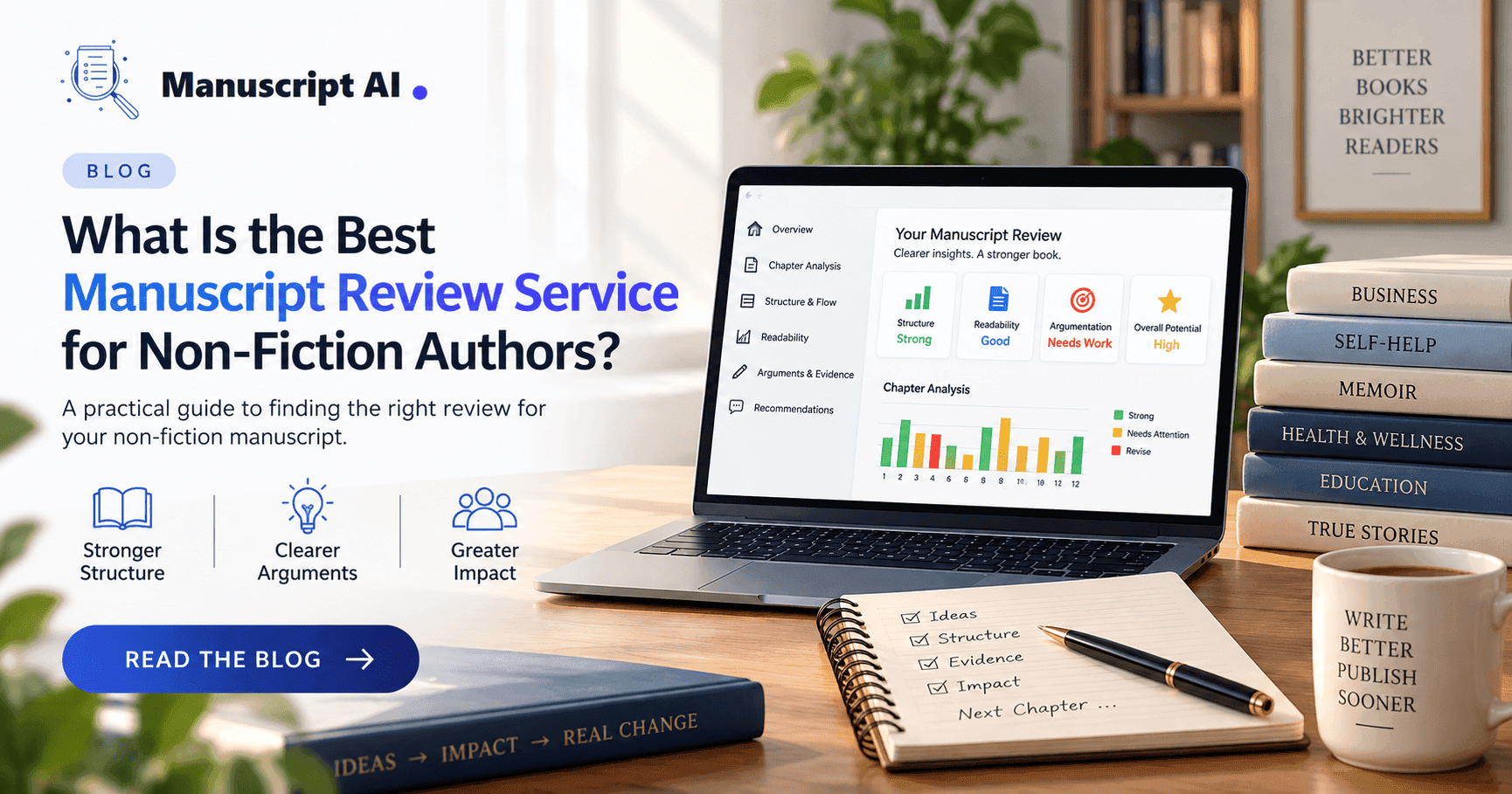
Table of Contents
So your draft is finally done. You have read it, tweaked it, maybe even printed it out just to see how it feels on paper. And now comes the part nobody warns you about — figuring out who should look at it next. Type "manuscript review" into Google, and you will get editors, agencies, apps, and freelancers, all insisting they are exactly what your book needs. Naturally, you start wondering, ‘what is the best manuscript review service’, especially for a non-fiction book, since fiction and non-fiction really do not need the same kind of eye. Good news, though — this is easier to figure out than it looks once you know what to actually check for.
Fiction editors mostly worry about character, voice, and plot. Non-fiction asks for something else entirely. Your reviewer needs to check whether your argument holds together from chapter to chapter, whether your evidence supports your claims, and whether a reader unfamiliar with your subject can follow you without getting lost. Pacing still matters, but it works differently here, since non-fiction pacing is about how clearly one idea builds into the next, not about tension or cliffhangers.
This is exactly why picking a service that understands non-fiction structure specifically matters more than picking the biggest name you recognise. A generalist editing service that mostly works with novelists may miss the exact issues that trip up readers of a business book, memoir, or self-help title, simply because those problems rarely show up in a novel.
These terms get thrown around loosely, so it is worth being precise about what each one actually covers, since "manuscript review" can mean very different things depending on who is offering it.
Structural editing, sometimes bundled with developmental editing, looks at your book from the top down. Does the order of your chapters make sense? Does your argument build logically, or does chapter six repeat a point you already made in chapter two? Is there a section that belongs earlier, or one that should be cut entirely because it does not serve the book's core promise? This is the highest-value work you can get done, and it is also the work most authors skip, usually because it is the hardest to do on your own draft.
Line editing works one level down, at the sentence and paragraph level. It asks whether your prose actually reads well, whether your sentences are doing their job efficiently, whether your tone stays consistent from page ten to page two hundred, and whether individual paragraphs flow into each other smoothly. It will not fix a chapter that is in the wrong place, but it will make every sentence in that chapter clearer.
Proofreading sits below both of these, catching typos, punctuation slips, and formatting inconsistencies right before publication. It is essential, but it is the last step, not the first, and doing it too early just means proofreading the same typo-riddled structural problems twice.
Knowing which of these your manuscript actually needs, rather than assuming you need all three at full professional rates, is most of the battle in answering what the best manuscript review service for your specific draft is.
AI-powered review tools are genuinely strong at structural and developmental-level analysis, which is exactly the layer of feedback most authors need first and skip because of the cost and turnaround of hiring a human for it. An AI model can read your entire manuscript in one pass, hold every chapter in view at once, and flag repetition, pacing dips, or a weak argument thread without getting tired or losing track thirty chapters in, something even the most diligent human editor struggles with over a full-length manuscript.
Compared to most tools on the market, which tend to stop at grammar-checking or surface-level style suggestions, a genuinely useful AI manuscript review goes further, into structure, pacing, and how well your book will land with its intended readers. That distinction matters, because a spelling-and-grammar pass and a structural assessment solve completely different problems, and paying for one when you needed the other wastes both time and money.
Where AI review reaches its limit is in judgement calls that depend on lived experience or external verification. It cannot check whether your statistics are accurate, whether your citations are trustworthy, or whether a claim that sounds authoritative is actually true. It also cannot replace the nuanced, subjective read a human editor brings to voice and tone, the kind of feedback that comes from years of reading manuscripts like yours. Line-level polish and final proofreading still benefit from a human eye too, since AI is built for the big picture, not the finishing touches.
Before you ask ‘what is the best manuscript review service’ for your book, it helps to know which features separate a genuinely useful review from an expensive guess. Look for a service that reviews structure and argument, not just grammar and spelling. A review that only flags typos is closer to a proofread than an assessment of whether your book actually works, and the two solve very different problems.
Turnaround time matters too, more than most authors expect going in. A traditional developmental edit can take several weeks, which is fine if you have that runway, but frustrating if you are trying to hit a launch date or a self-imposed deadline. And cost needs to make sense for what you are actually getting. Paying premium rates for feedback you could have caught with a faster, cheaper first pass is money better spent later in the process, on the parts that genuinely need a human's judgement rather than a first-round structural check.
Plenty of tools on the market call themselves an "AI editor," but most were built with fiction or general writing in mind, then repurposed for non-fiction as an afterthought. Manuscript AI was built the other way round, specifically for non-fiction from the start, and that shows up in the kind of feedback it actually gives.
Rather than a single pass-or-fail verdict, the report breaks your manuscript down chapter by chapter, with its own summary and recommendations for each one, so you can see exactly where the weak points sit instead of guessing which section needs the work. It also assesses your overall structural coherence at a macro level, checking whether your chapters sit in the order that best serves your argument, not just whether each one reads cleanly on its own. Alongside that, it looks specifically at logical argumentation, evidence quality, and source credibility, the exact areas a generic grammar or style checker was never built to evaluate.
You also get concrete readability metrics, word count, and estimated read time, plus visual comparisons of structure and readability across chapters, so you can see at a glance where pacing dips or an argument thins out. And if a section of the report raises a question you want to dig into further, you can ask it directly, things like whether your evidence is convincing or whether a particular argument flows logically, and get a specific answer back rather than a generic tip.
That combination, non-fiction-specific analysis, chapter-level detail, and the ability to interrogate your own report, is what separates a genuinely useful manuscript review from a repurposed grammar checker wearing an "AI editor" label.
The honest answer to ‘what is the best manuscript review service’ is rarely a single service at all. Most non-fiction authors get the strongest result by combining a few approaches in sequence. Start with a $19 Manuscript AI review to catch structural and pacing issues while they are still cheap to fix. Send the revised draft to beta readers from your target audience for honest, reader-level reactions. Verify your own facts and sources carefully. Then bring in a human editor for the final polish, focused on the details that still need a professional's touch.
This sequencing means every dollar you spend goes toward something that actually needed a human's attention, rather than paying full editorial rates to catch problems Manuscript AI could have flagged for a fraction of the cost.
There is no single service that suits every nxon-fiction author, since your book's needs depend on where your draft currently stands. But if you want a fast, affordable way to find out exactly where you stand before committing to anything bigger, an AI-powered review is a smart place to begin.
Start your $19 AI manuscript review and see exactly what your non-fiction manuscript needs next.

Co-founder of Manuscript AI | Ex-Bain & Co, Ex-Founder Writee AI (Acquired’23)